
NEWS

Native fungi offer a powerful solution to aflatoxin contamination: a landmark contribution from IITA
septembre 14, 2026
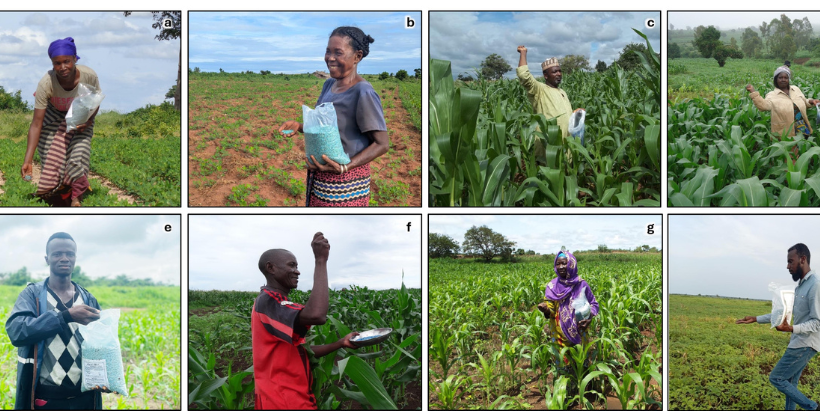
Farmers applying Aflasafe products in trials conducted on their farms in Mozambique (a), Madagascar (b), Nigeria (c), Kenya (d), Sierra Leone (e), Tanzania (f), Mali (g), and Sudan (h). Aflasafe products are being applied to groundnut (a, b), maize (c-f), sorghum (g), and sesame (h). These countries represent a selection of the broader range of countries across Africa where Aflasafe is used. Aflasafe products are commercially available in all the countries where treatment is shown except Madagascar, Sudan, and Sierra Leone, where field testing for registration purposes is ongoing. All photos were taken by IITA staff, except (e), which was taken by staff of the Sierra Leone Agricultural Research Institute.

Scientists from IITACGIAR have published a comprehensive review of aflatoxin biocontrol in the Annual Review of Phytopathology, the world’s leading plant pathology journal, with an impact factor of 13.6. The invited contribution marks a major milestone in global efforts to reduce aflatoxin contamination and improve food safety. The review synthesizes decades of scientific advances, field experience, and public-private partnerships aimed at addressing this persistent food-safety challenge.

The article, co-authored by IITA plant pathologists Alejandro Ortega-Beltran, Joseph Atehnkeng, Joao Augusto, George Mahuku, together with IITA Emeritus Scientist Ranajit Bandyopadhyay, reviews the science behind aflatoxin biocontrol, its evolution from research to commercial technology, and the conditions needed to deliver it at scale. It highlights IITA’s leading role in advancing this approach across Africa and provides a global overview of aflatoxin biocontrol efforts by other research groups and development organizations. As an open-access publication, the review makes this knowledge freely available to researchers, practitioners, policymakers, and other stakeholders worldwide. Link to the article: https://www.annualreviews.org/content/journals/10.1146/annurev-phyto-011325-114015 

Aflatoxins are highly toxic compounds produced mainly by Aspergillus flavus and closely related fungi. Aflatoxin B1 is among the most potent naturally occurring carcinogens known. Contamination of important staple crops such as maize and groundnut threatens food safety, public health, farmer livelihoods, and agricultural trade, particularly in Africa.

For decades, managing aflatoxin has been challenging because contamination is influenced by multiple factors, including climatic conditions, fungal populations, crop genetics, insect damage, agronomic practices, and postharvest conditions. Biocontrol offers a different approach: rather than trying to eliminate toxin-producing fungi, it shifts the fungal community toward beneficial strains that do not produce aflatoxin, thereby significantly reducing aflatoxin contamination before harvest.
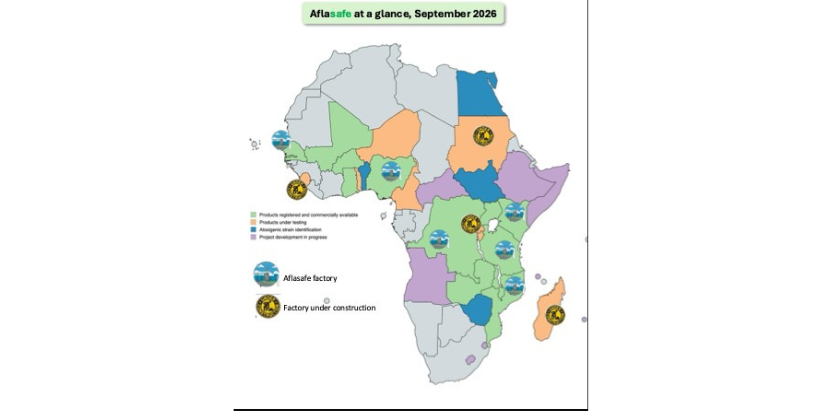
Status of Aflasafe activities across Africa, ranging from countries where i) projects are under development (purple), ii) atoxigenic strains are being characterized, iii) candidate products are being tested in farmer-led field trials, and iv) Aflasafe products are registered and commercially available through public-private partnerships.

Harnessing beneficial native fungi

Populations of A. flavus naturally contain both aflatoxin-producing and non-toxic (atoxigenic) strains. Scientists have identified naturally occurring atoxigenic strains that outcompete toxin-producing strains and developed them into effective biocontrol products.

Applied before crop flowering and during canopy expansion, these beneficial fungi become established in the field and reduce the prevalence of aflatoxin-producing strains. Across Africa, locally adapted biocontrol products have consistently reduced aflatoxin contamination by more than 80% and up to 100%.

Decades of research and implementation have shown that local adaptation is critical. Fungal communities and environmental conditions vary across regions, so strains effective in one environment may perform poorly elsewhere. IITA therefore identifies and selects native atoxigenic strains adapted to local agroecologies—a principle that underpins Aflasafe®, a portfolio of country- and/or regionally-adapted biocontrol products.

From discovery to impact

IITA’s contribution goes beyond proving that biocontrol works. Together with its partners, the Institute has translated scientific discoveries into practical solutions that are registered, manufactured, distributed, adopted by farmers, and integrated into food value chains. Aflasafe products are now registered or deployed in multiple African countries, supported by national research systems, regulatory frameworks, local manufacturing, distribution, and networks, and market partnerships. This ecosystem has been critical to translating research into sustainable impact at scale. This achievement reflects decades of truly multidisciplinary effort involving plant pathologists, breeders, food safety and postharvest specialists, engineers, social scientists, extensionists, regulators, commercialization experts, and many others.

The benefits extend across the entire value chain. Farmers can produce safer crops, achieve better health, access premium markets, and higher incomes, while reduced aflatoxin contamination strengthens food safety, better human and animal health, and builds confidence among buyers and processors. Farmers themselves provide compelling evidence of the technology’s value. They frequently report that treated crops look healthier, while some observe better health and productivity among livestock fed with grain or forage from treated fields.

A systems solution

Aflatoxin control requires more than a single technology. Aflasafe provides a highly effective pre-harvest foundation, but its impact is maximized when integrated with improved varieties, good agricultural practices, proper harvesting and storage, affordable testing and monitoring, traceability, digital advisory tools, effective regulation, an enabling environment, and market incentives for safer commodities.

Integration can also support nutrition outcomes. For example, combining Aflasafe with nutrient-dense crops such as provitamin A maize creates an opportunity to simultaneously improve food safety and nutrition, particularly in communities where maize is a major component of children’s diets.

Experiences across several countries demonstrate that sustainable aflatoxin management depends on coordinated action among farmers, researchers, policymakers, private-sector actors, regulators, development organizations, and extension services. Effective technologies achieve their greatest impact when supported by enabling policies, functioning markets, farmer awareness, and strong value-chain partnerships. Weakness in any one of these areas can limit the impact of an otherwise effective technology.

The next frontier: scale

The science of aflatoxin biocontrol has matured from promising research into a proven and scalable technology. The priority now is to make effective biocontrol available and affordable to millions of farmers, while strengthening incentives across food value chains for safer commodities.

Achieving this will require sustained investment, enabling policies and stronger collaboration among researchers, governments, regulators, manufacturers, distributors, farmers, food processors, development partners, and consumers. It also requires integrating biocontrol within broader food safety, market development, and agricultural transformation efforts.

IITA’s experience demonstrates what is possible when long-term sustained investments in innovation are supported from discovery through product development, commercialization, adoption, and impact. By harnessing naturally occurring atoxigenic fungi, biocontrol has become a practical tool for reducing aflatoxin contamination and protecting health. The next frontier is to scale this proven solution to the farmers, communities, and food systems that need it most.


Retour en haut
Olaosebikan, Olamide

Olamide Deborah Nwanze est une chercheuse principale spécialisée dans la recherche sur l'approche "genre" afin d'éclairer les politiques de sélection participative et inclusive, de développement de variétés et de systèmes semenciers concernant les cultures de racines, tubercules et bananes (RTB) au siège de l'Institut International d'Agriculture Tropicale, à Ibadan, au Nigeria. Elle est candidate au doctorat à l'Université d'Ibadan et titulaire d'un master et d'un diplôme d'ingénieur agronome en vulgarisation agricole et développement rural. Olamide est membre du programme African Women in Agricultural Research and Development – Gender Responsive Agricultural Systems Policy (SAISIE DE RÉCOMPENSEet les Chercheuses Sensibles au Genre Équipées pour la Transformation Agricole (SUPER. Elle cherche à appliquer ses apprentissages en matière d’approche genre, recherche sensible au genre, et expertise en développement et examen de politiques pour faciliter l’accès et l’adoption par les femmes, les jeunes, les enfants et les groupes sociaux vulnérables aux innovations agricoles qui garantissent la sécurité alimentaire, nutritionnelle, des revenus et des moyens de subsistance en Afrique. Ses rôles actuels comprennent le mentorat de chercheurs stagiaires, le développement de guides et manuels de formation, la mise en œuvre et l'adaptation de cadres et d'outils genre, l'engagement des acteurs de la chaîne de valeur en tant que partenaires de la science citoyenne, l'examen et la refonte des politiques, la gestion et l'analyse des données. Ses recherches actuelles portent sur les méthodes mixtes ainsi que sur les approches participatives et interdisciplinaires pour saisir et mettre en évidence les dynamiques de genre, les besoins, les préférences et les défis rencontrés par les parties prenantes au sein de la chaîne de valeur des moyens de subsistance agricoles afin de prioriser des stratégies axées sur le genre dans les programmes de sélection, la conception et la mise en œuvre des politiques.

À l'IITA, elle contribue à la mise en œuvre du CGIAR Initiative d'Élevage Accéléré et Innovation génétique Programmes ; recherche participative et genre au sein des Prochaine Génération ManiocHarvestPlusRTBAliments, et Tricot-ClimMob 1000Fermes Projets ; et la communication des connaissances sur le genre via le Série de webinaires G-LENS, vidéo documentaire, notes de politiquepublications, et blogs.


Publications récentes

de Sousa, K., van Etten, J., Manners, R. Bello, A., Teeken, B., Olaosebikan, O., et al. 2024. L'approche tricot : un cadre agile pour les essais décentralisés à la ferme soutenus par la science citoyenne. Une rétrospective. Agron. Sustain. Dev. 44, 8. https://doi.org/10.1007/s13593-023-00937-1

Madu, T., Onwuka, S., Nwafor, S., Onyemauwa, N., Ejechi, M., Ofoeze, M., Ukeje, B., Eluagu, C., Olaosebikan, O., Okoye, B., 2024. Les études sur les consommateurs inclusifs en matière de genre améliorent l'amélioration du manioc au Nigeria dans : Frontiers in Sociology, volume 9, numéro : 1224504, doi : 10.3389/fsoc.2024.1224504

Olaosebikan, O. ; Bello, A. ; Utoblo, O. ; Okoye, B. ; Olutegbe, N. ; Garner, E. ; Teeken, B. ; Bryan, E. ; Forsythe, L. ; Cole, S. ; Madu, T. 2023. Facteurs de stress et résilience au sein de la chaîne de valeur du manioc au Nigeria : Caractéristiques préférées des variétés de manioc et stratégies de réponse des hommes et des femmes pour informer l'amélioration variétale. Sustainability 15, 7837. https://doi.org/10.3390/su15107837

Okoye, B., Ofoeze, M., Ejechi, M., Onwuka, S., Nwafor, S., Onyemauwa, N., Ukeje, B., Eluagu, C., Obidiegwu, J.*, Olaosebikan, O., Madu, T.* 2023. Priorisation des traits préférés dans la chaîne de valeur de l'igname au Nigeria : une analyse de la situation en matière de genre in: Frontiers in Sociology, volume 8, numéro : 1232626, pages 1 – 9, ISSN 2297-7775, 2023. https://www.frontiersin.org/articles/10.3389/fsoc.2023.1232626/full

Olaosebikan, O., Bello, A. A., de Sousa, K., Ndjouenkeu, R., Adesokan, M., Alamu, E. O., Agbona, A., van Etten, J., Kegah, F. N.*, Dufour, D., Bouniol, A., Teeken, B. 2023. Acceptabilité par les consommateurs des produits alimentaires à base de gari-eba de manioc dans des contextes culturels et environnementaux variés en utilisant l'approche triade de comparaison des technologies (tricot) dans : Journal of the Science of Food and Agriculture,

Teeken, B., Olaosebikan, O., Bello, A. A., Madu, T.*, Cole, S. M. 2023. Évaluation qualitative de la positionnalité et des préférences des dyades en relation avec les activités liées au manioc : travailler avec des scientifiques citoyens du procès tricot https://hdl.handle.net/10568/138326 Type : Manuel

Bouniol, A., Ceballos, H., Bello, A. A., Teeken, B., Olaosebikan, O., Owoade, D., Agbona, A., Fotso Kuate, A., Madu, T.*, Okoye, B.*, Ofoeze, M.*, Nwafor, S.*, Onyemauwa, N.*, Adinsi, L.*, Forsythe, L., Dufour, D. 2023. Impact variétal sur le travail des femmes, la charge de travail et la pénibilité associée dans le traitement des plantes à racines, tubercules et bananes : focus sur le manioc en Afrique subsaharienne dans : Journal of the Science of Food and Agriculture, pages 1 – 25, ISSN 0022-5142,

Bello, A. A., Agbona, A., Olaosebikan, O., Edughaen, G., Dufour, D., Bouniol, A., Iluebbey, P., Ndjouenkeu, R.*, Rabbi, I. Y., Teeken, B. 2023. Effets génétiques et environnementaux sur la productivité de la transformation et le rendement des produits alimentaires : la pénibilité du travail des femmes dans : Journal of the Science of Food and Agriculture, pages 1 – 32, ISSN 0022-5142, 5

Cavicchioli, M., Zimbiti, T., Teeken, B., Nwanze, D.O., Liani, M., Parkes, E. & Bello, A. 2023. Rapport sur la formation en sélection génétique sensible au genre à l'IITA. Genetic Resources Center, IITA-HQ, Ibadan, 21-23 septembre 2022. Ibadan, Nigéria : IITA, (34 p.).https://hdl.handle.net/10568/131368

Agbona, A. Peteti P., Teeken B., Olaosebikan O. Bello, A. A., Parkes, E., Rabbi, I. Y., Mueller, L., Egesi, C., Kulakow, P. 2022. Gestion des données dans les programmes d'amélioration des cultures RTB africaines multidisciplinaires. In : Williamson, H.F., Leonelli, S. (eds) Towards Responsible Plant Data Linkage: Data Challenges for Agricultural Research and Development. Springer, Cham. https://doi.org/10.1007/978-3-031-13276-6_5

Lora Forsythe, Pricilla Marimo, Sarah Mayanja, Olamide D. Olaosebikan, Esme Stuart, Bela Teeken, Benjamin Okoye, Tessy Madu, (2021). Analyse transversale du genre dans RTBfoods Étape 2 Cartographie des genres sur les produits RTB. Comprendre les moteurs des préférences en matière de traits et le développement de profils de produits RTB multi-utilisateurs, WP1. Londres, Royaume-Uni : Rapport scientifique de terrain RTBfoods, 30 p.

Teeken, B., Garner, E., Agbona, A., Balogun, I., Olaosebikan, O., Bello, A., Madu, T., Okoye, B., Egesi, C., Kulakow, P. et Tufan, H.A. 2021. Au-delà des “ traits des femmes ” : explorer comment le genre, les différences sociales et les caractéristiques des ménages influencent les préférences pour les traits. Frontiers Systèmes alimentaires durables 5:740926. https://doi.org/10.3389/fsufs.2021.740926

Teeken, B., Agbona, A., Bello, A., Olaosebikan, O., Alamu, E., Adesokan, M., Awoyale, W., Madu, T., Okoye, B., Chijioke, U., Owoade, D., Okoro, M., Bouniol, A., Dufour, D., Hershey, C., Rabbi, I., Maziya‐Dixon, B., Egesi, C., Tufan, H. et Kulakow, P. (020. Comprendre les préférences variétales du manioc par le classement par paires du gari-eba et du fufu préparés par des agriculteurs-transformateurs locaux. Int J Food Sci Technol. https://doi.org/10.1111/ijfs.14862

Bela Teeken, Olamide Olaosebikan, Ireti Balogun, Benjamin Okoye, Tessy Madu, Steven Cole, Abolore Bello, Elizabeth Parkes. (2020). Pilotage des outils de profil client et produit G+ pour l'amélioration sensible au genre du manioc au Nigeria. Nigeria : Institut international d'agriculture tropicale (IIAT). https://hdl.handle.net/20.500.11766/13000