CIALCA marks 10 years of transforming livelihoods in Rwanda, Burundi and DR Congo
juin 13, 2016
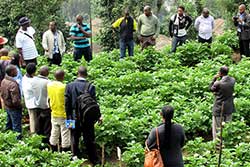
A field visit to CIALCA site.
Kigali, Rw anda – 12 June 2016 – The Consortium for Improving Agriculture-based Livelihoods in Central Africa (CIALCA), a multi-partner platform, marks its 10th anniversary this year with over half a million people lifted out of poverty in Rw anda, Burundi, and eastern DR Congo.
The initiative has widely tested and disseminated a range of innovative technologies to increase the productivity ― and resilience to climate change ― of legume-based farming systems in the three countries to improve the food security, nutrition, and livelihoods of the farming communities. These interventions include improved, high-yielding and disease resistant varieties, pest control, and integrated soil fertility technologies.
An impact assessment conducted in 2014 by one of the founding partners, the International Institute of Tropical Agriculture (IITA) concluded that in South Kivu, DR Congo, and in Rw anda, CIALCA had contributed to lifting an estimated 560,000 people out of poverty.
In its first phase, the initiative’s research-for-development agenda focused on on-farm testing and validation of technologies to enhance crop production and scaling out of these proven technologies in the second phase (2009-2011).
From 2011, CIALCA became a key operating platform for the CGIAR Research Program on Integrated Systems for the Humid Tropics. It builds on its many years of investment in innovation and partnerships to mobilize multi-stakeholder networks in Burundi, Rw anda, and eastern DR Congo for technology dissemination and adoption.
CIALCA was created in 2006 by three international research organizations―Bioversity International, the International Centre for Tropical Agriculture (CIAT), and IITA. It is funded by Belgian Directorate General for Development Cooperation (DGD). The initiative has also worked with a range of partners at both national and international levels including national agricultural research systems (NARS) and training institutes.
A forum to celebrate a decade of achievements will take place during the 7th African Agricultural Science Week organized by the Forum for Agricultural Research in Africa (FARA) taking place in Kigali, Rw anda on 12 – 16 June.
Some of CIALCA’s major impacts include:
Contributing to lifting an estimated 560,000 people out of poverty in South Kivu, DR Congo, and in Rw anda . Changes in poverty rates due to CIALCA are about 3%, 10%, and 21% for Burundi, South Kivu (DR Congo), and Rw anda, respectively.
Training of over 10 PhDs and 40 MSc students in a region that had lost of much of its science capacity during years of conflict. Many of CIALCA’s former MSc and PhD students are now in key positions in ministries and NARS in the three countries.
Promoting intercropping of banana and coffee systems for climate change mitigation, pest reduction, and augmentation of farmer’ income that has led the Rw andan Government, which had a strict monocropping policy on coffee, to tolerate banana/coffee intercropping in many parts of the country.
Bringing under control the bacterial wilt disease (BXW) that had nearly wiped out banana production in entire farms and villages in the three countries.
Training of over 50 partner organizations and more than 1000 trainers in―among others―seed multiplication technologies (e.g., macropropagation) and effective pest and disease control (e.g., BXW management), good agricultural practices and intercropping techniques, new crop varieties, postharvest processing, and collective marketing.
Advancing science related to integrated soil fertility management, climate-smart opportunities for smallholders, and the effectiveness of agricultural extension and other partnership modalities in supporting (specific groups of) farmers.
CIALCA will continue to further strengthen its strategic engagement with policy actors and other investment actors to support capable farmers with improved production, h andling, and marketing innovations and strengthen (agricultural) work opportunities for vulnerable groups, including the youth and women. It will address current and future challenges in integrated systems research while applying the many lessons learned along the way in its 10- year journey.
For more information:
Marc Schut, Social Scientist, IITA-Rw anda, m.schut@cgiar.org;
Katherine Lopez, Head of Communication, IITA-Nigeria, k.lopez@cgiar.orgAbout CIALCAwww.cialca.org
The Consortium for Improving Agriculture-based Livelihoods in Central Africa (CIALCA) is a Consortium of the International Institute of Tropical Agriculture (IITA), Bioversity International, and the International Centre for Tropical Agriculture (CIAT) and their national research and development partners, supported by the Belgian Directorate General for Development Cooperation (DGD), and aiming at improving livelihoods through enhancing income, health, and the natural resource base of smallholder farmers in Central Africa.
À propos de l'IITA, www.iita.org
IITA is one of the world’s leading research partners in finding solutions for hunger, malnutrition, and poverty. Its award-winning research-for-development (R4D) approach addresses the development needs of tropical countries. IITA works with partners to enhance crop quality and productivity, reduce producer and consumer risks, and generate wealth from agriculture. IITA is a non-profit organization founded in 1967 in Nigeria and governed by a Board of Trustees. IITA works on the following crops: cowpea, soybean, banana/plantain, yam, cassava, and maize. It is a member of CGIAR, a global agriculture research partnership for a food secure future.
Olamide Deborah Nwanze est une chercheuse principale spécialisée dans la recherche sur l'approche "genre" afin d'éclairer les politiques de sélection participative et inclusive, de développement de variétés et de systèmes semenciers concernant les cultures de racines, tubercules et bananes (RTB) au siège de l'Institut International d'Agriculture Tropicale, à Ibadan, au Nigeria. Elle est candidate au doctorat à l'Université d'Ibadan et titulaire d'un master et d'un diplôme d'ingénieur agronome en vulgarisation agricole et développement rural. Olamide est membre du programme African Women in Agricultural Research and Development – Gender Responsive Agricultural Systems Policy (SAISIE DE RÉCOMPENSEet les Chercheuses Sensibles au Genre Équipées pour la Transformation Agricole (SUPER. Elle cherche à appliquer ses apprentissages en matière d’approche genre, recherche sensible au genre, et expertise en développement et examen de politiques pour faciliter l’accès et l’adoption par les femmes, les jeunes, les enfants et les groupes sociaux vulnérables aux innovations agricoles qui garantissent la sécurité alimentaire, nutritionnelle, des revenus et des moyens de subsistance en Afrique. Ses rôles actuels comprennent le mentorat de chercheurs stagiaires, le développement de guides et manuels de formation, la mise en œuvre et l'adaptation de cadres et d'outils genre, l'engagement des acteurs de la chaîne de valeur en tant que partenaires de la science citoyenne, l'examen et la refonte des politiques, la gestion et l'analyse des données. Ses recherches actuelles portent sur les méthodes mixtes ainsi que sur les approches participatives et interdisciplinaires pour saisir et mettre en évidence les dynamiques de genre, les besoins, les préférences et les défis rencontrés par les parties prenantes au sein de la chaîne de valeur des moyens de subsistance agricoles afin de prioriser des stratégies axées sur le genre dans les programmes de sélection, la conception et la mise en œuvre des politiques.
de Sousa, K., van Etten, J., Manners, R. Bello, A., Teeken, B., Olaosebikan, O., et al. 2024. L'approche tricot : un cadre agile pour les essais décentralisés à la ferme soutenus par la science citoyenne. Une rétrospective. Agron. Sustain. Dev. 44, 8. https://doi.org/10.1007/s13593-023-00937-1
Madu, T., Onwuka, S., Nwafor, S., Onyemauwa, N., Ejechi, M., Ofoeze, M., Ukeje, B., Eluagu, C., Olaosebikan, O., Okoye, B., 2024. Les études sur les consommateurs inclusifs en matière de genre améliorent l'amélioration du manioc au Nigeria dans : Frontiers in Sociology, volume 9, numéro : 1224504, doi : 10.3389/fsoc.2024.1224504
Olaosebikan, O. ; Bello, A. ; Utoblo, O. ; Okoye, B. ; Olutegbe, N. ; Garner, E. ; Teeken, B. ; Bryan, E. ; Forsythe, L. ; Cole, S. ; Madu, T. 2023. Facteurs de stress et résilience au sein de la chaîne de valeur du manioc au Nigeria : Caractéristiques préférées des variétés de manioc et stratégies de réponse des hommes et des femmes pour informer l'amélioration variétale. Sustainability 15, 7837. https://doi.org/10.3390/su15107837
Okoye, B., Ofoeze, M., Ejechi, M., Onwuka, S., Nwafor, S., Onyemauwa, N., Ukeje, B., Eluagu, C., Obidiegwu, J.*, Olaosebikan, O., Madu, T.* 2023. Priorisation des traits préférés dans la chaîne de valeur de l'igname au Nigeria : une analyse de la situation en matière de genre in: Frontiers in Sociology, volume 8, numéro : 1232626, pages 1 – 9, ISSN 2297-7775, 2023. https://www.frontiersin.org/articles/10.3389/fsoc.2023.1232626/full
Olaosebikan, O., Bello, A. A., de Sousa, K., Ndjouenkeu, R., Adesokan, M., Alamu, E. O., Agbona, A., van Etten, J., Kegah, F. N.*, Dufour, D., Bouniol, A., Teeken, B. 2023. Acceptabilité par les consommateurs des produits alimentaires à base de gari-eba de manioc dans des contextes culturels et environnementaux variés en utilisant l'approche triade de comparaison des technologies (tricot) dans : Journal of the Science of Food and Agriculture,
Teeken, B., Olaosebikan, O., Bello, A. A., Madu, T.*, Cole, S. M. 2023. Évaluation qualitative de la positionnalité et des préférences des dyades en relation avec les activités liées au manioc : travailler avec des scientifiques citoyens du procès tricot https://hdl.handle.net/10568/138326 Type : Manuel
Bouniol, A., Ceballos, H., Bello, A. A., Teeken, B., Olaosebikan, O., Owoade, D., Agbona, A., Fotso Kuate, A., Madu, T.*, Okoye, B.*, Ofoeze, M.*, Nwafor, S.*, Onyemauwa, N.*, Adinsi, L.*, Forsythe, L., Dufour, D. 2023. Impact variétal sur le travail des femmes, la charge de travail et la pénibilité associée dans le traitement des plantes à racines, tubercules et bananes : focus sur le manioc en Afrique subsaharienne dans : Journal of the Science of Food and Agriculture, pages 1 – 25, ISSN 0022-5142,
Bello, A. A., Agbona, A., Olaosebikan, O., Edughaen, G., Dufour, D., Bouniol, A., Iluebbey, P., Ndjouenkeu, R.*, Rabbi, I. Y., Teeken, B. 2023. Effets génétiques et environnementaux sur la productivité de la transformation et le rendement des produits alimentaires : la pénibilité du travail des femmes dans : Journal of the Science of Food and Agriculture, pages 1 – 32, ISSN 0022-5142, 5
Cavicchioli, M., Zimbiti, T., Teeken, B., Nwanze, D.O., Liani, M., Parkes, E. & Bello, A. 2023. Rapport sur la formation en sélection génétique sensible au genre à l'IITA. Genetic Resources Center, IITA-HQ, Ibadan, 21-23 septembre 2022. Ibadan, Nigéria : IITA, (34 p.).https://hdl.handle.net/10568/131368
Agbona, A. Peteti P., Teeken B., Olaosebikan O. Bello, A. A., Parkes, E., Rabbi, I. Y., Mueller, L., Egesi, C., Kulakow, P. 2022. Gestion des données dans les programmes d'amélioration des cultures RTB africaines multidisciplinaires. In : Williamson, H.F., Leonelli, S. (eds) Towards Responsible Plant Data Linkage: Data Challenges for Agricultural Research and Development. Springer, Cham. https://doi.org/10.1007/978-3-031-13276-6_5
Lora Forsythe, Pricilla Marimo, Sarah Mayanja, Olamide D. Olaosebikan, Esme Stuart, Bela Teeken, Benjamin Okoye, Tessy Madu, (2021). Analyse transversale du genre dans RTBfoods Étape 2 Cartographie des genres sur les produits RTB. Comprendre les moteurs des préférences en matière de traits et le développement de profils de produits RTB multi-utilisateurs, WP1. Londres, Royaume-Uni : Rapport scientifique de terrain RTBfoods, 30 p.
Teeken, B., Garner, E., Agbona, A., Balogun, I., Olaosebikan, O., Bello, A., Madu, T., Okoye, B., Egesi, C., Kulakow, P. et Tufan, H.A. 2021. Au-delà des “ traits des femmes ” : explorer comment le genre, les différences sociales et les caractéristiques des ménages influencent les préférences pour les traits. Frontiers Systèmes alimentaires durables 5:740926. https://doi.org/10.3389/fsufs.2021.740926
Teeken, B., Agbona, A., Bello, A., Olaosebikan, O., Alamu, E., Adesokan, M., Awoyale, W., Madu, T., Okoye, B., Chijioke, U., Owoade, D., Okoro, M., Bouniol, A., Dufour, D., Hershey, C., Rabbi, I., Maziya‐Dixon, B., Egesi, C., Tufan, H. et Kulakow, P. (020. Comprendre les préférences variétales du manioc par le classement par paires du gari-eba et du fufu préparés par des agriculteurs-transformateurs locaux. Int J Food Sci Technol.https://doi.org/10.1111/ijfs.14862
Bela Teeken, Olamide Olaosebikan, Ireti Balogun, Benjamin Okoye, Tessy Madu, Steven Cole, Abolore Bello, Elizabeth Parkes. (2020). Pilotage des outils de profil client et produit G+ pour l'amélioration sensible au genre du manioc au Nigeria. Nigeria : Institut international d'agriculture tropicale (IIAT). https://hdl.handle.net/20.500.11766/13000