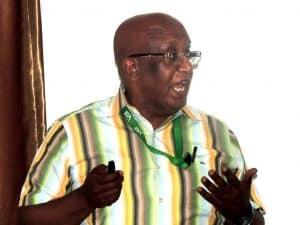
Although IITA has made great progress in integrating gender in its research there is still a lot that needs to be done to transform the Institute to a lead center in gender research and development outcomes. This was said by Dr Amare Tegbaru, IITA’s Gender Specialist, Unit Head and Humidtropics Gender Research Coordinator, during a seminar presentation entitled Engaging in IITA Gender Research aiming at enhancing equity and social inclusion in African Agriculture and Rural Development, held at IITA- Tanzania on 18 June 2015.
Dr Tegbaru speaking during the seminar
“When I joined IITA, gender was not a priority. We did not have any concerted efforts to integrate gender into our Research for Development. There was some gender research going on but it was mainly donor-driven and based on individual interpretations of what that meant,” Dr Tegbaru said. “It did lead to some successful outcomes and outputs which were strengthened and built upon by the CRPs (CGIAR Research Programs) which stressed gender research.”
“Currently, Dr Tegbaru said, “IITA’s is ensuring that all its research programs are gendered so that all technologies generated are able to benefit women and other vulnerable people. The Institute also has a gender policy in place and is emphasizing training on gender mainstreaming in addition to hiring more gender experts.”
Why gender research?
“Gender is not just about numbers. It’s also about voices and access to assets and improvement in decision-making. IITA’s vision to reduce hunger and poverty and malnutrition through increasing the yield of important staples can happen only when gender concerns are taken seriously. Our quest to enhance efficiencies and improve nutrition in the continent will not happen if we do not underst and the context. We also need to know how our efforts will affect women and how they will lead to gender equity between men and women and other marginalized groups,” he said.
Dr Tegbaru gave examples of some of the initiatives he had been involved in at the Institute that had integrated gender into their research agenda for greater impact. These included developing a gender strategy for the Humidtropics to address gender issues in systems thinking. “The strategy is distinct in that it is guided by the social science definition of gender as one among other systems of classification, such as those based on age, generation, kinship, race, ethnicity, religion, and social class. It emphasizes social inclusiveness of marginalized and minority ethnic groups and goes beyond gender responsive/adoptive research approach to a transformative research approach that contributes to change in power relations and the empowerment of women.”
Addressing Gender norms constraints
According to Dr Tegbaru, innovations in agriculture and Natural Resource Management (NRM) are constrained by existing gender norms which legitimize gender inequality in the control over and use of productive assets and resources. This holds back development.
On the other h and, more gender-equitable control over and use of resources leads to higher levels of poverty reduction, food security, nutrition, and sustainable resource use.
He gave examples of the Making agricultural innovations work for smallholder farmers affected by HIV and AIDS, in short, the MIRACLE project. This was implemented in Malawi, Mozambique, and Zambia, and sought to address the immediate health and nutritional needs of people living with HIV and AIDS. But in the end, the women who were marginalized and excluded owing to their HIV/status rose up in the community to become change agents and some were even elected as community leaders.
“The project and its innovation platform partners contributed to more transformational changes in the form of a reduction of the stigma and improvements in social inclusion. We are now trying to underst and how the project transcended from addressing the immediate health and nutritional security needs and unlocked the hidden and suppressed potential of women. “Backed by measurable evidence we are working to produce the stories of these women. They had become change agents and innovative champions serving their communities as lead farmers, elected community leaders, and some of them in the Training of Trainers on post-harvest processing and value addition,” Dr Tegbaru said. In conclusion he said there was still a lot of work ahead to be done to consolidate these gains and strengthen gender research at IITA. This in turn would ensure there was a sustained analytical capacity that could effectively translate IITA’s science-based outcomes of change not only in terms of income and improved nutrition but also in enabling the empowerment of women and other marginalized groups in decision-making and change in social and power relations.
For more information:
Andrea Gros, Head of Communication, IITA HQ, a.gros@cgiar.orgÀ propos de l'IITAwww.iita.org
L'IITA est l'un des principaux partenaires de recherche au monde pour trouver des solutions à la faim, à la malnutrition et à la pauvreté. Son approche primée de recherche pour le développement (R4D) répond aux besoins de développement des pays tropicaux. L'IITA travaille avec des partenaires pour améliorer la qualité et la productivité des cultures, réduire les risques pour les producteurs et les consommateurs, et générer de la richesse à partir de l'agriculture. L'IITA est une organisation à but non lucratif fondée en 1967 au Nigéria et régie par un Conseil d'administration. L'IITA travaille sur les cultures suivantes : le niébé, le soja, la banane/banane plantain, l'igname, le manioc et le maïs. Il est membre du CGIAR, un partenariat mondial de recherche agricole pour un avenir sûr sur le plan alimentaire.
Olamide Deborah Nwanze est une chercheuse principale spécialisée dans la recherche sur l'approche "genre" afin d'éclairer les politiques de sélection participative et inclusive, de développement de variétés et de systèmes semenciers concernant les cultures de racines, tubercules et bananes (RTB) au siège de l'Institut International d'Agriculture Tropicale, à Ibadan, au Nigeria. Elle est candidate au doctorat à l'Université d'Ibadan et titulaire d'un master et d'un diplôme d'ingénieur agronome en vulgarisation agricole et développement rural. Olamide est membre du programme African Women in Agricultural Research and Development – Gender Responsive Agricultural Systems Policy (SAISIE DE RÉCOMPENSEet les Chercheuses Sensibles au Genre Équipées pour la Transformation Agricole (SUPER. Elle cherche à appliquer ses apprentissages en matière d’approche genre, recherche sensible au genre, et expertise en développement et examen de politiques pour faciliter l’accès et l’adoption par les femmes, les jeunes, les enfants et les groupes sociaux vulnérables aux innovations agricoles qui garantissent la sécurité alimentaire, nutritionnelle, des revenus et des moyens de subsistance en Afrique. Ses rôles actuels comprennent le mentorat de chercheurs stagiaires, le développement de guides et manuels de formation, la mise en œuvre et l'adaptation de cadres et d'outils genre, l'engagement des acteurs de la chaîne de valeur en tant que partenaires de la science citoyenne, l'examen et la refonte des politiques, la gestion et l'analyse des données. Ses recherches actuelles portent sur les méthodes mixtes ainsi que sur les approches participatives et interdisciplinaires pour saisir et mettre en évidence les dynamiques de genre, les besoins, les préférences et les défis rencontrés par les parties prenantes au sein de la chaîne de valeur des moyens de subsistance agricoles afin de prioriser des stratégies axées sur le genre dans les programmes de sélection, la conception et la mise en œuvre des politiques.
de Sousa, K., van Etten, J., Manners, R. Bello, A., Teeken, B., Olaosebikan, O., et al. 2024. L'approche tricot : un cadre agile pour les essais décentralisés à la ferme soutenus par la science citoyenne. Une rétrospective. Agron. Sustain. Dev. 44, 8. https://doi.org/10.1007/s13593-023-00937-1
Madu, T., Onwuka, S., Nwafor, S., Onyemauwa, N., Ejechi, M., Ofoeze, M., Ukeje, B., Eluagu, C., Olaosebikan, O., Okoye, B., 2024. Les études sur les consommateurs inclusifs en matière de genre améliorent l'amélioration du manioc au Nigeria dans : Frontiers in Sociology, volume 9, numéro : 1224504, doi : 10.3389/fsoc.2024.1224504
Olaosebikan, O. ; Bello, A. ; Utoblo, O. ; Okoye, B. ; Olutegbe, N. ; Garner, E. ; Teeken, B. ; Bryan, E. ; Forsythe, L. ; Cole, S. ; Madu, T. 2023. Facteurs de stress et résilience au sein de la chaîne de valeur du manioc au Nigeria : Caractéristiques préférées des variétés de manioc et stratégies de réponse des hommes et des femmes pour informer l'amélioration variétale. Sustainability 15, 7837. https://doi.org/10.3390/su15107837
Okoye, B., Ofoeze, M., Ejechi, M., Onwuka, S., Nwafor, S., Onyemauwa, N., Ukeje, B., Eluagu, C., Obidiegwu, J.*, Olaosebikan, O., Madu, T.* 2023. Priorisation des traits préférés dans la chaîne de valeur de l'igname au Nigeria : une analyse de la situation en matière de genre in: Frontiers in Sociology, volume 8, numéro : 1232626, pages 1 – 9, ISSN 2297-7775, 2023. https://www.frontiersin.org/articles/10.3389/fsoc.2023.1232626/full
Olaosebikan, O., Bello, A. A., de Sousa, K., Ndjouenkeu, R., Adesokan, M., Alamu, E. O., Agbona, A., van Etten, J., Kegah, F. N.*, Dufour, D., Bouniol, A., Teeken, B. 2023. Acceptabilité par les consommateurs des produits alimentaires à base de gari-eba de manioc dans des contextes culturels et environnementaux variés en utilisant l'approche triade de comparaison des technologies (tricot) dans : Journal of the Science of Food and Agriculture,
Teeken, B., Olaosebikan, O., Bello, A. A., Madu, T.*, Cole, S. M. 2023. Évaluation qualitative de la positionnalité et des préférences des dyades en relation avec les activités liées au manioc : travailler avec des scientifiques citoyens du procès tricot https://hdl.handle.net/10568/138326 Type : Manuel
Bouniol, A., Ceballos, H., Bello, A. A., Teeken, B., Olaosebikan, O., Owoade, D., Agbona, A., Fotso Kuate, A., Madu, T.*, Okoye, B.*, Ofoeze, M.*, Nwafor, S.*, Onyemauwa, N.*, Adinsi, L.*, Forsythe, L., Dufour, D. 2023. Impact variétal sur le travail des femmes, la charge de travail et la pénibilité associée dans le traitement des plantes à racines, tubercules et bananes : focus sur le manioc en Afrique subsaharienne dans : Journal of the Science of Food and Agriculture, pages 1 – 25, ISSN 0022-5142,
Bello, A. A., Agbona, A., Olaosebikan, O., Edughaen, G., Dufour, D., Bouniol, A., Iluebbey, P., Ndjouenkeu, R.*, Rabbi, I. Y., Teeken, B. 2023. Effets génétiques et environnementaux sur la productivité de la transformation et le rendement des produits alimentaires : la pénibilité du travail des femmes dans : Journal of the Science of Food and Agriculture, pages 1 – 32, ISSN 0022-5142, 5
Cavicchioli, M., Zimbiti, T., Teeken, B., Nwanze, D.O., Liani, M., Parkes, E. & Bello, A. 2023. Rapport sur la formation en sélection génétique sensible au genre à l'IITA. Genetic Resources Center, IITA-HQ, Ibadan, 21-23 septembre 2022. Ibadan, Nigéria : IITA, (34 p.).https://hdl.handle.net/10568/131368
Agbona, A. Peteti P., Teeken B., Olaosebikan O. Bello, A. A., Parkes, E., Rabbi, I. Y., Mueller, L., Egesi, C., Kulakow, P. 2022. Gestion des données dans les programmes d'amélioration des cultures RTB africaines multidisciplinaires. In : Williamson, H.F., Leonelli, S. (eds) Towards Responsible Plant Data Linkage: Data Challenges for Agricultural Research and Development. Springer, Cham. https://doi.org/10.1007/978-3-031-13276-6_5
Lora Forsythe, Pricilla Marimo, Sarah Mayanja, Olamide D. Olaosebikan, Esme Stuart, Bela Teeken, Benjamin Okoye, Tessy Madu, (2021). Analyse transversale du genre dans RTBfoods Étape 2 Cartographie des genres sur les produits RTB. Comprendre les moteurs des préférences en matière de traits et le développement de profils de produits RTB multi-utilisateurs, WP1. Londres, Royaume-Uni : Rapport scientifique de terrain RTBfoods, 30 p.
Teeken, B., Garner, E., Agbona, A., Balogun, I., Olaosebikan, O., Bello, A., Madu, T., Okoye, B., Egesi, C., Kulakow, P. et Tufan, H.A. 2021. Au-delà des “ traits des femmes ” : explorer comment le genre, les différences sociales et les caractéristiques des ménages influencent les préférences pour les traits. Frontiers Systèmes alimentaires durables 5:740926. https://doi.org/10.3389/fsufs.2021.740926
Teeken, B., Agbona, A., Bello, A., Olaosebikan, O., Alamu, E., Adesokan, M., Awoyale, W., Madu, T., Okoye, B., Chijioke, U., Owoade, D., Okoro, M., Bouniol, A., Dufour, D., Hershey, C., Rabbi, I., Maziya‐Dixon, B., Egesi, C., Tufan, H. et Kulakow, P. (020. Comprendre les préférences variétales du manioc par le classement par paires du gari-eba et du fufu préparés par des agriculteurs-transformateurs locaux. Int J Food Sci Technol.https://doi.org/10.1111/ijfs.14862
Bela Teeken, Olamide Olaosebikan, Ireti Balogun, Benjamin Okoye, Tessy Madu, Steven Cole, Abolore Bello, Elizabeth Parkes. (2020). Pilotage des outils de profil client et produit G+ pour l'amélioration sensible au genre du manioc au Nigeria. Nigeria : Institut international d'agriculture tropicale (IIAT). https://hdl.handle.net/20.500.11766/13000