Project brings ray of hope to fight against cassava viruses in Africa
avril 13, 2017
The 5CP project has come to an end but it has made significant progress in fast-tracking the development of cassava varieties with dual resistance to two viral diseases.
In 2012, five countries came together and shared their five best cassava varieties. The main criteria was how well they were able to resist the two viral diseases, Cassava mosaic disease (CMD) and Cassava brown streak disease (CBSD), affecting cassava production in Eastern and parts of Southern and Central Africa. These varieties were first cleaned of viruses before they were sent to the countries. Each country received 25 varieties to test for adaptation and performance in their local environments.
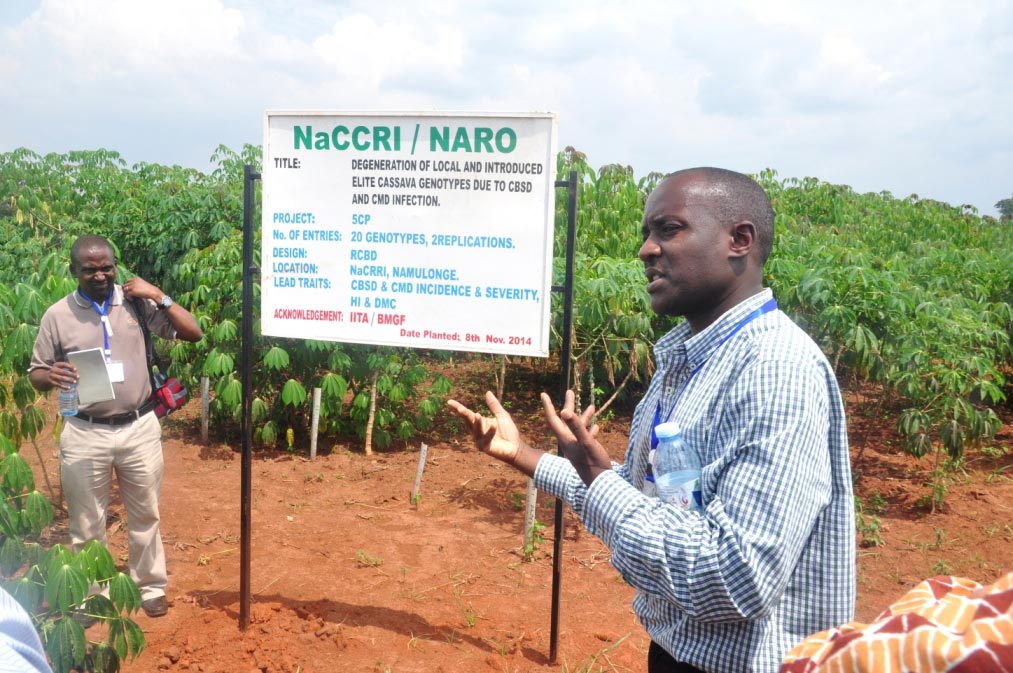
Edward Kanju speaking at 5CP final meeting
Five years later, each of the five countries has identified their top four to five best varieties that will be integrated into their national breeding programs to generate more breeding populations, and further testing on-farm for acceptability and possible release as new, dual-resistant varieties.
The sharing and testing of the 25 best varieties pooled from the five countries―Kenya, Malawi, Mozambique, Tanzania, and Zambia―was one of the main activities of the New Cassava Varieties and Clean Seeds to combat CMD and CBSD project (5CP in short). The project was funded by the Fondation Bill & Melinda Gates.
The activity aimed at fast tracking efforts to provide farmers with improved high-yielding and dual-resistant cassava varieties, and in turn revive the crop’s production and contribute to improving income and food security of the target countries.
The project was led by IITA, working in collaboration with the national cassava breeding programs of the five countries. It started in June 2012 and came to an end on 31 March 2017.
Threat to cassava production
CBSD and CMD together cause production losses worth more than US$1 billion every year and are a threat to food and income security for over 30 million farmers growing cassava in East and Central Africa.
“Africa loses more than a third of its potential cassava harvest to pests and diseases. The most important of these are CBSD and CMD. A severe form of CMD which causes curling of the leaves and drastically reduces yield started spreading in sub-Saharan Africa in the late 1980s and early 1990s,” said Edward Kanju, IITA cassava breeder and 5CP Coordinator.
“In the early 2000s, CBSD which causes a dry rot and was previously confined to low coastal areas, started spreading rapidly and nearly all the newly deployed varieties with resistance to CMD were susceptible. Countries had no varieties resistant to this new disease creating the need for the five hard-hit countries to join forces to find a quick solution,” Kanju said.
Sharing of virus-free planting material
Each country selected and sent its top five improved varieties and one local check―a local variety that is highly susceptible to the two diseases for comparison―to the Natural Resources Institute (NRI, UK) and to Kenya Plant Health Inspectorate Services (KEPHIS) for virus cleaning. This was to avoid the spread of new strains of viruses to new places in the target countries.
The clean material was then forwarded to the Genetic Technologies International Ltd. (GTIL), a private tissue culture company in Nairobi, Kenya, where it was multiplied and sent to all the five countries as tissue culture plantlets. Researchers first hardened and acclimatized the plantlets before planting them in research fields in areas with high disease pressure. This was to compare their performances against the local susceptible varieties being grown by the farmers and the identified local checks.
A pilot clean cassava seed system
In Tanzania, the project had another objective―to develop a pilot system to deliver clean seeds of improved varieties to farmers from the research system. Under this objective, researchers from IITA, the national agriculture research system, and the Tanzania Official Seed Certification Institute (TOSCI) worked together to develop st andards for clean cassava planting material and virus testing methods.
The project also established four sites with very low disease pressure in all the main cassava-growing areas for multiplying high-quality, clean seed areas targeting various agroecologies.
“In these four sites, we have so far produced 4 million cuttings. In the future, we hope to start the process of commercialization so the national root crops research system can sell this top quality planting material of high-yielding, disease-resistant varieties to private companies to multiply and deliver to farmers in large quantities. Ultimately we hope this will have a positive impact on boosting cassava production in Tanzania,” said James Legg, Virologist, IITA-Tanzania.
The seed certification guidelines for cassava developed by the project were incorporated into the Seed Act of Tanzania in January 2017.
A clean seed site in Tanzania
“One of the highlights of this initiative is that, working with various partners in Tanzania, we were able develop guidelines on how to produce the highest quality of cassava planting material. These guidelines were recently enacted into law. We are really excited about this,” James Legg enthused.
The project trained more than 50 TOSCI seed inspectors on certification of vegetatively propagated cassava seeds and equipped the institution with essential equipment for testing viruses in cassava planting material.
Project successes
Top four to five of 25 in each country: Each country had already identified its choice of four or five varieties to integrate into their breeding program for further testing. These were selected from field trials in at least five or more sites per country in areas with high disease pressure. There were a total of 33 field sites across the five countries.
Networking and unusual partnerships: The project brought the breeding programs of the five countries to work closely together, sharing their knowledge and skills, and cemented their relationship for future collaboration. The project also brought breeders and virologists to work together in the development of new varieties with dual resistance to CBSD and CMD.
Underst anding responses of cassava varieties to the viruses: The project also supported the five countries to carry out degeneration trials of their own five best varieties. This was to underst and how they respond to the viruses and identify those that remain healthy for a long time even when infected.
Building capacity for cassava breeding: The project had a strong capacity-building element to support cassava breeding in the five countries. It supported five students in their postgraduate studies―four MScs and one PhD. Numerous short courses were also conducted for the national researchers including h andling of tissue culture plantlets, testing for viruses using real-time PCRs, and conducting and analyzing data from multilocation trials, among others.
Next steps
Robert Kawuki of Ug anda explains 5CP work in the country during the team meeting.
Now that the project has ended, each country will integrate the varieties they have selected into their national breeding programs for further testing and breeding. In Tanzania, the successes and lessons learned in piloting the cassava seed system project have been incorporated into the recently launched ‘Building an Economically Sustainable Seed System for Cassava in Tanzania – BEST Cassava project funded by the Gates Foundation. The project is being implemented by Mennonite Economic Development Associates (MEDA) in partnership with the Tanzanian Ministry of Agriculture, Livestock and Fisheries (MALF) and IITA in 11 regions in Tanzania.
5CP voices
On 23 and 24 March, the project team held their last meeting to review the project successes and the way forward. The team was enthusiastic about their achievements and experiences during project implementation.
“The project has generated a lot of output. We have seen many people trained, many varieties identified that we can share with farmers across the five countries, and the certification of cassava seed systems in Tanzania.” Arthur Tugume, Chair, 5CP Technical Advisory Committee
“The most important thing about the 5CP project was that we had access to some of the best varieties in the region, we were able to test them, and we have identified four very outst anding ones compared to what we had. These varieties from Tanzania, Mozambique, and Kenya have shown very high resistance to cassava brown streak, which is a major constraint to cassava production in Ug anda. Right now, they are under participatory variety selection trials in farmers’ fields in nine districts in the country. We will get their final verdict in terms of their preferences and their likes but we are optimistic that they will go through and be taken up by the farmers.” Robert Kawuki, National Agricultural Research Organisation (NARO), Ug anda
“CMD and CBSD had drastically reduced cassava production in the country in that all varieties were susceptible. This required us to look for other varieties for farmers. 5CP came in h andy in that we were able to introduce varieties from the region. We have tested them in several sites across the country and some of the varieties were doing so well that farmers took all the cuttings. This is an indication that the varieties are good and can be used to mitigate the effect of the two diseases.” Theresia Munga, Kenya Agriculture and Livestock Research Organization (KALRO)
“CBSD is a major problem in Malawi especially among the shores of Lake Malawi. Farmers cannot reap the benefits of their hard work. Therefore these varieties we have identified will go a long way in solving the viral disease problems in Malawi.” Obed Mwenye, Department of Agricultural Research Services, Malawi
“Another important achievement of the 5CP project is delivering high-quality, clean cassava seeds to farmers in Tanzania. We have done this by setting up four clean sites in each of the main cassava growing areas of Tanzania and developed protocols for doing this. Some of the small-scale seed entrepreneurs at village level have received some of these materials to be multiplied and then sold to their colleagues and other cassava producers. So already new improved, disease-resistant varieties from the research systems are finding their way to the farmers and are having a positive impact on cassava production in Tanzania.” James Legg, IITA Tanzania
“As we come to the end of this project, the most interesting achievement is that each country was able to receive the 25 elite varieties promised at the beginning of the project, and tested them across different agroecologies in their respective countries. In this meeting, each country has been able to flag at least four varieties that have shown high resistance to both cassava mosaic disease and cassava brown streak disease.” Silver Tumwegamire, IITA Tanzania
Olamide Deborah Nwanze est une chercheuse principale spécialisée dans la recherche sur l'approche "genre" afin d'éclairer les politiques de sélection participative et inclusive, de développement de variétés et de systèmes semenciers concernant les cultures de racines, tubercules et bananes (RTB) au siège de l'Institut International d'Agriculture Tropicale, à Ibadan, au Nigeria. Elle est candidate au doctorat à l'Université d'Ibadan et titulaire d'un master et d'un diplôme d'ingénieur agronome en vulgarisation agricole et développement rural. Olamide est membre du programme African Women in Agricultural Research and Development – Gender Responsive Agricultural Systems Policy (SAISIE DE RÉCOMPENSEet les Chercheuses Sensibles au Genre Équipées pour la Transformation Agricole (SUPER. Elle cherche à appliquer ses apprentissages en matière d’approche genre, recherche sensible au genre, et expertise en développement et examen de politiques pour faciliter l’accès et l’adoption par les femmes, les jeunes, les enfants et les groupes sociaux vulnérables aux innovations agricoles qui garantissent la sécurité alimentaire, nutritionnelle, des revenus et des moyens de subsistance en Afrique. Ses rôles actuels comprennent le mentorat de chercheurs stagiaires, le développement de guides et manuels de formation, la mise en œuvre et l'adaptation de cadres et d'outils genre, l'engagement des acteurs de la chaîne de valeur en tant que partenaires de la science citoyenne, l'examen et la refonte des politiques, la gestion et l'analyse des données. Ses recherches actuelles portent sur les méthodes mixtes ainsi que sur les approches participatives et interdisciplinaires pour saisir et mettre en évidence les dynamiques de genre, les besoins, les préférences et les défis rencontrés par les parties prenantes au sein de la chaîne de valeur des moyens de subsistance agricoles afin de prioriser des stratégies axées sur le genre dans les programmes de sélection, la conception et la mise en œuvre des politiques.
de Sousa, K., van Etten, J., Manners, R. Bello, A., Teeken, B., Olaosebikan, O., et al. 2024. L'approche tricot : un cadre agile pour les essais décentralisés à la ferme soutenus par la science citoyenne. Une rétrospective. Agron. Sustain. Dev. 44, 8. https://doi.org/10.1007/s13593-023-00937-1
Madu, T., Onwuka, S., Nwafor, S., Onyemauwa, N., Ejechi, M., Ofoeze, M., Ukeje, B., Eluagu, C., Olaosebikan, O., Okoye, B., 2024. Les études sur les consommateurs inclusifs en matière de genre améliorent l'amélioration du manioc au Nigeria dans : Frontiers in Sociology, volume 9, numéro : 1224504, doi : 10.3389/fsoc.2024.1224504
Olaosebikan, O. ; Bello, A. ; Utoblo, O. ; Okoye, B. ; Olutegbe, N. ; Garner, E. ; Teeken, B. ; Bryan, E. ; Forsythe, L. ; Cole, S. ; Madu, T. 2023. Facteurs de stress et résilience au sein de la chaîne de valeur du manioc au Nigeria : Caractéristiques préférées des variétés de manioc et stratégies de réponse des hommes et des femmes pour informer l'amélioration variétale. Sustainability 15, 7837. https://doi.org/10.3390/su15107837
Okoye, B., Ofoeze, M., Ejechi, M., Onwuka, S., Nwafor, S., Onyemauwa, N., Ukeje, B., Eluagu, C., Obidiegwu, J.*, Olaosebikan, O., Madu, T.* 2023. Priorisation des traits préférés dans la chaîne de valeur de l'igname au Nigeria : une analyse de la situation en matière de genre in: Frontiers in Sociology, volume 8, numéro : 1232626, pages 1 – 9, ISSN 2297-7775, 2023. https://www.frontiersin.org/articles/10.3389/fsoc.2023.1232626/full
Olaosebikan, O., Bello, A. A., de Sousa, K., Ndjouenkeu, R., Adesokan, M., Alamu, E. O., Agbona, A., van Etten, J., Kegah, F. N.*, Dufour, D., Bouniol, A., Teeken, B. 2023. Acceptabilité par les consommateurs des produits alimentaires à base de gari-eba de manioc dans des contextes culturels et environnementaux variés en utilisant l'approche triade de comparaison des technologies (tricot) dans : Journal of the Science of Food and Agriculture,
Teeken, B., Olaosebikan, O., Bello, A. A., Madu, T.*, Cole, S. M. 2023. Évaluation qualitative de la positionnalité et des préférences des dyades en relation avec les activités liées au manioc : travailler avec des scientifiques citoyens du procès tricot https://hdl.handle.net/10568/138326 Type : Manuel
Bouniol, A., Ceballos, H., Bello, A. A., Teeken, B., Olaosebikan, O., Owoade, D., Agbona, A., Fotso Kuate, A., Madu, T.*, Okoye, B.*, Ofoeze, M.*, Nwafor, S.*, Onyemauwa, N.*, Adinsi, L.*, Forsythe, L., Dufour, D. 2023. Impact variétal sur le travail des femmes, la charge de travail et la pénibilité associée dans le traitement des plantes à racines, tubercules et bananes : focus sur le manioc en Afrique subsaharienne dans : Journal of the Science of Food and Agriculture, pages 1 – 25, ISSN 0022-5142,
Bello, A. A., Agbona, A., Olaosebikan, O., Edughaen, G., Dufour, D., Bouniol, A., Iluebbey, P., Ndjouenkeu, R.*, Rabbi, I. Y., Teeken, B. 2023. Effets génétiques et environnementaux sur la productivité de la transformation et le rendement des produits alimentaires : la pénibilité du travail des femmes dans : Journal of the Science of Food and Agriculture, pages 1 – 32, ISSN 0022-5142, 5
Cavicchioli, M., Zimbiti, T., Teeken, B., Nwanze, D.O., Liani, M., Parkes, E. & Bello, A. 2023. Rapport sur la formation en sélection génétique sensible au genre à l'IITA. Genetic Resources Center, IITA-HQ, Ibadan, 21-23 septembre 2022. Ibadan, Nigéria : IITA, (34 p.).https://hdl.handle.net/10568/131368
Agbona, A. Peteti P., Teeken B., Olaosebikan O. Bello, A. A., Parkes, E., Rabbi, I. Y., Mueller, L., Egesi, C., Kulakow, P. 2022. Gestion des données dans les programmes d'amélioration des cultures RTB africaines multidisciplinaires. In : Williamson, H.F., Leonelli, S. (eds) Towards Responsible Plant Data Linkage: Data Challenges for Agricultural Research and Development. Springer, Cham. https://doi.org/10.1007/978-3-031-13276-6_5
Lora Forsythe, Pricilla Marimo, Sarah Mayanja, Olamide D. Olaosebikan, Esme Stuart, Bela Teeken, Benjamin Okoye, Tessy Madu, (2021). Analyse transversale du genre dans RTBfoods Étape 2 Cartographie des genres sur les produits RTB. Comprendre les moteurs des préférences en matière de traits et le développement de profils de produits RTB multi-utilisateurs, WP1. Londres, Royaume-Uni : Rapport scientifique de terrain RTBfoods, 30 p.
Teeken, B., Garner, E., Agbona, A., Balogun, I., Olaosebikan, O., Bello, A., Madu, T., Okoye, B., Egesi, C., Kulakow, P. et Tufan, H.A. 2021. Au-delà des “ traits des femmes ” : explorer comment le genre, les différences sociales et les caractéristiques des ménages influencent les préférences pour les traits. Frontiers Systèmes alimentaires durables 5:740926. https://doi.org/10.3389/fsufs.2021.740926
Teeken, B., Agbona, A., Bello, A., Olaosebikan, O., Alamu, E., Adesokan, M., Awoyale, W., Madu, T., Okoye, B., Chijioke, U., Owoade, D., Okoro, M., Bouniol, A., Dufour, D., Hershey, C., Rabbi, I., Maziya‐Dixon, B., Egesi, C., Tufan, H. et Kulakow, P. (020. Comprendre les préférences variétales du manioc par le classement par paires du gari-eba et du fufu préparés par des agriculteurs-transformateurs locaux. Int J Food Sci Technol.https://doi.org/10.1111/ijfs.14862
Bela Teeken, Olamide Olaosebikan, Ireti Balogun, Benjamin Okoye, Tessy Madu, Steven Cole, Abolore Bello, Elizabeth Parkes. (2020). Pilotage des outils de profil client et produit G+ pour l'amélioration sensible au genre du manioc au Nigeria. Nigeria : Institut international d'agriculture tropicale (IIAT). https://hdl.handle.net/20.500.11766/13000