
NOUVELLES DE L'IITA

IITA moves to commercialize and disseminate first aflatoxin biocontrol products to Africa farmers
janvier 5, 2017

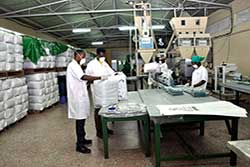
Photo of Scientists in Aflasafe Factory
Aflasafe Factory
…flags off project to ensure aflasafe products reach farmers’ h ands.


African farmers will soon have a product that would ensure safer food for their families and communities. A natural product called aflasafe that can reduce contamination from aflatoxin, a silent killer, would be made available in at least 11 countries in sub-Saharan Africa.


Following the success of aflasafe— the first indigenous biocontrol innovation for the prevention of aflatoxin contamination on the fields and store houses of maize and groundnut farmers in Africa, the International Institute of Tropical Agriculture (IITA) is now set to enable commercialization of the technology, to ensure that farmers in need of the product would have access to it.


More than 4.5 billion people in the developing world are exposed to aflatoxins, carcinogenic poisons produced by a fungus that contaminates crops. Aflatoxins are detrimental to human health, and can even cause death. They suppress immune systems and are associated with stunting in children. Aflatoxins also reduce crop value—at least $450 million in commerce is lost annually to African economies due to aflatoxins.


Aflasafe is a revolutionary biocontrol product developed by IITA, United States Department of Agriculture – Agriculture Research Service (USDA-ARS), and national partners. So far, aflasafe has been reported to achieve up to 98% efficacy in reducing grain contamination on the fields and stores of farmers where aflasafe products are registered or in the process of becoming a nationally registered in 11 countries.


But farmers will not be the sole beneficiaries of the technology. IITA envisages a scenario where every African farmer will apply the product on their field, producing aflatoxin-safe grains for their families and communities buying from the market. This is expected to positively affect the heath conditions of people and improve profitability of maize and groundnut value chains.


The new aflasafe Technology Transfer and Commercialization Project (aTTC), funded by a $20 million grant from the Bill & Melinda Gates Foundation and USAID, was launched last December 2016 to be implemented in 11 countries consisting of Burkina Faso, the Gambia, Ghana, Kenya, Malawi, Mozambique, Nigeria, Senegal, Tanzania, Ug anda, and Zambia. aTTC will be led by IITA with support from USDA-ARS, Chemonics, Dalberg Global Development Advisors, the Partnership for Aflatoxin Control in Africa of the African Union (PACA), national institutions, and Regional Economic Communities such as the Economic Community of West African States (ECOWAS).


aTTC places partnership with the private sector at the core and is working with business partners that can help to achieve the goal of producing an effective, affordable product that would ensure that farmers, consumers, and communities are protected from the deadly effects of aflatoxin contamination.


“To get aflasafe to the masses, we need many companies, millions of small-scale farmers, distributors, who know what aflasafe can do to apply it. IITA is excited because the Institute is on the edge of reaching this goal,” IITA Deputy Director General, Partnerships for Delivery, Kenton Dashiell said.


Corroborating the need to work with private businesses in getting the technology out, Ranajit B andyopadhyay, IITA Plant Pathologist and leader of Africa-wide aflasafe Initiative who had been working on the product for more than a decade now, noted that “This product is indigenous! Developing the technology was not difficult, taking it out to the end users is the challenge; therefore, partnership is very crucial”.
The aTTC project is designed to identify and enable partners for manufacturing/distribution of aflasafe, and increase its availability. The launch event in Ibadan had researchers, farmers’ organizations, private and public sectors partners in attendance.


Also speaking at the launch event, Amare Ayalew, Program Manager, PACA, highlighted the need for disseminating the innovation to the farmers.


“African farmers need game-changing research technologies like aflasafe to meet aflatoxin st andards for international trade and also to nourish their families and other people who eat their produce with wholesome produce” Ayalew stated.


Managing Director of the aTTC project, Abdou Konlambigue, said that the project is designed to identify strategic options for partnerships with private companies, and/ or government entities, execute those partnerships, and help ensure that aflasafe reaches millions of farmers throughout sub-Saharan Africa.


“We look forward to making sure that this technology reaches the h ands of farmers in the soonest time possible through strategic partnerships with governments, the private sector, and other key stakeholders. Ultimately, we want to ensure that African farmers produce safe food and their income is reassured by adopting aflasafe.”
ENDS


About IITA www.iita.org
The International Institute of Tropical Agriculture (IITA) is a not-for-profit institution that generates agricultural innovations to meet Africa’s most pressing challenges of hunger, malnutrition, poverty, and natural resource degradation. Working with various partners across sub-Saharan Africa, we improve livelihoods, enhance food and nutrition security, increase employment, and preserve natural resource integrity. IITA is a member of CGIAR, a global agriculture research partnership for a food secure future.


Media contact: Katherine Lopez, Head of Communication, k.lopez@cgiar.org


Contribué par

Nouvelles connexes

Aucun article trouvé

Laisser un commentaire

Votre adresse e-mail ne sera pas publiée. Les champs obligatoires sont indiqués avec *

Retour en haut
Olaosebikan, Olamide

Olamide Deborah Nwanze est une chercheuse principale spécialisée dans la recherche sur l'approche "genre" afin d'éclairer les politiques de sélection participative et inclusive, de développement de variétés et de systèmes semenciers concernant les cultures de racines, tubercules et bananes (RTB) au siège de l'Institut International d'Agriculture Tropicale, à Ibadan, au Nigeria. Elle est candidate au doctorat à l'Université d'Ibadan et titulaire d'un master et d'un diplôme d'ingénieur agronome en vulgarisation agricole et développement rural. Olamide est membre du programme African Women in Agricultural Research and Development – Gender Responsive Agricultural Systems Policy (SAISIE DE RÉCOMPENSEet les Chercheuses Sensibles au Genre Équipées pour la Transformation Agricole (SUPER. Elle cherche à appliquer ses apprentissages en matière d’approche genre, recherche sensible au genre, et expertise en développement et examen de politiques pour faciliter l’accès et l’adoption par les femmes, les jeunes, les enfants et les groupes sociaux vulnérables aux innovations agricoles qui garantissent la sécurité alimentaire, nutritionnelle, des revenus et des moyens de subsistance en Afrique. Ses rôles actuels comprennent le mentorat de chercheurs stagiaires, le développement de guides et manuels de formation, la mise en œuvre et l'adaptation de cadres et d'outils genre, l'engagement des acteurs de la chaîne de valeur en tant que partenaires de la science citoyenne, l'examen et la refonte des politiques, la gestion et l'analyse des données. Ses recherches actuelles portent sur les méthodes mixtes ainsi que sur les approches participatives et interdisciplinaires pour saisir et mettre en évidence les dynamiques de genre, les besoins, les préférences et les défis rencontrés par les parties prenantes au sein de la chaîne de valeur des moyens de subsistance agricoles afin de prioriser des stratégies axées sur le genre dans les programmes de sélection, la conception et la mise en œuvre des politiques.

À l'IITA, elle contribue à la mise en œuvre du CGIAR Initiative d'Élevage Accéléré et Innovation génétique Programmes ; recherche participative et genre au sein des Prochaine Génération ManiocHarvestPlusRTBAliments, et Tricot-ClimMob 1000Fermes Projets ; et la communication des connaissances sur le genre via le Série de webinaires G-LENS, vidéo documentaire, notes de politiquepublications, et blogs.


Publications récentes

de Sousa, K., van Etten, J., Manners, R. Bello, A., Teeken, B., Olaosebikan, O., et al. 2024. L'approche tricot : un cadre agile pour les essais décentralisés à la ferme soutenus par la science citoyenne. Une rétrospective. Agron. Sustain. Dev. 44, 8. https://doi.org/10.1007/s13593-023-00937-1

Madu, T., Onwuka, S., Nwafor, S., Onyemauwa, N., Ejechi, M., Ofoeze, M., Ukeje, B., Eluagu, C., Olaosebikan, O., Okoye, B., 2024. Les études sur les consommateurs inclusifs en matière de genre améliorent l'amélioration du manioc au Nigeria dans : Frontiers in Sociology, volume 9, numéro : 1224504, doi : 10.3389/fsoc.2024.1224504

Olaosebikan, O. ; Bello, A. ; Utoblo, O. ; Okoye, B. ; Olutegbe, N. ; Garner, E. ; Teeken, B. ; Bryan, E. ; Forsythe, L. ; Cole, S. ; Madu, T. 2023. Facteurs de stress et résilience au sein de la chaîne de valeur du manioc au Nigeria : Caractéristiques préférées des variétés de manioc et stratégies de réponse des hommes et des femmes pour informer l'amélioration variétale. Sustainability 15, 7837. https://doi.org/10.3390/su15107837

Okoye, B., Ofoeze, M., Ejechi, M., Onwuka, S., Nwafor, S., Onyemauwa, N., Ukeje, B., Eluagu, C., Obidiegwu, J.*, Olaosebikan, O., Madu, T.* 2023. Priorisation des traits préférés dans la chaîne de valeur de l'igname au Nigeria : une analyse de la situation en matière de genre in: Frontiers in Sociology, volume 8, numéro : 1232626, pages 1 – 9, ISSN 2297-7775, 2023. https://www.frontiersin.org/articles/10.3389/fsoc.2023.1232626/full

Olaosebikan, O., Bello, A. A., de Sousa, K., Ndjouenkeu, R., Adesokan, M., Alamu, E. O., Agbona, A., van Etten, J., Kegah, F. N.*, Dufour, D., Bouniol, A., Teeken, B. 2023. Acceptabilité par les consommateurs des produits alimentaires à base de gari-eba de manioc dans des contextes culturels et environnementaux variés en utilisant l'approche triade de comparaison des technologies (tricot) dans : Journal of the Science of Food and Agriculture,

Teeken, B., Olaosebikan, O., Bello, A. A., Madu, T.*, Cole, S. M. 2023. Évaluation qualitative de la positionnalité et des préférences des dyades en relation avec les activités liées au manioc : travailler avec des scientifiques citoyens du procès tricot https://hdl.handle.net/10568/138326 Type : Manuel

Bouniol, A., Ceballos, H., Bello, A. A., Teeken, B., Olaosebikan, O., Owoade, D., Agbona, A., Fotso Kuate, A., Madu, T.*, Okoye, B.*, Ofoeze, M.*, Nwafor, S.*, Onyemauwa, N.*, Adinsi, L.*, Forsythe, L., Dufour, D. 2023. Impact variétal sur le travail des femmes, la charge de travail et la pénibilité associée dans le traitement des plantes à racines, tubercules et bananes : focus sur le manioc en Afrique subsaharienne dans : Journal of the Science of Food and Agriculture, pages 1 – 25, ISSN 0022-5142,

Bello, A. A., Agbona, A., Olaosebikan, O., Edughaen, G., Dufour, D., Bouniol, A., Iluebbey, P., Ndjouenkeu, R.*, Rabbi, I. Y., Teeken, B. 2023. Effets génétiques et environnementaux sur la productivité de la transformation et le rendement des produits alimentaires : la pénibilité du travail des femmes dans : Journal of the Science of Food and Agriculture, pages 1 – 32, ISSN 0022-5142, 5

Cavicchioli, M., Zimbiti, T., Teeken, B., Nwanze, D.O., Liani, M., Parkes, E. & Bello, A. 2023. Rapport sur la formation en sélection génétique sensible au genre à l'IITA. Genetic Resources Center, IITA-HQ, Ibadan, 21-23 septembre 2022. Ibadan, Nigéria : IITA, (34 p.).https://hdl.handle.net/10568/131368

Agbona, A. Peteti P., Teeken B., Olaosebikan O. Bello, A. A., Parkes, E., Rabbi, I. Y., Mueller, L., Egesi, C., Kulakow, P. 2022. Gestion des données dans les programmes d'amélioration des cultures RTB africaines multidisciplinaires. In : Williamson, H.F., Leonelli, S. (eds) Towards Responsible Plant Data Linkage: Data Challenges for Agricultural Research and Development. Springer, Cham. https://doi.org/10.1007/978-3-031-13276-6_5

Lora Forsythe, Pricilla Marimo, Sarah Mayanja, Olamide D. Olaosebikan, Esme Stuart, Bela Teeken, Benjamin Okoye, Tessy Madu, (2021). Analyse transversale du genre dans RTBfoods Étape 2 Cartographie des genres sur les produits RTB. Comprendre les moteurs des préférences en matière de traits et le développement de profils de produits RTB multi-utilisateurs, WP1. Londres, Royaume-Uni : Rapport scientifique de terrain RTBfoods, 30 p.

Teeken, B., Garner, E., Agbona, A., Balogun, I., Olaosebikan, O., Bello, A., Madu, T., Okoye, B., Egesi, C., Kulakow, P. et Tufan, H.A. 2021. Au-delà des “ traits des femmes ” : explorer comment le genre, les différences sociales et les caractéristiques des ménages influencent les préférences pour les traits. Frontiers Systèmes alimentaires durables 5:740926. https://doi.org/10.3389/fsufs.2021.740926

Teeken, B., Agbona, A., Bello, A., Olaosebikan, O., Alamu, E., Adesokan, M., Awoyale, W., Madu, T., Okoye, B., Chijioke, U., Owoade, D., Okoro, M., Bouniol, A., Dufour, D., Hershey, C., Rabbi, I., Maziya‐Dixon, B., Egesi, C., Tufan, H. et Kulakow, P. (020. Comprendre les préférences variétales du manioc par le classement par paires du gari-eba et du fufu préparés par des agriculteurs-transformateurs locaux. Int J Food Sci Technol. https://doi.org/10.1111/ijfs.14862

Bela Teeken, Olamide Olaosebikan, Ireti Balogun, Benjamin Okoye, Tessy Madu, Steven Cole, Abolore Bello, Elizabeth Parkes. (2020). Pilotage des outils de profil client et produit G+ pour l'amélioration sensible au genre du manioc au Nigeria. Nigeria : Institut international d'agriculture tropicale (IIAT). https://hdl.handle.net/20.500.11766/13000