
Over 130 participants from 25 countries met in Addis Ababa, Ethiopia, to confirm partners and priorities at the launching of the CGIAR Research Program on Grain Legumes and Dryl and Cereals (GLDC). Dr Peter Carberry, Director of GLDC, set the framework, underlining that the Program’s approach is premised on how it can add value to what is already being undertaken. Linking initiatives and building on each other’s strengths will be a key focus of the approach.
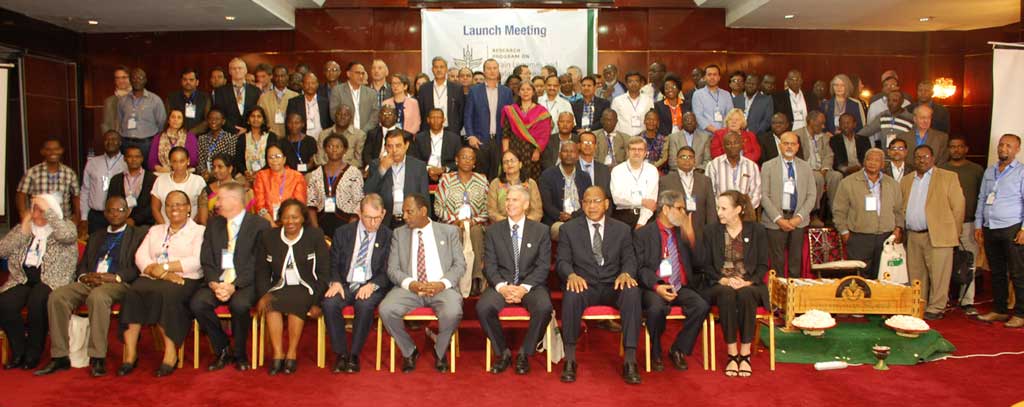
Ethiopia’s Minister of Agriculture and Natural Resources, H.E. Dr Eyasu Abraha Alle, who inaugurated GLDC, supported the value chain approach noting that “Grain legumes and the sorghum and millets are what have been termed as ‘Smart Food’ because they are’ good for you, good for the planet, and good for the farmer’. However, they have received less attention and their value chains have not been as well developed. We need to do something different! Through partnerships like GLDC, we will build this whole industry from the consumer end and also develop the food processing industry and connect this right back to the farmers.”
He also challenged the team saying, “We have to work furiously for the dryl ands. Tackling the dryl ands means being climate smart. Grain legumes and dryl and cereals are well adapted to the dryl ands and naturally nutritious. These are smart foods and we need to diversify our diets with them. I challenge the CRP to come up with a strategy for the dryl ands of Ethiopia.”
Jointly launching the Program was Dr Nigel Kerby, Board Chair of the Institut international de recherche sur les cultures des zones tropicales semiarides (ICRISAT), who congratulated the whole team behind GLDC: “As Chair of the ICRISAT Board and on behalf of ICRISAT which has pulled together the partners and prospectus for this Program, I take great pleasure in joining the 44 partner institutions and the Minister of Agriculture and Natural Resources for the launch of GLDC. I am very impressed by the commitment shown by the over 130 delegates at the launch, from many different disciplines and their belief in GLDC. I wish great success to the team over the next five years and beyond.”
GLDC’s vision is to deliver improved rural livelihoods and nutrition by prioritizing dem and-driven innovations to increase production and market opportunities along value chains. The program supports research for development on six legumes (chickpea, cowpea, pigeon pea, groundnut, lentil, and soybean) and three cereals (sorghum, pearl millet, and finger millet). It will focus on the semi-arid and subhumid dryl and agroecologies of sub-Saharan Africa and South Asia. The Program is a partnership of CGIAR centers that includes IITA, public and private organizations, governments, and farmers worldwide.
From a media release on the GLDC website.
Contribué par
Histoires récentes