Présentation de la plus grande collection d'insectes d'Afrique de l'Ouest
mai 15, 2020
Quick facts
IITA’s insect collection is based in BeninIt is the most extensive insect collection in West AfricaIt has 366,000 insect speciesMuseum houses both pests and beneficial insectsOffers free insect identification services
How do you catch all these insects? How do you know where they are? Do you go into the bushes with a net and wave it in the air? There were so many questions that I kept asking as I stood perplexed. “Look around you,” Georg tells me with a look of amusement on his face. I look, nothing. “Lookup”, he directs my gaze. I look and spot what looks like a giant spider at whose sight I wince a little. Georg, amused, lets out a loud laugh, “look again”, he encourages me further. This time I let my eyes roam the entire room, which is about 40 by 40 ft; all over the walls are all kinds of enormous insects.
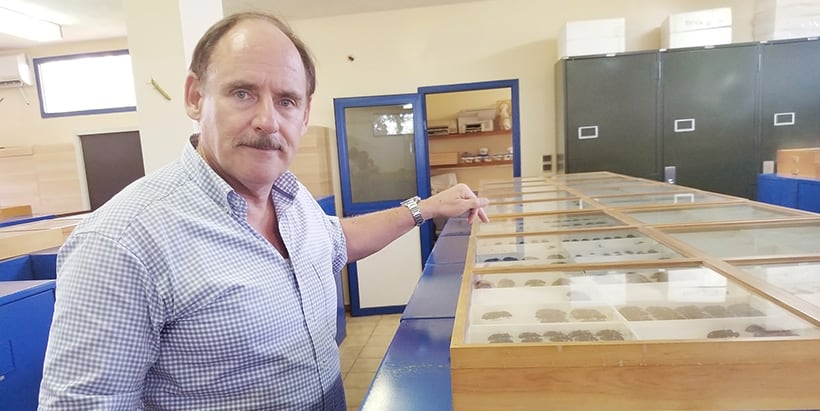
Georg Georgen, an entomologist and head of IITA’s insect museum in Cotonou, Benin
By this time, I was almost screaming until my eyes rest on a colossal grasshopper and with a little more scrutiny, I realize they are plastic insects – decorations. Georg is laughing, clearly enjoying my scared reaction. “Insects are everywhere; you don’t see them because you are not looking for them. That is how it starts; we go out in the natural environment and look for them. First, we see the big ones, but as we look closely, we even see the tinier ones”. This is a scene from the International Institute of Tropical Agriculture (IITA)’s Biodiversity Centre based in Cotonou, Benin. It is West Africa’s biggest insect museum or “insect collection” as IITA’s entomologist and biocontrol specialist, Goergen Georg prefers to call it.
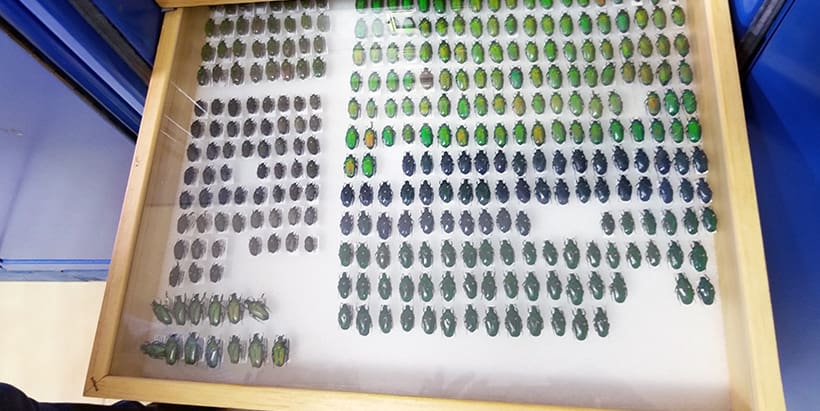
I am sure you have as many questions as I had. Insect museum? Why collect insects, how does one collect insects, who on earth collects insects? I put all these and more questions to Georg, a jolly man of German descent who grew up in Morocco playing with spiders and scorpions. No wonder he heads IITA’s insect collection. In a lightly air-conditioned room with blue cabinets lay 366,000 insect species. With a playful look and almost permanent smile, Georg, who laughs easily, eagerly shows me one insect collection after another. Some are quite pretty I must admit. The beetles have a vibrant sapphire green colour, and the house flies in the collection are not nasty pit latrine hopping creatures, they are a luxurious shimmery blue. Why collect insects, I ask as Georg pulls out another blue cabinet to reveal beautiful butterflies.In another drawer, I see spiders, and I let out a gasp. We need to stop looking at insects, so I insist on getting my question answered, why? “I’ll tell you, be patient”, Georg hushes as he pulls out yet more drawers. It’s evident he’s proud of the work he and his team are doing. “Some are pretty rare”, he adds as he pulls out another cabinet. Later, after he is done showing off his impressive collection, he answers my question, why collect insects?
Some of the insects in the museumPurpose of the collection
“We exist to offer a free identification service for any insect that is of concern to agriculture or health,” Georg says. “Over time, we have developed a reputation that we offer this service, and in return, we are often the first to be informed of new pests in West Africa. This was the case with the Fall armyworm (FAW). Once our partners proved that they were confronted with a new pest, they sent us samples for identification.” Georg and his team went ahead and identified the FAW as a new and invasive species on the African continent. Read about the fall armyworm and its discovery here.History CGIAR-IITA’s insect collection emerged from the first biocontrol success in Africa, which was targeted at the cassava mealybug. Scientists studied the cassava mealybug food web as well as its most efficient and effective natural enemy. However, in reviewing the mealybug’s natural enemies, the researchers were confronted with the lack of a facility to identify samples locally. “All samples were sent abroad for identification, which was characterized by long delays in both dispatch and response”. It is against that background and the regional need for an arthropod diagnostic service that IITA decided to open its own identification center. What started as a small insect collection at IITA’s headquarters in Ibadan, Nigeria was later moved to Cotonou in Benin at the Institute’s biocontrol centre. From 1,000 specimens in Ibadan, the insect collection now boasts of 366,000 specimens and more than 6,000 identified species, making it the best insect collection in West Africa with both pests and beneficial insects.
This growth has come mostly from material kept from past projects, as Georg explains: “In the past, when a project would end, the identified materials would be discarded, which was a pity because they were valuable references. The insects are now preserved permanently so that future projects could benefit from them.” Permanent preservation is possible because of the suitable conditions in the museum, such as controlled access. One cannot have direct access to the collection; they must pass through two doors which limits unnecessary movement. The room is also permanently air-conditioned with back-up generators in case of electricity outage. The windows are not only small to avoid exposure to sunlight, but they are also never opened. Georg explains the rationale, “Insects decay mostly from fungi, attack from fellow insects and exposure to sunlight. If these conditions are minimized, then permanent preservation is possible.”
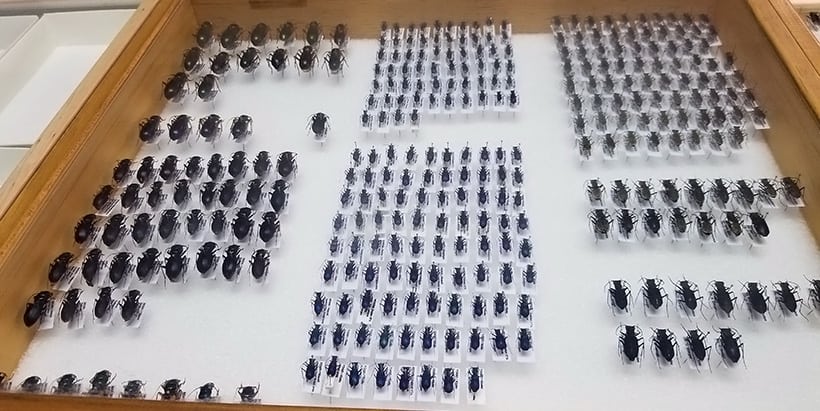
Beetles in the insect collection
There are so many insects of the same species, i.e., several kinds of houseflies, butterflies, bees, or beetles, and there is a reason for this. “We collect everything we can get from different regions. It may seem like a waste to the untrained mind, but nothing is never in vain, as Georg explains. “When the opportunity availed itself, we collected aquatic beetles, and everyone wondered whether we had gone bonkers. Then, ten years later, it was discovered that aquatic beetles are involved in the transmission of the Buruli ulcer, a locally emerging infectious skin disease. Suddenly, everyone was interested in what type of aquatic insects we have in West Africa, and thankfully we had preserved some of them.” That is why, when Georg or anyone on his team, find themselves in a new environment, they collect a sample that is representative of the region’s insects—you never know when you will need them! “The idea is to store them and come back anytime by looking into the cabinets – i.e. the museum – because the past helps us to master current problems”. Also, one cannot know if a species is new to the continent or not without any reference. In the case of the Fall Armyworm, Georg says they would never have known that it was alien to Africa if they had not collected other moths to which it was compared.
So, there it is—the collection is essential to identifying and studying new invasive and beneficial insects as well as finding an effective biocontrol measure, i.e., natural enemies that can suppress an insect pest. Over the years, IITA has used natural enemies (beneficial insects) to control pests such as the cassava mealybug. Biocontrol of cassava mealybug delivered the highest return on investment in the history of the CGIAR. A Benefit:Cost ratio of 149:1, meaning every $1 invested in cassava mealybug biocontrol gave a return of $149. Other noteworthy biocontrol successes include controlling the water hyacinth on Lake Victoria, the world’s largest fresh water body, using weevils. . The water fern in Congo Brazzaville was also entirely controlled by introducing a specific weevil.
Find out more about the use of natural enemies in the control of pests, here et ici.
Olamide Deborah Nwanze est une chercheuse principale spécialisée dans la recherche sur l'approche "genre" afin d'éclairer les politiques de sélection participative et inclusive, de développement de variétés et de systèmes semenciers concernant les cultures de racines, tubercules et bananes (RTB) au siège de l'Institut International d'Agriculture Tropicale, à Ibadan, au Nigeria. Elle est candidate au doctorat à l'Université d'Ibadan et titulaire d'un master et d'un diplôme d'ingénieur agronome en vulgarisation agricole et développement rural. Olamide est membre du programme African Women in Agricultural Research and Development – Gender Responsive Agricultural Systems Policy (SAISIE DE RÉCOMPENSEet les Chercheuses Sensibles au Genre Équipées pour la Transformation Agricole (SUPER. Elle cherche à appliquer ses apprentissages en matière d’approche genre, recherche sensible au genre, et expertise en développement et examen de politiques pour faciliter l’accès et l’adoption par les femmes, les jeunes, les enfants et les groupes sociaux vulnérables aux innovations agricoles qui garantissent la sécurité alimentaire, nutritionnelle, des revenus et des moyens de subsistance en Afrique. Ses rôles actuels comprennent le mentorat de chercheurs stagiaires, le développement de guides et manuels de formation, la mise en œuvre et l'adaptation de cadres et d'outils genre, l'engagement des acteurs de la chaîne de valeur en tant que partenaires de la science citoyenne, l'examen et la refonte des politiques, la gestion et l'analyse des données. Ses recherches actuelles portent sur les méthodes mixtes ainsi que sur les approches participatives et interdisciplinaires pour saisir et mettre en évidence les dynamiques de genre, les besoins, les préférences et les défis rencontrés par les parties prenantes au sein de la chaîne de valeur des moyens de subsistance agricoles afin de prioriser des stratégies axées sur le genre dans les programmes de sélection, la conception et la mise en œuvre des politiques.
de Sousa, K., van Etten, J., Manners, R. Bello, A., Teeken, B., Olaosebikan, O., et al. 2024. L'approche tricot : un cadre agile pour les essais décentralisés à la ferme soutenus par la science citoyenne. Une rétrospective. Agron. Sustain. Dev. 44, 8. https://doi.org/10.1007/s13593-023-00937-1
Madu, T., Onwuka, S., Nwafor, S., Onyemauwa, N., Ejechi, M., Ofoeze, M., Ukeje, B., Eluagu, C., Olaosebikan, O., Okoye, B., 2024. Les études sur les consommateurs inclusifs en matière de genre améliorent l'amélioration du manioc au Nigeria dans : Frontiers in Sociology, volume 9, numéro : 1224504, doi : 10.3389/fsoc.2024.1224504
Olaosebikan, O. ; Bello, A. ; Utoblo, O. ; Okoye, B. ; Olutegbe, N. ; Garner, E. ; Teeken, B. ; Bryan, E. ; Forsythe, L. ; Cole, S. ; Madu, T. 2023. Facteurs de stress et résilience au sein de la chaîne de valeur du manioc au Nigeria : Caractéristiques préférées des variétés de manioc et stratégies de réponse des hommes et des femmes pour informer l'amélioration variétale. Sustainability 15, 7837. https://doi.org/10.3390/su15107837
Okoye, B., Ofoeze, M., Ejechi, M., Onwuka, S., Nwafor, S., Onyemauwa, N., Ukeje, B., Eluagu, C., Obidiegwu, J.*, Olaosebikan, O., Madu, T.* 2023. Priorisation des traits préférés dans la chaîne de valeur de l'igname au Nigeria : une analyse de la situation en matière de genre in: Frontiers in Sociology, volume 8, numéro : 1232626, pages 1 – 9, ISSN 2297-7775, 2023. https://www.frontiersin.org/articles/10.3389/fsoc.2023.1232626/full
Olaosebikan, O., Bello, A. A., de Sousa, K., Ndjouenkeu, R., Adesokan, M., Alamu, E. O., Agbona, A., van Etten, J., Kegah, F. N.*, Dufour, D., Bouniol, A., Teeken, B. 2023. Acceptabilité par les consommateurs des produits alimentaires à base de gari-eba de manioc dans des contextes culturels et environnementaux variés en utilisant l'approche triade de comparaison des technologies (tricot) dans : Journal of the Science of Food and Agriculture,
Teeken, B., Olaosebikan, O., Bello, A. A., Madu, T.*, Cole, S. M. 2023. Évaluation qualitative de la positionnalité et des préférences des dyades en relation avec les activités liées au manioc : travailler avec des scientifiques citoyens du procès tricot https://hdl.handle.net/10568/138326 Type : Manuel
Bouniol, A., Ceballos, H., Bello, A. A., Teeken, B., Olaosebikan, O., Owoade, D., Agbona, A., Fotso Kuate, A., Madu, T.*, Okoye, B.*, Ofoeze, M.*, Nwafor, S.*, Onyemauwa, N.*, Adinsi, L.*, Forsythe, L., Dufour, D. 2023. Impact variétal sur le travail des femmes, la charge de travail et la pénibilité associée dans le traitement des plantes à racines, tubercules et bananes : focus sur le manioc en Afrique subsaharienne dans : Journal of the Science of Food and Agriculture, pages 1 – 25, ISSN 0022-5142,
Bello, A. A., Agbona, A., Olaosebikan, O., Edughaen, G., Dufour, D., Bouniol, A., Iluebbey, P., Ndjouenkeu, R.*, Rabbi, I. Y., Teeken, B. 2023. Effets génétiques et environnementaux sur la productivité de la transformation et le rendement des produits alimentaires : la pénibilité du travail des femmes dans : Journal of the Science of Food and Agriculture, pages 1 – 32, ISSN 0022-5142, 5
Cavicchioli, M., Zimbiti, T., Teeken, B., Nwanze, D.O., Liani, M., Parkes, E. & Bello, A. 2023. Rapport sur la formation en sélection génétique sensible au genre à l'IITA. Genetic Resources Center, IITA-HQ, Ibadan, 21-23 septembre 2022. Ibadan, Nigéria : IITA, (34 p.).https://hdl.handle.net/10568/131368
Agbona, A. Peteti P., Teeken B., Olaosebikan O. Bello, A. A., Parkes, E., Rabbi, I. Y., Mueller, L., Egesi, C., Kulakow, P. 2022. Gestion des données dans les programmes d'amélioration des cultures RTB africaines multidisciplinaires. In : Williamson, H.F., Leonelli, S. (eds) Towards Responsible Plant Data Linkage: Data Challenges for Agricultural Research and Development. Springer, Cham. https://doi.org/10.1007/978-3-031-13276-6_5
Lora Forsythe, Pricilla Marimo, Sarah Mayanja, Olamide D. Olaosebikan, Esme Stuart, Bela Teeken, Benjamin Okoye, Tessy Madu, (2021). Analyse transversale du genre dans RTBfoods Étape 2 Cartographie des genres sur les produits RTB. Comprendre les moteurs des préférences en matière de traits et le développement de profils de produits RTB multi-utilisateurs, WP1. Londres, Royaume-Uni : Rapport scientifique de terrain RTBfoods, 30 p.
Teeken, B., Garner, E., Agbona, A., Balogun, I., Olaosebikan, O., Bello, A., Madu, T., Okoye, B., Egesi, C., Kulakow, P. et Tufan, H.A. 2021. Au-delà des “ traits des femmes ” : explorer comment le genre, les différences sociales et les caractéristiques des ménages influencent les préférences pour les traits. Frontiers Systèmes alimentaires durables 5:740926. https://doi.org/10.3389/fsufs.2021.740926
Teeken, B., Agbona, A., Bello, A., Olaosebikan, O., Alamu, E., Adesokan, M., Awoyale, W., Madu, T., Okoye, B., Chijioke, U., Owoade, D., Okoro, M., Bouniol, A., Dufour, D., Hershey, C., Rabbi, I., Maziya‐Dixon, B., Egesi, C., Tufan, H. et Kulakow, P. (020. Comprendre les préférences variétales du manioc par le classement par paires du gari-eba et du fufu préparés par des agriculteurs-transformateurs locaux. Int J Food Sci Technol.https://doi.org/10.1111/ijfs.14862
Bela Teeken, Olamide Olaosebikan, Ireti Balogun, Benjamin Okoye, Tessy Madu, Steven Cole, Abolore Bello, Elizabeth Parkes. (2020). Pilotage des outils de profil client et produit G+ pour l'amélioration sensible au genre du manioc au Nigeria. Nigeria : Institut international d'agriculture tropicale (IIAT). https://hdl.handle.net/20.500.11766/13000