Lutter ensemble : les stations de l'IITA répondent par des innovations
23 mai 2020
Avec l'épidémie de COVID-19, CGIAR-IITA a mis un accent particulier sur la collaboration avec les gouvernements d'Afrique subsaharienne pour renforcer leurs systèmes alimentaires afin de lutter contre le fléau de cette pandémie et de le vaincre. Outre cette réponse globale de l'Institut, les stations de l'IITA dans différentes localités ont élaboré diverses solutions innovantes visant à aider leurs communautés immédiates à faire face aux retombées de l'épidémie. Lutter contre le COVID-19 au Bénin :
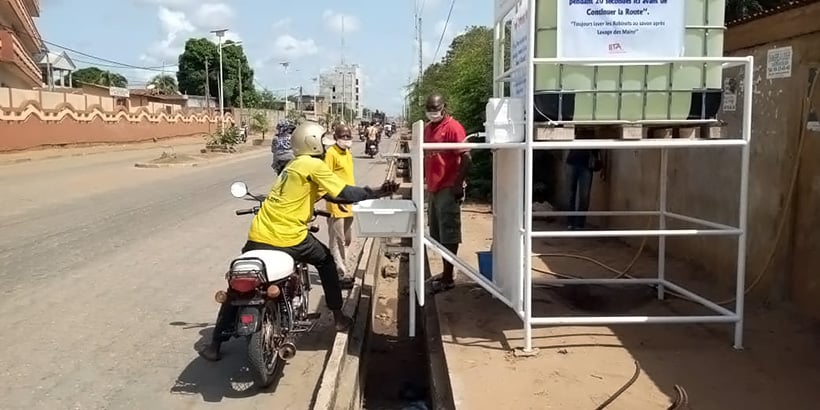
Lutte contre le COVID-19 au Bénin : Systèmes de lavage des mains de rue pour les motocyclistes et les piétonsDes conducteurs de zemidjan à l'extérieur d'IITA-Bénin, utilisant le système de lavage des mains de rue.
Les rues sont des points de rencontre pour la plupart des individus, car les gens doivent se déplacer d'une extrémité à l'autre pour leurs diverses activités. Par conséquent, les rues pourraient devenir des foyers de contamination et de propagation de la COVID-19. Pour limiter la propagation de ce virus dans la communauté, IITA-Bénin le 4 mai, a lancé un système de lavage des mains de rue dans le quartier de Calavi à Cotonou, au Bénin. Ce système est conçu pour un lavage des mains facile et rapide pour les usagers de la rue tels que les motocyclistes, les piétons et même les automobilistes.
Dans le cas du Bénin, les cibles de cette installation prototype située à l'extérieur de la clôture d'IITA-Bénin étaient principalement les taxis bien connus sous le nom de “ Zemidjan ”. L'idée de ce dispositif de lavage “ au volant ”, simple mais efficace, a été motivée par la nécessité pour chaque site de l'IITA de trouver des solutions innovantes pour faire face à la pandémie. Entomologiste moléculaire à l'IITA et responsable de la plateforme AgroEcoHealth à Cotonou, Rousseau Djouaka, a développé la solution avec l'assistance technique du responsable des services de gestion des installations (FMS), Gontran Honfoga, et de l'équipe FMS.
L'administrateur de la station IITA-Bénin, François Tosse, a inauguré le dispositif avec la participation des conducteurs de Zemidjan et des passants.
Ce système devrait être étendu à d'autres rues dans d'autres pays africains afin de limiter la propagation de la COVID-19 et d'autres maladies associées aux solutions d'eau, d'hygiène et d'assainissement (WaSH).
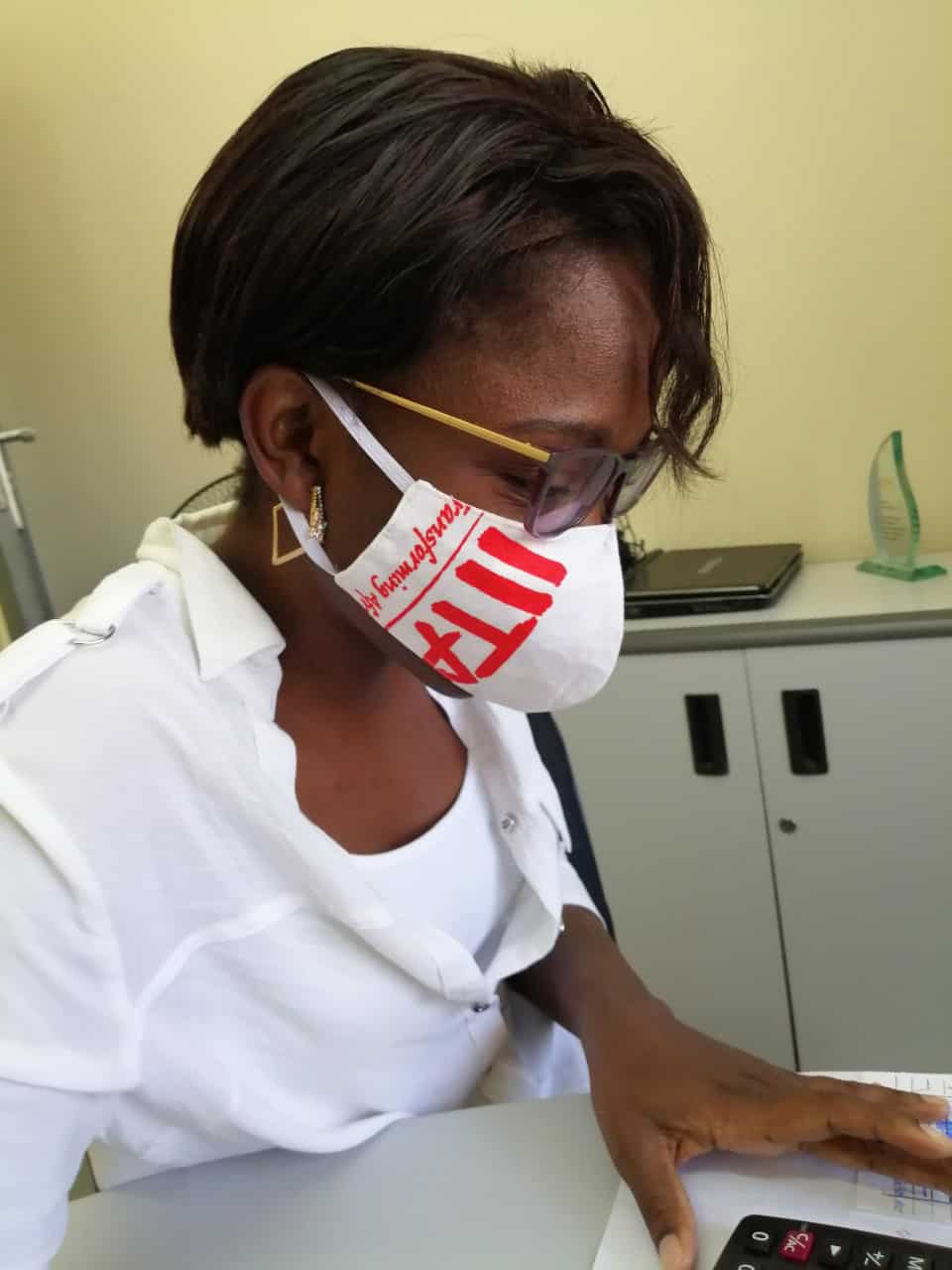
Les héros masqués : Masques faciaux spéciaux pour les travailleurs d'IITA-MozambiqueLe personnel d'IITA-Mozambique portant un masque facial coloré de l'IITA.
Alors que les gens retournaient au travail en République du Mozambique, le gouvernement a rendu obligatoire l'utilisation de masques faciaux dans les lieux publics dans le cadre de directives visant à prévenir la propagation de la COVID-19. Dans IITA-Mozambique station, la direction a travaillé dur pour veiller à ce que l'Institut se conforme à ces mesures, non seulement parmi le personnel, mais aussi auprès des partenaires locaux, y compris les membres des associations d'agriculteurs.
L'IITA y parvient en produisant et en mettant à disposition des masques faciaux personnalisés aux couleurs de l'IITA pour tout le personnel, ainsi que pour les membres des associations d'agriculteurs lors des journées sur le terrain. Ils ont également veillé à ce que les événements respectent les directives en limitant la participation à un maximum de 10 personnes par événement.
Les agriculteurs et les chercheurs sont essentiels pour préserver la sécurité alimentaire dans toute société, c'est pourquoi l'IITA essaie de protéger ces héros en sensibilisant le personnel et les partenaires aux mesures visant à prévenir l'infection et la propagation de la COVID-19. Parmi les directives mises en avant lors de ces événements figurent l'utilisation d'équipements de protection individuelle (EPI), la distanciation sociale et physique, ainsi que les pratiques d'hygiène telles que le lavage fréquent des mains.
IITA Rwanda soutient les familles vulnérables pendant le confinement
En raison des restrictions de confinement au Rwanda entrées en vigueur le 16 mars, toutes les activités non essentielles ont cessé, laissant de nombreuses familles vulnérables qui dépendent de petites entreprises telles que des étals de fruits, des restaurants et des bars, sans source de revenus. Cette perturbation de leurs finances et de leur capacité à se procurer de la nourriture a fait de la famine une possibilité réelle.
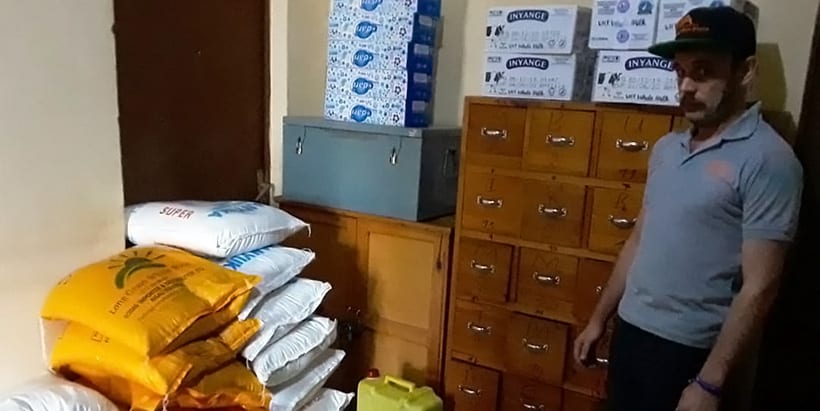
IITA-Rwanda ayant demandé et obtenu une autorisation de déplacement officielle de la police en raison de la nature essentielle de l'agriculture. Ayant observé les difficultés auxquelles font face ces familles, le 27 mars, le personnel général et la direction d'IITA-Rwanda ont réuni une contribution de 500 000 FRw (francs rwandais) pour les soutenir en fournissant des produits alimentaires. Ce budget a permis d'acheter divers produits alimentaires pour les communautés vulnérables du secteur de Kacyiru, dans la ville de Kigali, où se trouvent les bureaux d'IITA-Rwanda.
Deux membres du personnel d'IITA Rwanda ont remis les articles à la secrétaire exécutive du secteur, Gertrude Urujeni, qui les a ensuite donnés aux familles les plus vulnérables identifiées, les rassemblements publics n'étant pas autorisés en tant que mesure de prévention contre le COVID-19.
Le personnel d'IITA-Rwanda a livré les articles destinés aux communautés vulnérables du secteur de Kacyiru, dans la ville de Kigali.
“ Nous comptons maintenant 900 familles vulnérables dans notre secteur qui ont un besoin urgent de nourriture. C'est le premier soutien que nous recevons jusqu'à présent. Nous allons commencer par les familles ayant de jeunes enfants et des personnes âgées ”, a déclaré Urujeni. “ Merci beaucoup d'avoir pensé à vos voisins. Vous avez donné un bon exemple aux autres organisations pour qu'elles fassent de même envers leurs familles vulnérables voisines. ”
Le gouvernement a ensuite mis en place un système de soutien pour s'assurer que toutes les familles vulnérables à travers le pays reçoivent une aide alimentaire, en fonction de la taille de chaque famille, pendant la période de confinement.
Olamide Deborah Nwanze est une chercheuse principale spécialisée dans la recherche sur l'approche "genre" afin d'éclairer les politiques de sélection participative et inclusive, de développement de variétés et de systèmes semenciers concernant les cultures de racines, tubercules et bananes (RTB) au siège de l'Institut International d'Agriculture Tropicale, à Ibadan, au Nigeria. Elle est candidate au doctorat à l'Université d'Ibadan et titulaire d'un master et d'un diplôme d'ingénieur agronome en vulgarisation agricole et développement rural. Olamide est membre du programme African Women in Agricultural Research and Development – Gender Responsive Agricultural Systems Policy (SAISIE DE RÉCOMPENSEet les Chercheuses Sensibles au Genre Équipées pour la Transformation Agricole (SUPER. Elle cherche à appliquer ses apprentissages en matière d’approche genre, recherche sensible au genre, et expertise en développement et examen de politiques pour faciliter l’accès et l’adoption par les femmes, les jeunes, les enfants et les groupes sociaux vulnérables aux innovations agricoles qui garantissent la sécurité alimentaire, nutritionnelle, des revenus et des moyens de subsistance en Afrique. Ses rôles actuels comprennent le mentorat de chercheurs stagiaires, le développement de guides et manuels de formation, la mise en œuvre et l'adaptation de cadres et d'outils genre, l'engagement des acteurs de la chaîne de valeur en tant que partenaires de la science citoyenne, l'examen et la refonte des politiques, la gestion et l'analyse des données. Ses recherches actuelles portent sur les méthodes mixtes ainsi que sur les approches participatives et interdisciplinaires pour saisir et mettre en évidence les dynamiques de genre, les besoins, les préférences et les défis rencontrés par les parties prenantes au sein de la chaîne de valeur des moyens de subsistance agricoles afin de prioriser des stratégies axées sur le genre dans les programmes de sélection, la conception et la mise en œuvre des politiques.
de Sousa, K., van Etten, J., Manners, R. Bello, A., Teeken, B., Olaosebikan, O., et al. 2024. L'approche tricot : un cadre agile pour les essais décentralisés à la ferme soutenus par la science citoyenne. Une rétrospective. Agron. Sustain. Dev. 44, 8. https://doi.org/10.1007/s13593-023-00937-1
Madu, T., Onwuka, S., Nwafor, S., Onyemauwa, N., Ejechi, M., Ofoeze, M., Ukeje, B., Eluagu, C., Olaosebikan, O., Okoye, B., 2024. Les études sur les consommateurs inclusifs en matière de genre améliorent l'amélioration du manioc au Nigeria dans : Frontiers in Sociology, volume 9, numéro : 1224504, doi : 10.3389/fsoc.2024.1224504
Olaosebikan, O. ; Bello, A. ; Utoblo, O. ; Okoye, B. ; Olutegbe, N. ; Garner, E. ; Teeken, B. ; Bryan, E. ; Forsythe, L. ; Cole, S. ; Madu, T. 2023. Facteurs de stress et résilience au sein de la chaîne de valeur du manioc au Nigeria : Caractéristiques préférées des variétés de manioc et stratégies de réponse des hommes et des femmes pour informer l'amélioration variétale. Sustainability 15, 7837. https://doi.org/10.3390/su15107837
Okoye, B., Ofoeze, M., Ejechi, M., Onwuka, S., Nwafor, S., Onyemauwa, N., Ukeje, B., Eluagu, C., Obidiegwu, J.*, Olaosebikan, O., Madu, T.* 2023. Priorisation des traits préférés dans la chaîne de valeur de l'igname au Nigeria : une analyse de la situation en matière de genre in: Frontiers in Sociology, volume 8, numéro : 1232626, pages 1 – 9, ISSN 2297-7775, 2023. https://www.frontiersin.org/articles/10.3389/fsoc.2023.1232626/full
Olaosebikan, O., Bello, A. A., de Sousa, K., Ndjouenkeu, R., Adesokan, M., Alamu, E. O., Agbona, A., van Etten, J., Kegah, F. N.*, Dufour, D., Bouniol, A., Teeken, B. 2023. Acceptabilité par les consommateurs des produits alimentaires à base de gari-eba de manioc dans des contextes culturels et environnementaux variés en utilisant l'approche triade de comparaison des technologies (tricot) dans : Journal of the Science of Food and Agriculture,
Teeken, B., Olaosebikan, O., Bello, A. A., Madu, T.*, Cole, S. M. 2023. Évaluation qualitative de la positionnalité et des préférences des dyades en relation avec les activités liées au manioc : travailler avec des scientifiques citoyens du procès tricot https://hdl.handle.net/10568/138326 Type : Manuel
Bouniol, A., Ceballos, H., Bello, A. A., Teeken, B., Olaosebikan, O., Owoade, D., Agbona, A., Fotso Kuate, A., Madu, T.*, Okoye, B.*, Ofoeze, M.*, Nwafor, S.*, Onyemauwa, N.*, Adinsi, L.*, Forsythe, L., Dufour, D. 2023. Impact variétal sur le travail des femmes, la charge de travail et la pénibilité associée dans le traitement des plantes à racines, tubercules et bananes : focus sur le manioc en Afrique subsaharienne dans : Journal of the Science of Food and Agriculture, pages 1 – 25, ISSN 0022-5142,
Bello, A. A., Agbona, A., Olaosebikan, O., Edughaen, G., Dufour, D., Bouniol, A., Iluebbey, P., Ndjouenkeu, R.*, Rabbi, I. Y., Teeken, B. 2023. Effets génétiques et environnementaux sur la productivité de la transformation et le rendement des produits alimentaires : la pénibilité du travail des femmes dans : Journal of the Science of Food and Agriculture, pages 1 – 32, ISSN 0022-5142, 5
Cavicchioli, M., Zimbiti, T., Teeken, B., Nwanze, D.O., Liani, M., Parkes, E. & Bello, A. 2023. Rapport sur la formation en sélection génétique sensible au genre à l'IITA. Genetic Resources Center, IITA-HQ, Ibadan, 21-23 septembre 2022. Ibadan, Nigéria : IITA, (34 p.).https://hdl.handle.net/10568/131368
Agbona, A. Peteti P., Teeken B., Olaosebikan O. Bello, A. A., Parkes, E., Rabbi, I. Y., Mueller, L., Egesi, C., Kulakow, P. 2022. Gestion des données dans les programmes d'amélioration des cultures RTB africaines multidisciplinaires. In : Williamson, H.F., Leonelli, S. (eds) Towards Responsible Plant Data Linkage: Data Challenges for Agricultural Research and Development. Springer, Cham. https://doi.org/10.1007/978-3-031-13276-6_5
Lora Forsythe, Pricilla Marimo, Sarah Mayanja, Olamide D. Olaosebikan, Esme Stuart, Bela Teeken, Benjamin Okoye, Tessy Madu, (2021). Analyse transversale du genre dans RTBfoods Étape 2 Cartographie des genres sur les produits RTB. Comprendre les moteurs des préférences en matière de traits et le développement de profils de produits RTB multi-utilisateurs, WP1. Londres, Royaume-Uni : Rapport scientifique de terrain RTBfoods, 30 p.
Teeken, B., Garner, E., Agbona, A., Balogun, I., Olaosebikan, O., Bello, A., Madu, T., Okoye, B., Egesi, C., Kulakow, P. et Tufan, H.A. 2021. Au-delà des “ traits des femmes ” : explorer comment le genre, les différences sociales et les caractéristiques des ménages influencent les préférences pour les traits. Frontiers Systèmes alimentaires durables 5:740926. https://doi.org/10.3389/fsufs.2021.740926
Teeken, B., Agbona, A., Bello, A., Olaosebikan, O., Alamu, E., Adesokan, M., Awoyale, W., Madu, T., Okoye, B., Chijioke, U., Owoade, D., Okoro, M., Bouniol, A., Dufour, D., Hershey, C., Rabbi, I., Maziya‐Dixon, B., Egesi, C., Tufan, H. et Kulakow, P. (020. Comprendre les préférences variétales du manioc par le classement par paires du gari-eba et du fufu préparés par des agriculteurs-transformateurs locaux. Int J Food Sci Technol.https://doi.org/10.1111/ijfs.14862
Bela Teeken, Olamide Olaosebikan, Ireti Balogun, Benjamin Okoye, Tessy Madu, Steven Cole, Abolore Bello, Elizabeth Parkes. (2020). Pilotage des outils de profil client et produit G+ pour l'amélioration sensible au genre du manioc au Nigeria. Nigeria : Institut international d'agriculture tropicale (IIAT). https://hdl.handle.net/20.500.11766/13000