
NOUVELLES DE L'IITA

Talking about food loss and food waste with Dr Christopher Mutungi, IITA Food Technology Specialist
septembre 29, 2020

By 2050, the world’s population is estimated to increase to 9 billion people. To feed the increasing population, agriculture production needs to more than double. While agricultural stakeholders are thinking of how to produce the needed food, the current food loss and waste along the food systems need to be curbed to secure food production. Thus, in support of the Food and Agriculture Organisation (FAO) in marking the first International Day of Awareness of Food Loss and Food Waste, IITA Food Technology Specialist, Dr Christopher Mutungi was interviewed by Gloriana Ndibalema, Communication Assistant, both based at the IITA offices in Dar es Salaam, Tanzania, on how IITA is addressing food loss.
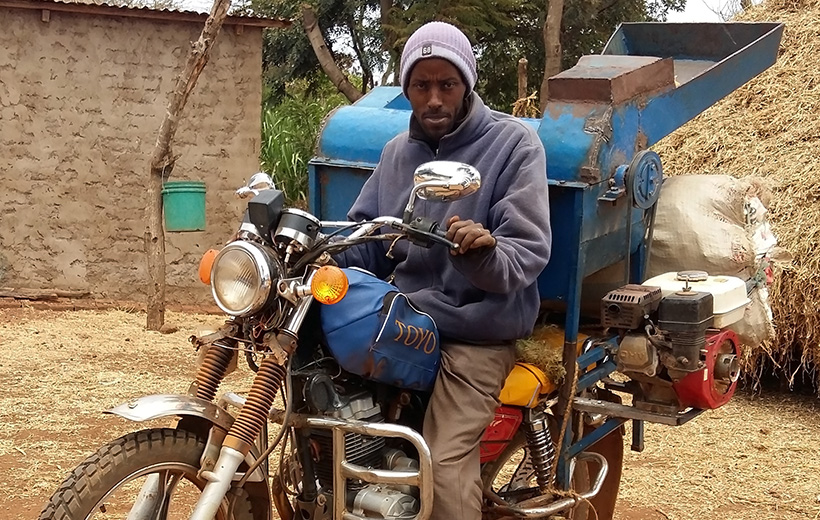
A youth provides services to farmers in a rural setting (Photo: C. Mutungi/IITA).

What is food loss?
First, it’s important to understand the extent of postharvest loss and food waste; it’s not just what people perceive as quantity lost. It includes quality loss in terms of nutrition value and captures the economic loss in terms of lost opportunity because farmers cannot make money or have food because what they have produced is lost or gone to waste.

How does food waste differ from food loss?
Food waste is more of a social issue, in the sense that people have the food, but do not consume it because they perceive it as not appropriate either by making a wrong choice or other social reasons. This happens more in the developed world. We have food waste in Tanzania, especially in the urban areas; for example, in restaurants or meetings, people are served with large portions of food and they end up leaving half on the plate.

How much food is lost in the world and Tanzania?
Globally the figure is between 30% and 40%. Tanzania’s food loss is about 25%, which occurs during postharvest. During storage, 15% of the produce is lost, and this is often caused by insect damage.

How is IITA intervening in the postharvest loss challenge?
Our target now is to deliberately examine loss in crops that make the food basket (cereals, legumes) driven by the infrastructure, facilities used, and capacity for storing the produce. The big concern are the timelines on harvesting and operations around harvesting. Farmers use cumbersome and time-wasting technologies. Therefore, the technologies that we are disseminating are those that help farmers to collect their produce and store it quickly, reducing the time crops are subjected to the damaging effects of bad weather and biological pests. We promote technologies that include collapsible dryers, motorized shellers, and improved air-tight storage containers. We promote them as a package; the expectation is that once you bring these together, you can reduce the losses by as much as 90%.

How do these postharvest loss technologies benefit the community?
When we introduced the motorized shellers in some villages, we went back to learn how they are benefiting from this technology. It was interesting to find out that the technology creates more free time for households to spend with their families. As mothers spent more time with their families, children ate more frequently and nutrition improved. Also, farmers used some of their free time to engage in vegetable and other crop production. Technologies that improve time availability also translate to more productivity in other areas.

Some farmers have turned the motorized shelling machine into a business opportunity where they provide shelling services within their communities, improving income while reducing food loss.
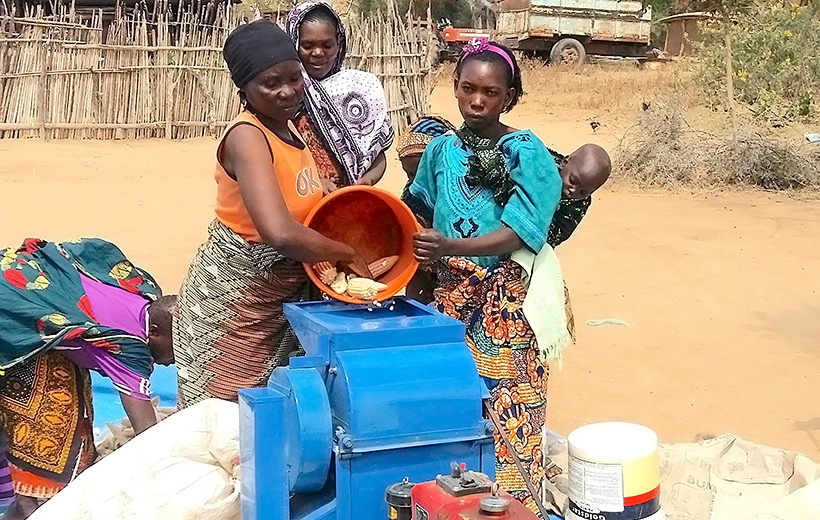
Rural women (Kongwa District, Tanzania) use a low-cost maize thresher run by a diesel engine. The technology reduces labor needs by 77% and frees 90% of time spent in manual shelling for other income-generating activities or household duties (Photo: C. Mutungi/IITA).

How do you commercialize the technologies to the farmers?
Generally, we work with the private sector, companies that manufacture the technologies, or companies that source the technologies from the manufacturers in Asia or China. We work with farmers’ groups or producers where we demonstrate the use of the technologies, examine the performance, and validate them. Then we link them with the suppliers and other public and private sector players. Tanzania has strong institutions tied to mechanization like the Centre for Agriculture Mechanization and Rural Technology (CAMARTECH), which study the needs of farmers in terms of mechanization and produce a prototype. CAMARTECH also helps to improve farmers’ challenges in using prototypes.

We also use postharvest loss management as business opportunities for youth. For example, webring on board youth groups like local artisans and mechanics who have basic skills in mechanization; they act as service providers when machines break down and sell spare parts. Motorists who provide transport services see opportunities to use a motorized mechanical sheller to offer shelling services to farmers.

What are the effects of food loss?
If farmers produce a certain amount of food but end up losing some, they do not only miss their target, but they also run out of food or run short of some resources to generate income. In the thinking of many farmers, they will want to expand new land spaces and ecosystems to produce more to compensate for what they have lost, and that has a negative impact on the environment.

How critical is it to address postharvest loss during this COVID-19 pandemic?
I want to look at the post-COVID-19 situation because I am optimistic that we are coming out of it. We have seen the need to have a surplus at both community and national levels. The institute should now invest in research or action that improves the capacity of farmers and other players in the value chain to preserve produce. One area that is completely lacking in sub-Saharan Africa is processing. We have different crops including cereals, vegetables, roots, and tubers. We must now put effort into processing to stabilize the supply of the produce. We should be able to convert the produce in a form that can stay on the shelves for longer periods. That’s when we can say that we are secure—when we have enough stocks to take us through periods of uncertainty.

When we enter a postharvest discourse, we must look at it from the systems perspective. We can reduce the progression of climate change and what has happened by cutting down food production in new ecosystems through proper use of what we have. If we fail to control food losses and waste, it is a misuse of resources that pushes farmers into a more vicious circle of poverty.


Contribué par

Nouvelles connexes

Aucun article trouvé

Laisser un commentaire

Votre adresse e-mail ne sera pas publiée. Les champs obligatoires sont indiqués avec *

Retour en haut
Olaosebikan, Olamide

Olamide Deborah Nwanze est une chercheuse principale spécialisée dans la recherche sur l'approche "genre" afin d'éclairer les politiques de sélection participative et inclusive, de développement de variétés et de systèmes semenciers concernant les cultures de racines, tubercules et bananes (RTB) au siège de l'Institut International d'Agriculture Tropicale, à Ibadan, au Nigeria. Elle est candidate au doctorat à l'Université d'Ibadan et titulaire d'un master et d'un diplôme d'ingénieur agronome en vulgarisation agricole et développement rural. Olamide est membre du programme African Women in Agricultural Research and Development – Gender Responsive Agricultural Systems Policy (SAISIE DE RÉCOMPENSEet les Chercheuses Sensibles au Genre Équipées pour la Transformation Agricole (SUPER. Elle cherche à appliquer ses apprentissages en matière d’approche genre, recherche sensible au genre, et expertise en développement et examen de politiques pour faciliter l’accès et l’adoption par les femmes, les jeunes, les enfants et les groupes sociaux vulnérables aux innovations agricoles qui garantissent la sécurité alimentaire, nutritionnelle, des revenus et des moyens de subsistance en Afrique. Ses rôles actuels comprennent le mentorat de chercheurs stagiaires, le développement de guides et manuels de formation, la mise en œuvre et l'adaptation de cadres et d'outils genre, l'engagement des acteurs de la chaîne de valeur en tant que partenaires de la science citoyenne, l'examen et la refonte des politiques, la gestion et l'analyse des données. Ses recherches actuelles portent sur les méthodes mixtes ainsi que sur les approches participatives et interdisciplinaires pour saisir et mettre en évidence les dynamiques de genre, les besoins, les préférences et les défis rencontrés par les parties prenantes au sein de la chaîne de valeur des moyens de subsistance agricoles afin de prioriser des stratégies axées sur le genre dans les programmes de sélection, la conception et la mise en œuvre des politiques.

À l'IITA, elle contribue à la mise en œuvre du CGIAR Initiative d'Élevage Accéléré et Innovation génétique Programmes ; recherche participative et genre au sein des Prochaine Génération ManiocHarvestPlusRTBAliments, et Tricot-ClimMob 1000Fermes Projets ; et la communication des connaissances sur le genre via le Série de webinaires G-LENS, vidéo documentaire, notes de politiquepublications, et blogs.


Publications récentes

de Sousa, K., van Etten, J., Manners, R. Bello, A., Teeken, B., Olaosebikan, O., et al. 2024. L'approche tricot : un cadre agile pour les essais décentralisés à la ferme soutenus par la science citoyenne. Une rétrospective. Agron. Sustain. Dev. 44, 8. https://doi.org/10.1007/s13593-023-00937-1

Madu, T., Onwuka, S., Nwafor, S., Onyemauwa, N., Ejechi, M., Ofoeze, M., Ukeje, B., Eluagu, C., Olaosebikan, O., Okoye, B., 2024. Les études sur les consommateurs inclusifs en matière de genre améliorent l'amélioration du manioc au Nigeria dans : Frontiers in Sociology, volume 9, numéro : 1224504, doi : 10.3389/fsoc.2024.1224504

Olaosebikan, O. ; Bello, A. ; Utoblo, O. ; Okoye, B. ; Olutegbe, N. ; Garner, E. ; Teeken, B. ; Bryan, E. ; Forsythe, L. ; Cole, S. ; Madu, T. 2023. Facteurs de stress et résilience au sein de la chaîne de valeur du manioc au Nigeria : Caractéristiques préférées des variétés de manioc et stratégies de réponse des hommes et des femmes pour informer l'amélioration variétale. Sustainability 15, 7837. https://doi.org/10.3390/su15107837

Okoye, B., Ofoeze, M., Ejechi, M., Onwuka, S., Nwafor, S., Onyemauwa, N., Ukeje, B., Eluagu, C., Obidiegwu, J.*, Olaosebikan, O., Madu, T.* 2023. Priorisation des traits préférés dans la chaîne de valeur de l'igname au Nigeria : une analyse de la situation en matière de genre in: Frontiers in Sociology, volume 8, numéro : 1232626, pages 1 – 9, ISSN 2297-7775, 2023. https://www.frontiersin.org/articles/10.3389/fsoc.2023.1232626/full

Olaosebikan, O., Bello, A. A., de Sousa, K., Ndjouenkeu, R., Adesokan, M., Alamu, E. O., Agbona, A., van Etten, J., Kegah, F. N.*, Dufour, D., Bouniol, A., Teeken, B. 2023. Acceptabilité par les consommateurs des produits alimentaires à base de gari-eba de manioc dans des contextes culturels et environnementaux variés en utilisant l'approche triade de comparaison des technologies (tricot) dans : Journal of the Science of Food and Agriculture,

Teeken, B., Olaosebikan, O., Bello, A. A., Madu, T.*, Cole, S. M. 2023. Évaluation qualitative de la positionnalité et des préférences des dyades en relation avec les activités liées au manioc : travailler avec des scientifiques citoyens du procès tricot https://hdl.handle.net/10568/138326 Type : Manuel

Bouniol, A., Ceballos, H., Bello, A. A., Teeken, B., Olaosebikan, O., Owoade, D., Agbona, A., Fotso Kuate, A., Madu, T.*, Okoye, B.*, Ofoeze, M.*, Nwafor, S.*, Onyemauwa, N.*, Adinsi, L.*, Forsythe, L., Dufour, D. 2023. Impact variétal sur le travail des femmes, la charge de travail et la pénibilité associée dans le traitement des plantes à racines, tubercules et bananes : focus sur le manioc en Afrique subsaharienne dans : Journal of the Science of Food and Agriculture, pages 1 – 25, ISSN 0022-5142,

Bello, A. A., Agbona, A., Olaosebikan, O., Edughaen, G., Dufour, D., Bouniol, A., Iluebbey, P., Ndjouenkeu, R.*, Rabbi, I. Y., Teeken, B. 2023. Effets génétiques et environnementaux sur la productivité de la transformation et le rendement des produits alimentaires : la pénibilité du travail des femmes dans : Journal of the Science of Food and Agriculture, pages 1 – 32, ISSN 0022-5142, 5

Cavicchioli, M., Zimbiti, T., Teeken, B., Nwanze, D.O., Liani, M., Parkes, E. & Bello, A. 2023. Rapport sur la formation en sélection génétique sensible au genre à l'IITA. Genetic Resources Center, IITA-HQ, Ibadan, 21-23 septembre 2022. Ibadan, Nigéria : IITA, (34 p.).https://hdl.handle.net/10568/131368

Agbona, A. Peteti P., Teeken B., Olaosebikan O. Bello, A. A., Parkes, E., Rabbi, I. Y., Mueller, L., Egesi, C., Kulakow, P. 2022. Gestion des données dans les programmes d'amélioration des cultures RTB africaines multidisciplinaires. In : Williamson, H.F., Leonelli, S. (eds) Towards Responsible Plant Data Linkage: Data Challenges for Agricultural Research and Development. Springer, Cham. https://doi.org/10.1007/978-3-031-13276-6_5

Lora Forsythe, Pricilla Marimo, Sarah Mayanja, Olamide D. Olaosebikan, Esme Stuart, Bela Teeken, Benjamin Okoye, Tessy Madu, (2021). Analyse transversale du genre dans RTBfoods Étape 2 Cartographie des genres sur les produits RTB. Comprendre les moteurs des préférences en matière de traits et le développement de profils de produits RTB multi-utilisateurs, WP1. Londres, Royaume-Uni : Rapport scientifique de terrain RTBfoods, 30 p.

Teeken, B., Garner, E., Agbona, A., Balogun, I., Olaosebikan, O., Bello, A., Madu, T., Okoye, B., Egesi, C., Kulakow, P. et Tufan, H.A. 2021. Au-delà des “ traits des femmes ” : explorer comment le genre, les différences sociales et les caractéristiques des ménages influencent les préférences pour les traits. Frontiers Systèmes alimentaires durables 5:740926. https://doi.org/10.3389/fsufs.2021.740926

Teeken, B., Agbona, A., Bello, A., Olaosebikan, O., Alamu, E., Adesokan, M., Awoyale, W., Madu, T., Okoye, B., Chijioke, U., Owoade, D., Okoro, M., Bouniol, A., Dufour, D., Hershey, C., Rabbi, I., Maziya‐Dixon, B., Egesi, C., Tufan, H. et Kulakow, P. (020. Comprendre les préférences variétales du manioc par le classement par paires du gari-eba et du fufu préparés par des agriculteurs-transformateurs locaux. Int J Food Sci Technol. https://doi.org/10.1111/ijfs.14862

Bela Teeken, Olamide Olaosebikan, Ireti Balogun, Benjamin Okoye, Tessy Madu, Steven Cole, Abolore Bello, Elizabeth Parkes. (2020). Pilotage des outils de profil client et produit G+ pour l'amélioration sensible au genre du manioc au Nigeria. Nigeria : Institut international d'agriculture tropicale (IIAT). https://hdl.handle.net/20.500.11766/13000