Scaling agricultural innovations to strengthen Africa’s food systems, food safety and nutrition
février 26, 2021
Africa’s food systems are at an inflection point. Food demand in sub-Saharan Africa is expected to at least double between 2015 and 2050. Moreover, income growth and urbanization are driving significant changes in consumer demand, including for more varied, nutritious, and value-added foods. Meanwhile, food security remains a challenge—according to the United Nations Food and Agriculture Organization, every day, 256 million Africans go hungry, 93% of them in sub-Saharan Africa. Production volatility is expected to grow as climate change increases variability and alters growing conditions. Without significant transformation, Africa’s food systems will not be able to meet the growing and changing needs of consumers, increase food security and resilience, and deliver on the promise of inclusive agricultural transformation.
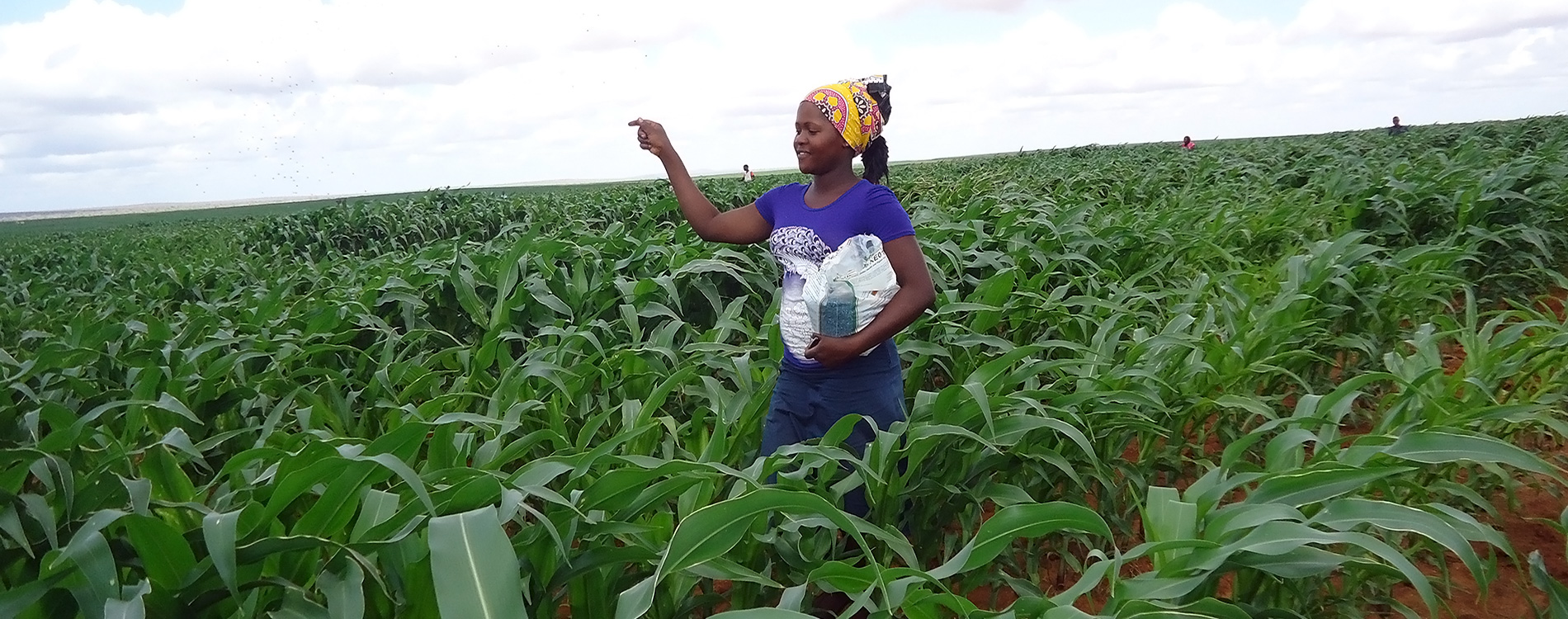
Application of Aflasafe KE01 on a maize field by Sarah Chughu. (Photo: U Mutuku/IITA)
Africa’s food and nutrition security have been worsened by COVID-19 supply-chain disruptions, movement restrictions, and associated economic downturns. Perhaps even more urgently than before, Africa must accelerate the development and dissemination of agricultural technologies and innovations.
For this reason, CGIAR’s International Institute of Tropical Agriculture (IITA) and the Fondation Bill & Melinda Gates are co-organizing a series of virtual workshops from 2 to 4 March 2021 to share experiences and lessons learned from scaling and commercializing agricultural technologies to improve food safety and nutrition.
Entitled Scaling of Agricultural Innovations through Commercialization for Sustainable Food-System Transformation, the series of three webinars will cover private-sector engagement, and how to create an enabling environment for the transformation of food systems through commercialization and strategic partnerships.
“Strengthening food systems to meet the challenges of the 21St century will require continued investment in adaptive and appropriate agricultural technologies,” observed Nteranya Sanginga, Director General of IITA. “For such technologies to be widely adopted and scaled, they must be rooted in a strong understanding of the market dynamics and enabling country systems. Coordinated and concerted effort from a range of actors including governments, private sector companies, investors, donors, researchers and civil society, will be required to jointly bring the most promising solutions to scale,” Sanginga continued.
Food safety is now a precondition for access to global food markets, and increasingly, to high-value domestic markets in developing countries. Foodborne diseases afflict 91 million Africans every year, with 137,000 dying—one-third of the global death toll.
If left unaddressed, food-safety barriers will continue to impede intra-African trade, even as the African Continental Free Trade Area came into force last month, in January 2021. Therefore, as we rethink the future of global food systems, food safety needs to be given priority to help attain the United Nations Sustainable Development Goals.
“One of the main hindrances to food safety is aflatoxin contamination, which afflicts some of the continent’s key staples such as maize, groundnuts, and sorghum,” said Matieyedou Konlambigue, Managing Director, Aflasafe Technology Transfer Program.
Aflatoxin is a natural poison from toxin-producing types of the Aspergillus fungus. Because aflatoxin contaminates food, consistent exposure results in the poison building up in our bodies and damaging our health, sometimes leading to rapid death when build-up is acute.
According to the African Union’s Partnership for Aflatoxin Control in Africa, aflatoxin alone is responsible for 30% of liver cancer cases globally, with the highest incidence (more than 40%) occurring in Africa. Trade-wise, Africa loses an estimated USD 670 million in potential export trade alone due to aflatoxin contamination. “If we are to effectively fight aflatoxin, there must be cross-sectoral convergence in technology, markets, policy and institutions, as well as behavior change,” says Sanginga.
Researchers have developed smallholder-friendly technological breakthroughs and practices that—together—reduce aflatoxin contamination along the agricultural value chains from plot to plate. Proper postharvest grain drying, sorting, and storage all control aflatoxin contamination. Hermetic storage technologies developed and promoted by several organizations such as the Purdue Improved Crop Storage (PICS) from Purdue University halt contamination. There are new tools for farmers themselves to monitor postharvest grain moisture content. There is also Aflasafe®—the commercial name for a natural product applied pre-harvest, already in use in several African countries. Aflasafe was developed by IITA, in partnership with the Agricultural Research Service of the United States Department of Agriculture (USDA–ARS) and respective national institutions in Africa. Aflasafe consistently reduces aflatoxin contamination in groundnuts, maize, and sorghum by between 80% and 100% when the crop is in the field. An integrated aflatoxin management system combining these technologies along the entire value chain would significantly contribute to producing safe and nutritious food in Africa.
During this webinar series, speakers and participants from the research, private sector, national governments, non-governmental organizations, development finance institutions and funders will discuss the scaling experience of these innovations. They will also deliberate on the future of innovations development and commercialization to improve food safety and nutrition.
‘’The outcomes of this event will contribute to our ongoing efforts to ensure scalability and sustainability of our investments,” added Sanginga.
The webinar series will also be highly relevant to discussions in the lead-up to the upcoming United Nations Food Systems Summit, especially Action Track 1: Ensure access to safe and nutritious food for all.
For more information on the webinars, contact Njeri Okono, n.okono@cgiar.org
À propos de l'IITA
Le Institut international d'agriculture tropicale est une institution à but non lucratif qui génère des innovations agricoles pour relever les défis les plus pressants de l'Afrique en matière de faim, de malnutrition, de pauvreté et de dégradation des ressources naturelles. En collaboration avec divers partenaires à travers l'Afrique subsaharienne, nous améliorons les moyens de subsistance, renforçons la sécurité alimentaire et nutritionnelle, augmentons l'emploi et préservons l'intégrité des ressources naturelles. L'IITA est membre du CGIAR, un partenariat mondial de recherche agricole pour un avenir axé sur la sécurité alimentaire.
Contacts presse
Njeri Okono, Communication Consultant, n.okono@cgiar.org
Katherine Lopez, Head of Communication, k.lopez@cgiar.orgHashtags
Follow the webinar series on Twitter: #ScalingAgInnovations #CommercializingAgInnovations #FoodSystems #FoodSystemTransformation
Olamide Deborah Nwanze est une chercheuse principale spécialisée dans la recherche sur l'approche "genre" afin d'éclairer les politiques de sélection participative et inclusive, de développement de variétés et de systèmes semenciers concernant les cultures de racines, tubercules et bananes (RTB) au siège de l'Institut International d'Agriculture Tropicale, à Ibadan, au Nigeria. Elle est candidate au doctorat à l'Université d'Ibadan et titulaire d'un master et d'un diplôme d'ingénieur agronome en vulgarisation agricole et développement rural. Olamide est membre du programme African Women in Agricultural Research and Development – Gender Responsive Agricultural Systems Policy (SAISIE DE RÉCOMPENSEet les Chercheuses Sensibles au Genre Équipées pour la Transformation Agricole (SUPER. Elle cherche à appliquer ses apprentissages en matière d’approche genre, recherche sensible au genre, et expertise en développement et examen de politiques pour faciliter l’accès et l’adoption par les femmes, les jeunes, les enfants et les groupes sociaux vulnérables aux innovations agricoles qui garantissent la sécurité alimentaire, nutritionnelle, des revenus et des moyens de subsistance en Afrique. Ses rôles actuels comprennent le mentorat de chercheurs stagiaires, le développement de guides et manuels de formation, la mise en œuvre et l'adaptation de cadres et d'outils genre, l'engagement des acteurs de la chaîne de valeur en tant que partenaires de la science citoyenne, l'examen et la refonte des politiques, la gestion et l'analyse des données. Ses recherches actuelles portent sur les méthodes mixtes ainsi que sur les approches participatives et interdisciplinaires pour saisir et mettre en évidence les dynamiques de genre, les besoins, les préférences et les défis rencontrés par les parties prenantes au sein de la chaîne de valeur des moyens de subsistance agricoles afin de prioriser des stratégies axées sur le genre dans les programmes de sélection, la conception et la mise en œuvre des politiques.
de Sousa, K., van Etten, J., Manners, R. Bello, A., Teeken, B., Olaosebikan, O., et al. 2024. L'approche tricot : un cadre agile pour les essais décentralisés à la ferme soutenus par la science citoyenne. Une rétrospective. Agron. Sustain. Dev. 44, 8. https://doi.org/10.1007/s13593-023-00937-1
Madu, T., Onwuka, S., Nwafor, S., Onyemauwa, N., Ejechi, M., Ofoeze, M., Ukeje, B., Eluagu, C., Olaosebikan, O., Okoye, B., 2024. Les études sur les consommateurs inclusifs en matière de genre améliorent l'amélioration du manioc au Nigeria dans : Frontiers in Sociology, volume 9, numéro : 1224504, doi : 10.3389/fsoc.2024.1224504
Olaosebikan, O. ; Bello, A. ; Utoblo, O. ; Okoye, B. ; Olutegbe, N. ; Garner, E. ; Teeken, B. ; Bryan, E. ; Forsythe, L. ; Cole, S. ; Madu, T. 2023. Facteurs de stress et résilience au sein de la chaîne de valeur du manioc au Nigeria : Caractéristiques préférées des variétés de manioc et stratégies de réponse des hommes et des femmes pour informer l'amélioration variétale. Sustainability 15, 7837. https://doi.org/10.3390/su15107837
Okoye, B., Ofoeze, M., Ejechi, M., Onwuka, S., Nwafor, S., Onyemauwa, N., Ukeje, B., Eluagu, C., Obidiegwu, J.*, Olaosebikan, O., Madu, T.* 2023. Priorisation des traits préférés dans la chaîne de valeur de l'igname au Nigeria : une analyse de la situation en matière de genre in: Frontiers in Sociology, volume 8, numéro : 1232626, pages 1 – 9, ISSN 2297-7775, 2023. https://www.frontiersin.org/articles/10.3389/fsoc.2023.1232626/full
Olaosebikan, O., Bello, A. A., de Sousa, K., Ndjouenkeu, R., Adesokan, M., Alamu, E. O., Agbona, A., van Etten, J., Kegah, F. N.*, Dufour, D., Bouniol, A., Teeken, B. 2023. Acceptabilité par les consommateurs des produits alimentaires à base de gari-eba de manioc dans des contextes culturels et environnementaux variés en utilisant l'approche triade de comparaison des technologies (tricot) dans : Journal of the Science of Food and Agriculture,
Teeken, B., Olaosebikan, O., Bello, A. A., Madu, T.*, Cole, S. M. 2023. Évaluation qualitative de la positionnalité et des préférences des dyades en relation avec les activités liées au manioc : travailler avec des scientifiques citoyens du procès tricot https://hdl.handle.net/10568/138326 Type : Manuel
Bouniol, A., Ceballos, H., Bello, A. A., Teeken, B., Olaosebikan, O., Owoade, D., Agbona, A., Fotso Kuate, A., Madu, T.*, Okoye, B.*, Ofoeze, M.*, Nwafor, S.*, Onyemauwa, N.*, Adinsi, L.*, Forsythe, L., Dufour, D. 2023. Impact variétal sur le travail des femmes, la charge de travail et la pénibilité associée dans le traitement des plantes à racines, tubercules et bananes : focus sur le manioc en Afrique subsaharienne dans : Journal of the Science of Food and Agriculture, pages 1 – 25, ISSN 0022-5142,
Bello, A. A., Agbona, A., Olaosebikan, O., Edughaen, G., Dufour, D., Bouniol, A., Iluebbey, P., Ndjouenkeu, R.*, Rabbi, I. Y., Teeken, B. 2023. Effets génétiques et environnementaux sur la productivité de la transformation et le rendement des produits alimentaires : la pénibilité du travail des femmes dans : Journal of the Science of Food and Agriculture, pages 1 – 32, ISSN 0022-5142, 5
Cavicchioli, M., Zimbiti, T., Teeken, B., Nwanze, D.O., Liani, M., Parkes, E. & Bello, A. 2023. Rapport sur la formation en sélection génétique sensible au genre à l'IITA. Genetic Resources Center, IITA-HQ, Ibadan, 21-23 septembre 2022. Ibadan, Nigéria : IITA, (34 p.).https://hdl.handle.net/10568/131368
Agbona, A. Peteti P., Teeken B., Olaosebikan O. Bello, A. A., Parkes, E., Rabbi, I. Y., Mueller, L., Egesi, C., Kulakow, P. 2022. Gestion des données dans les programmes d'amélioration des cultures RTB africaines multidisciplinaires. In : Williamson, H.F., Leonelli, S. (eds) Towards Responsible Plant Data Linkage: Data Challenges for Agricultural Research and Development. Springer, Cham. https://doi.org/10.1007/978-3-031-13276-6_5
Lora Forsythe, Pricilla Marimo, Sarah Mayanja, Olamide D. Olaosebikan, Esme Stuart, Bela Teeken, Benjamin Okoye, Tessy Madu, (2021). Analyse transversale du genre dans RTBfoods Étape 2 Cartographie des genres sur les produits RTB. Comprendre les moteurs des préférences en matière de traits et le développement de profils de produits RTB multi-utilisateurs, WP1. Londres, Royaume-Uni : Rapport scientifique de terrain RTBfoods, 30 p.
Teeken, B., Garner, E., Agbona, A., Balogun, I., Olaosebikan, O., Bello, A., Madu, T., Okoye, B., Egesi, C., Kulakow, P. et Tufan, H.A. 2021. Au-delà des “ traits des femmes ” : explorer comment le genre, les différences sociales et les caractéristiques des ménages influencent les préférences pour les traits. Frontiers Systèmes alimentaires durables 5:740926. https://doi.org/10.3389/fsufs.2021.740926
Teeken, B., Agbona, A., Bello, A., Olaosebikan, O., Alamu, E., Adesokan, M., Awoyale, W., Madu, T., Okoye, B., Chijioke, U., Owoade, D., Okoro, M., Bouniol, A., Dufour, D., Hershey, C., Rabbi, I., Maziya‐Dixon, B., Egesi, C., Tufan, H. et Kulakow, P. (020. Comprendre les préférences variétales du manioc par le classement par paires du gari-eba et du fufu préparés par des agriculteurs-transformateurs locaux. Int J Food Sci Technol.https://doi.org/10.1111/ijfs.14862
Bela Teeken, Olamide Olaosebikan, Ireti Balogun, Benjamin Okoye, Tessy Madu, Steven Cole, Abolore Bello, Elizabeth Parkes. (2020). Pilotage des outils de profil client et produit G+ pour l'amélioration sensible au genre du manioc au Nigeria. Nigeria : Institut international d'agriculture tropicale (IIAT). https://hdl.handle.net/20.500.11766/13000