
To ensure food security and improve the nutrition of Africans, the Genetic Resource Center (GRC) organized a workshop on “Participatory variety selection of African Yam Bean (AYB)” on 20–21 December. The workshop aimed to provide enough seeds of AYB to farmers for increased income and food security. However, this has been hitherto impossible because there are no registered or officially released improved varieties of AYB in Nigeria, a prerequisite for commercial seed production within the formal seed system.
IITA West Africa Hub Director Michael Abberton appreciated the organizers for the excellent effort put into the workshop. He stated that the workshop would serve as a platform for interaction to improve the potentials of AYB.
IITA Seed Bank Manager Olaniyi Oyatomi mentioned some of the workshop’s objectives and the workshop’s outputs to significantly improve farmers’ interest in traits and nutrients that are beneficial to the consumers. “We hope that AYB will be extended to the world and enhance nutritional security,” he stated.
YIIFSWA II Project Tissue Culture Specialist Morufat Balogun, who managed the recently concluded “Bean-preneurs” project, noted that GRC collections of AYB were evaluated for their potential to mitigate the challenges associated with AYB. These challenges include long gestation, long cooking time, and short shelf-life of the tubers produced by some of the collections. On-station and on-farm trials are required before registration of varieties in Nigeria, so the workshop was to co-identify preferred accessions based on farmer and researcher perception using the current on-station experiment. Furthermore, she explained that AYB could be intercropped with some staple crops such as yam, cassava, and maize to improve the soil fertility due to AYB’s nodule-forming properties.
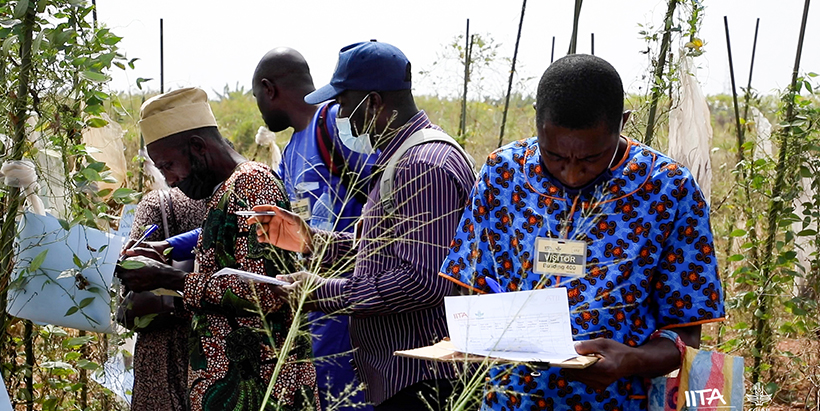
Wumi Jegede, a PhD student at the University of Ibadan and Research Fellow with the GRC, explained that the experiment’s main objective was to understand how Genotype and Environment (G × E) affects dry matter partitioning into seed and tuber in AYB. She highlighted that the experiment was carried out in Ibadan and Ikenne, using forty accessions collected all over Nigeria and randomized in three replicates. Furthermore, she mentioned that criteria for the selection included short gestation period, disease incidence, and seed and tuber yield in choosing the best variety for AYB.
Dr Ibidun Adetiloye, a Plant Breeder representing the National Center for Genetic Resources and Biotechnology having the mandate to register and release improved varieties in Nigeria, suggested that more farmers should be involved in on-farm trials. The Institute of Agricultural Research and Training, Moor Plantation, Ibadan, was also represented at the workshop.
Dr Muhammed Sanusi, an Extension Specialist from the University of Ibadan, explained the procedures for selection to the participants using a Focus Group Discussion.
At least five best-performing accessions are expected to be selected and pushed for on-farm trials.
Contribué par
Histoires récentes