
Field days are farm events organized by producers and agricultural institutes to educate farmers on good agricultural practices (GAP) and promote the adoption of recommended improved crop varieties by smallholder farmers.
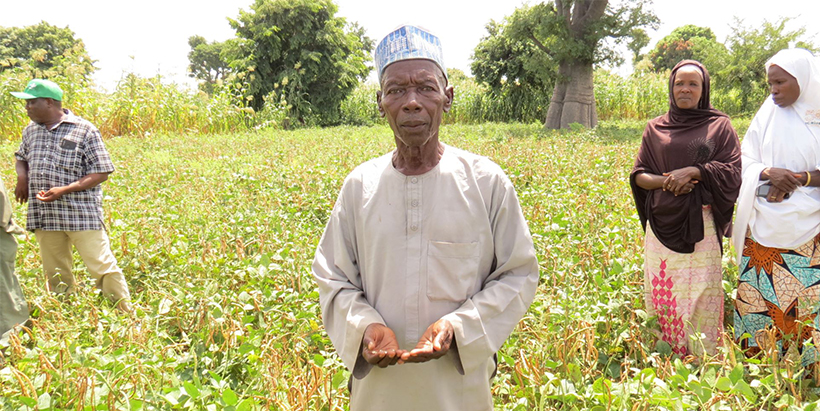
The Accelerated Varietal Improvement and Seed Delivery of Legumes and Cereals in Africa (AVISA) project organized a farmers’ field day on 7 October on its Cowpea demonstration plots to showcase GAP as part of increasing consumer awareness and access to improved cowpea varieties in the project.
The cowpea demonstration plots are situated in the Bichi LGA of Badume Community of Kano State. Thirty-four farmers and three growers participated in the field day, which focused on GAP for enhanced production of climate-smart improved cowpea varieties (FUAMPEA1 and SAMPEA 14) introduced to the community. The farmers were amazed to see the two new cowpea varieties completely free of the parasitic weed (Striga gesnerioides) while their existing variety, used as farmers’ choice, was devasted by Striga.
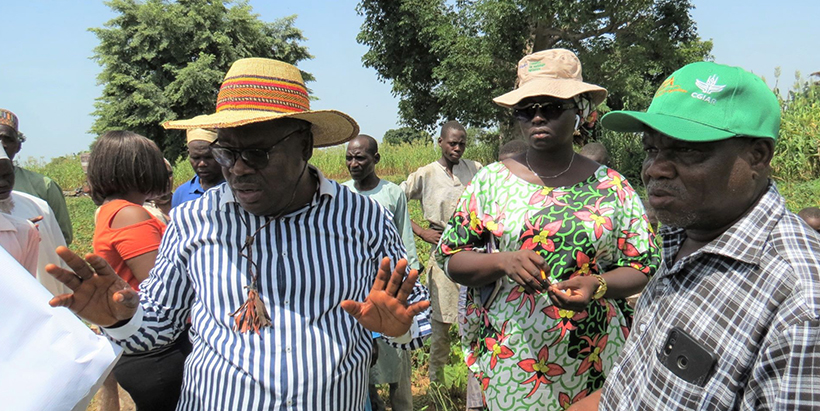
The participating farmers now have enhanced knowledge of good practices and access to climate-smart varieties. They will share their learnings with neighboring farmers by disseminating the technology for enhancing cowpea production in the areas.
In his welcome remarks at the AVISA Farmers’ Field Day ceremony, IITA Seed Systems Agronomist Lucky Omoigui gave an overview of the project and a cowpea demonstration. Omoigui emphasized the essence of the field day and the new varieties introduced to increase yield (productivity) and incomes and livelihood of the smallholder farmers.
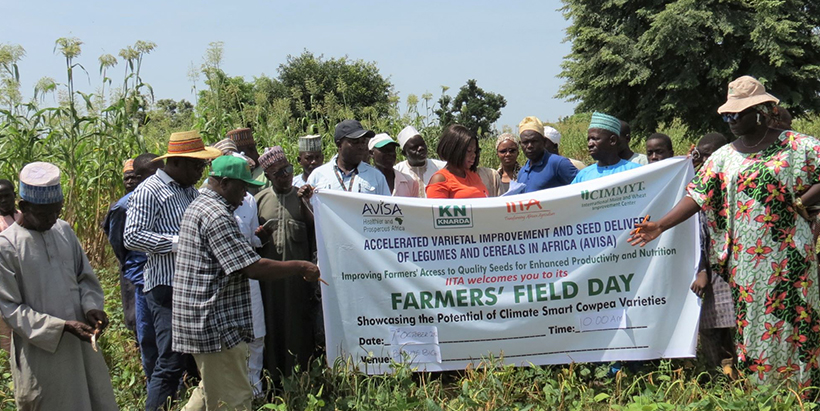
He advised the farmers to take advantage of the varieties to improve their yield and encourage more women to participate in producing the new cowpea varieties in the community to avoid being marginalized. The AVISA project emphasizes inclusiveness so that both men and women can have improved livelihoods. Among the varieties introduced to the community, the farmers were very impressed with the performance of FUAMPEA1 and SAMPEA14, more importantly, due to their early maturing and high pod load, which will translate to high grain yield.
All the farmers expressed their gratitude, and when asked which of the varieties they preferred, they said FUAMPEA1 and SAMPEA14 instead of their own farmers’ choice cultivar. They promised to continue good agricultural practices to maximize the yield potential.
The AVISA project is funded by the Bill & Melinda Gates Foundation, implemented by OneCGIAR—International Maize and Wheat Improvement Center (CIMMYT), International Center for Tropical Agriculture (CIAT), and IITA—in partnership with Syngenta Foundation for Sustainable Agriculture (SFSA), private seed companies, and the National Agricultural Research System (NARS).
Proposé par Sarah Sallau
Contribué par
Histoires récentes