ATAC project trains Ministries of research and agriculture agents on seed production techniques
septembre 29, 2023
A training on seed production techniques, management of diseases, pests, and weeds of cassava, corn, and soybean was held from 5 to 10 June in Nkayi. Initiated by IITA–CGIAR through its Agenda for the Transformation of Agriculture in Congo (ATAC), the training brought together thirty participants from the Ministries responsible for Agriculture and Scientific Research. This training was conducted by a team of African experts led by ATAC Coordinator Pheneas Ntawuruhunga.
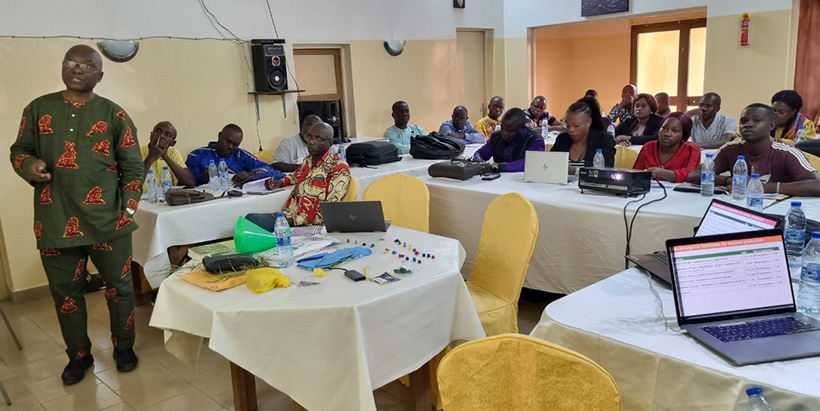
A view of one of the indoor training sessions with Professor Elekeleme.
Participants attended modules presented by several African experts from Cameroon, DRC, Nigeria, etc., to enrich their knowledge in an expanding agricultural sector. The training included field visits to the sites of the National Institute of Scientific Research (IRA) and N-SAT in the Loudima district in the department of Bouenza.
The team included Professor Friday Ekeleme and Drs Jean Pierre Kabongo, Samuel Nanga Nanga, Sikirou Mouritala, Abebe Tesfaye, Emmanuel Nsanga, and Léon Nabahungu.
Following the recent signing of an agreement with the Integrated Development Project for Agricultural Value Chains in Congo (PRODIVAC), PRODIVAC Communication and Knowledge Sharing Expert Hugues Koudimbila also attended the meetings.
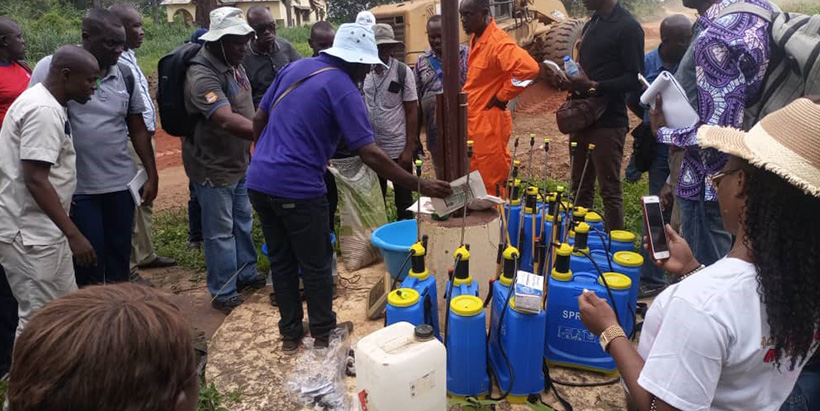
Demonstration on the use of a sprayer by Dr Nanga at IRA station.
Responses tailored to participants’ concerns
One of the sources of concern in agriculture is the emergence of certain diseases and the solutions to be found to eradicate them. Most sub-Saharan countries experience similar situations as demonstrated during the presentations and discussions.
Beyond the issue relating to seed diseases, pests are also another widespread phenomenon. The fall armyworm (FAW) is the most widespread corn pest in Congo. For the control of the fall armyworm, we use integrated control through the use of good agricultural practices (for small producers); the right seed, respecting the sowing date, good fertilization, crop rotation; the use of organic pesticides (chili pepper, tobacco, ash, sand, detergent, etc.); the application of chemicals to large areas; the use of biofertilizers (Titonia, poultry droppings and others); biological control against the presence of natural enemies; the insect that parasitizes the eggs and larvae, the insect that kills the eggs, the insect that eats the larvae, etc.); physical struggle (ploughing).
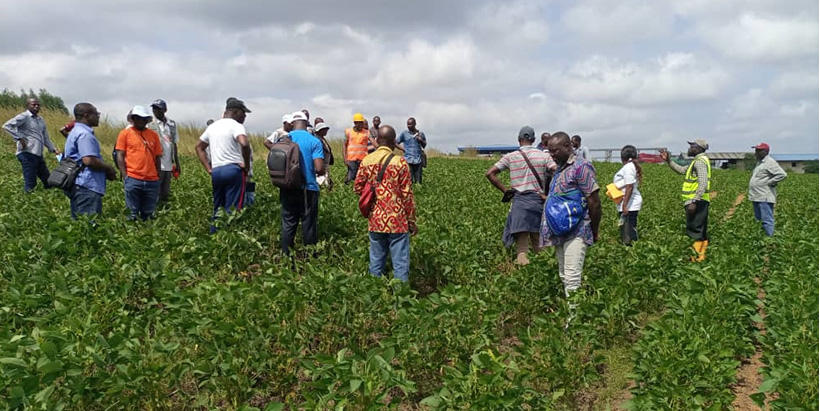
Participants appreciating the performance of the soybean variety in one of the fields at the N-SAT site.
Concerning soya, the known pests are aphids, mites, leaf beetles, bugs, pod bugs, which are very destructive. The method of control is integrated insect management.
Apart from these diseases which affect the life of these agro-food value chains, the training also focused on other modules such as soil degradation, integrated management of soil fertility, the importance of soil analysis and fertilizer formulation, selection of new preferred varieties, etc.
However, it is hoped that integrated pest management should lead to responsible use of chemicals in order to protect the environment and human health.
Unfortunately, this question on the environmental and social safeguards to be implemented during the use of chemical products (fertilizers, pesticides and others) was not sufficiently explored during the training. So much so that PRODIVAC has made it a major concern.
All the presentations that were made during this training were mentioned in a duly established program, on which the IITA experts relied to organize their presentations around the following themes: “Weed management in seed production cassava, corn and soybeans”; “Establishment of a corn production farm”; “Establishment of a cassava production farm”; “Establishment of a soybean production farm”; “Soil fertility management and fertilizer use in corn, cassava and soybean”; “Integrated disease and pest management in cassava production systems”.
Field test of the lessons received
After the classroom training, participants went to two IITA seed sites in the surroundings of the Loudima district, namely: the IRA site which includes the corn field and that of N-SAT, home to two soybean fields. On site, they were able to experience the lessons received by expressing some curiosities to the experts in order to obtain clarifications relating to them. The latter, to be more explicit, proceeded with physical and material demonstrations, to make themselves better understood. This is the case of Dr Jean Pierre Kabongo who spoke about the growing difficulties of soya on the N-SAT site.
Similar to the demonstration on the IRA website by Professor Ekeleme on the use of the knapsack sprayer, often used to spread certain products such as pesticides. This material caught the attention of the participants who asked questions on wearing the appropriate gear, the correct dosage of the product to be sprayed, as well as certain adjustments to be made to the device. A simulation of spraying a (virtual) field was done for everyone.
In the IRA corn field, in Loudima, participants noticed growth problems with the stalks and that certain rows were missing corn stalks, not to mention the leaves attacked by pests.
On the N-SAT site, in the same locality, practical training took place around soya. On this occasion, two fields were visited by the participants, with particular characteristics for each. The first field, at the entrance to the site, is the best developed, with stems of an acceptable height, due to relatively abundant rainfall. The second field gave rise to two lessons: first at the entrance to the field, the stems show a real slow growth, then from the middle of the field to the wide, the stems are of average size. The technical workers met on site, and whose mission is to ensure the proper maintenance of these fields, emphasized that this field is in an area of low rainfall. Therefore, a lot of watering is required to allow this soybean to grow sufficiently.
An expert even said: the less rain there is, the greater the risk of having small pods, sometimes without contents.
Despite everything, when taking stock of this training, great satisfaction was expressed among all the participants. Some hoped that this type of training should be increased to enable the Congolese farmer to be able to practice healthy and largely productive agriculture.
The only false note noted by some participants was in the use of the English language, because the training which took place in this language was not well assimilated, despite the effort of translation. Just like for the experts who intervened by videoconference and who technically had enormous transmission problems.
At the end of the training, all thirty (30) participants received certificates of participation.
For further information contact: (p.ntawuruhunga@cgiar.org)
Contributed by Pheneas Ntawuruhunga
Olamide Deborah Nwanze est une chercheuse principale spécialisée dans la recherche sur l'approche "genre" afin d'éclairer les politiques de sélection participative et inclusive, de développement de variétés et de systèmes semenciers concernant les cultures de racines, tubercules et bananes (RTB) au siège de l'Institut International d'Agriculture Tropicale, à Ibadan, au Nigeria. Elle est candidate au doctorat à l'Université d'Ibadan et titulaire d'un master et d'un diplôme d'ingénieur agronome en vulgarisation agricole et développement rural. Olamide est membre du programme African Women in Agricultural Research and Development – Gender Responsive Agricultural Systems Policy (SAISIE DE RÉCOMPENSEet les Chercheuses Sensibles au Genre Équipées pour la Transformation Agricole (SUPER. Elle cherche à appliquer ses apprentissages en matière d’approche genre, recherche sensible au genre, et expertise en développement et examen de politiques pour faciliter l’accès et l’adoption par les femmes, les jeunes, les enfants et les groupes sociaux vulnérables aux innovations agricoles qui garantissent la sécurité alimentaire, nutritionnelle, des revenus et des moyens de subsistance en Afrique. Ses rôles actuels comprennent le mentorat de chercheurs stagiaires, le développement de guides et manuels de formation, la mise en œuvre et l'adaptation de cadres et d'outils genre, l'engagement des acteurs de la chaîne de valeur en tant que partenaires de la science citoyenne, l'examen et la refonte des politiques, la gestion et l'analyse des données. Ses recherches actuelles portent sur les méthodes mixtes ainsi que sur les approches participatives et interdisciplinaires pour saisir et mettre en évidence les dynamiques de genre, les besoins, les préférences et les défis rencontrés par les parties prenantes au sein de la chaîne de valeur des moyens de subsistance agricoles afin de prioriser des stratégies axées sur le genre dans les programmes de sélection, la conception et la mise en œuvre des politiques.
de Sousa, K., van Etten, J., Manners, R. Bello, A., Teeken, B., Olaosebikan, O., et al. 2024. L'approche tricot : un cadre agile pour les essais décentralisés à la ferme soutenus par la science citoyenne. Une rétrospective. Agron. Sustain. Dev. 44, 8. https://doi.org/10.1007/s13593-023-00937-1
Madu, T., Onwuka, S., Nwafor, S., Onyemauwa, N., Ejechi, M., Ofoeze, M., Ukeje, B., Eluagu, C., Olaosebikan, O., Okoye, B., 2024. Les études sur les consommateurs inclusifs en matière de genre améliorent l'amélioration du manioc au Nigeria dans : Frontiers in Sociology, volume 9, numéro : 1224504, doi : 10.3389/fsoc.2024.1224504
Olaosebikan, O. ; Bello, A. ; Utoblo, O. ; Okoye, B. ; Olutegbe, N. ; Garner, E. ; Teeken, B. ; Bryan, E. ; Forsythe, L. ; Cole, S. ; Madu, T. 2023. Facteurs de stress et résilience au sein de la chaîne de valeur du manioc au Nigeria : Caractéristiques préférées des variétés de manioc et stratégies de réponse des hommes et des femmes pour informer l'amélioration variétale. Sustainability 15, 7837. https://doi.org/10.3390/su15107837
Okoye, B., Ofoeze, M., Ejechi, M., Onwuka, S., Nwafor, S., Onyemauwa, N., Ukeje, B., Eluagu, C., Obidiegwu, J.*, Olaosebikan, O., Madu, T.* 2023. Priorisation des traits préférés dans la chaîne de valeur de l'igname au Nigeria : une analyse de la situation en matière de genre in: Frontiers in Sociology, volume 8, numéro : 1232626, pages 1 – 9, ISSN 2297-7775, 2023. https://www.frontiersin.org/articles/10.3389/fsoc.2023.1232626/full
Olaosebikan, O., Bello, A. A., de Sousa, K., Ndjouenkeu, R., Adesokan, M., Alamu, E. O., Agbona, A., van Etten, J., Kegah, F. N.*, Dufour, D., Bouniol, A., Teeken, B. 2023. Acceptabilité par les consommateurs des produits alimentaires à base de gari-eba de manioc dans des contextes culturels et environnementaux variés en utilisant l'approche triade de comparaison des technologies (tricot) dans : Journal of the Science of Food and Agriculture,
Teeken, B., Olaosebikan, O., Bello, A. A., Madu, T.*, Cole, S. M. 2023. Évaluation qualitative de la positionnalité et des préférences des dyades en relation avec les activités liées au manioc : travailler avec des scientifiques citoyens du procès tricot https://hdl.handle.net/10568/138326 Type : Manuel
Bouniol, A., Ceballos, H., Bello, A. A., Teeken, B., Olaosebikan, O., Owoade, D., Agbona, A., Fotso Kuate, A., Madu, T.*, Okoye, B.*, Ofoeze, M.*, Nwafor, S.*, Onyemauwa, N.*, Adinsi, L.*, Forsythe, L., Dufour, D. 2023. Impact variétal sur le travail des femmes, la charge de travail et la pénibilité associée dans le traitement des plantes à racines, tubercules et bananes : focus sur le manioc en Afrique subsaharienne dans : Journal of the Science of Food and Agriculture, pages 1 – 25, ISSN 0022-5142,
Bello, A. A., Agbona, A., Olaosebikan, O., Edughaen, G., Dufour, D., Bouniol, A., Iluebbey, P., Ndjouenkeu, R.*, Rabbi, I. Y., Teeken, B. 2023. Effets génétiques et environnementaux sur la productivité de la transformation et le rendement des produits alimentaires : la pénibilité du travail des femmes dans : Journal of the Science of Food and Agriculture, pages 1 – 32, ISSN 0022-5142, 5
Cavicchioli, M., Zimbiti, T., Teeken, B., Nwanze, D.O., Liani, M., Parkes, E. & Bello, A. 2023. Rapport sur la formation en sélection génétique sensible au genre à l'IITA. Genetic Resources Center, IITA-HQ, Ibadan, 21-23 septembre 2022. Ibadan, Nigéria : IITA, (34 p.).https://hdl.handle.net/10568/131368
Agbona, A. Peteti P., Teeken B., Olaosebikan O. Bello, A. A., Parkes, E., Rabbi, I. Y., Mueller, L., Egesi, C., Kulakow, P. 2022. Gestion des données dans les programmes d'amélioration des cultures RTB africaines multidisciplinaires. In : Williamson, H.F., Leonelli, S. (eds) Towards Responsible Plant Data Linkage: Data Challenges for Agricultural Research and Development. Springer, Cham. https://doi.org/10.1007/978-3-031-13276-6_5
Lora Forsythe, Pricilla Marimo, Sarah Mayanja, Olamide D. Olaosebikan, Esme Stuart, Bela Teeken, Benjamin Okoye, Tessy Madu, (2021). Analyse transversale du genre dans RTBfoods Étape 2 Cartographie des genres sur les produits RTB. Comprendre les moteurs des préférences en matière de traits et le développement de profils de produits RTB multi-utilisateurs, WP1. Londres, Royaume-Uni : Rapport scientifique de terrain RTBfoods, 30 p.
Teeken, B., Garner, E., Agbona, A., Balogun, I., Olaosebikan, O., Bello, A., Madu, T., Okoye, B., Egesi, C., Kulakow, P. et Tufan, H.A. 2021. Au-delà des “ traits des femmes ” : explorer comment le genre, les différences sociales et les caractéristiques des ménages influencent les préférences pour les traits. Frontiers Systèmes alimentaires durables 5:740926. https://doi.org/10.3389/fsufs.2021.740926
Teeken, B., Agbona, A., Bello, A., Olaosebikan, O., Alamu, E., Adesokan, M., Awoyale, W., Madu, T., Okoye, B., Chijioke, U., Owoade, D., Okoro, M., Bouniol, A., Dufour, D., Hershey, C., Rabbi, I., Maziya‐Dixon, B., Egesi, C., Tufan, H. et Kulakow, P. (020. Comprendre les préférences variétales du manioc par le classement par paires du gari-eba et du fufu préparés par des agriculteurs-transformateurs locaux. Int J Food Sci Technol.https://doi.org/10.1111/ijfs.14862
Bela Teeken, Olamide Olaosebikan, Ireti Balogun, Benjamin Okoye, Tessy Madu, Steven Cole, Abolore Bello, Elizabeth Parkes. (2020). Pilotage des outils de profil client et produit G+ pour l'amélioration sensible au genre du manioc au Nigeria. Nigeria : Institut international d'agriculture tropicale (IIAT). https://hdl.handle.net/20.500.11766/13000