
Value addition of agriculture products is crucial to the sector’s development in Tanzania and improving the livelihood of the country’s smallholder farmers. To contribute to agricultural transformation, IITA-Tanzania and the Alliance of Bioversity International and CIAT (ABC), through the Supporting and Strengthening Community Resilience in Tanzania (SSUCORETA) project purchased 14 processing machines for smallholder farmers and processors groups to increase processing efficiency in value addition of their products.
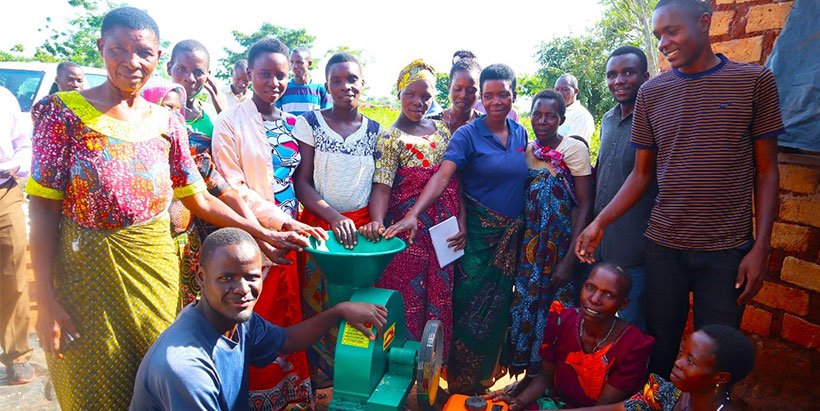
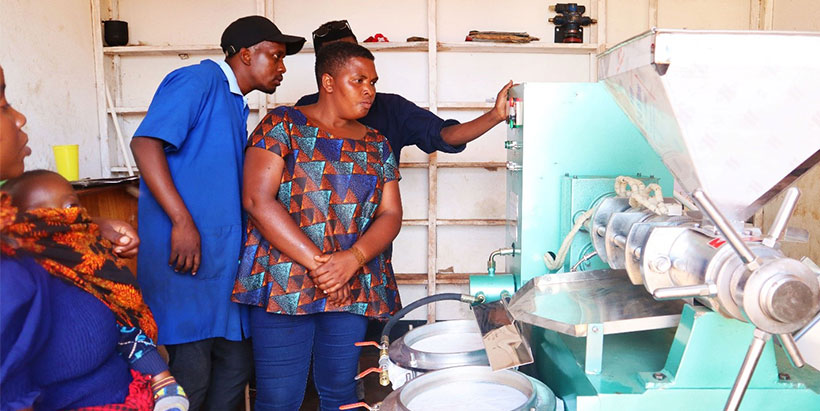
SSUCORETA handed over eight cassava milling machines and six sunflower oil presses to farmers and processors in six regions—Dodoma, Geita, Kagera, Manyara, Morogoro, and Mwanza. Production from the new machines will increase the value of agricultural commodities, boosting revenue and income for smallholder farmers and processors.
During the installation, the beneficiaries also received hands-on training on properly operating the machines. Speaking at the hand-over of cassava slicing machines to the Kolping Society of Tanzania group in the Kagera region, the project coordinator from IITA, Lembris Laizer, noted that the SSUCORETA project empowers farmers to add value to their crops, particularly cassava, sunflower, and beans.
“By its appearance, the machine seems too small, but once it starts processing, you will see how efficient it is. This machine can process cassava, sorghum, and carrots,” Lembris noted.
Lestuta Deogratius, a treasurer of the Kolping Society group from the Kagera region, applauded the new machines’ efficiency, noting that while their previous machines would take a day to process, the new machines take a few hours. They are also more efficient and less expensive to operate, yet process high-quality cassava flour. “Thanks to SSUCORETA, we will manage to get a good market for our cassava flour,” Deogratius said.
She added that the group plans to expand their production in cassava farms to increase cassava flour production and enhance their income.
Gabriel Matemu, a cassava value chain off-taker and Production Manager of Kipipa Millers LTD from the Mwanza region, noted that the company used to get poor quality cassava chips from the aggregated farmers due to poor post-harvest handling and considerable delays in producing enough quantity. But the new machines will improve the farmers’ chips quality.
“The new cassava slicing machine can process at least ten metric tons per day and boost cassava flour production because I will get quality cassava chips in large quantities. My advice to youths is to ensure a consistent supply of quality cassava chips, and our company will offer them competitive prices, form cooperatives, and engage in cassava and other crops farming to have decent employment and earn income,” Matemu said.
Kinyakala youth group leader Pendo Petro Mahiga, a farmer and processor from Rubeho village in Gairo District, grows cassava, sunflower, and maize. Unfortunately, their old machine was damaged, and they could not repair it because of the financial constraints caused by COVID-19. “We are happy with the new machine because it saves the group from the oil loss that used to happen while processing sunflowers. The new machine saves us from losing three liters for every 70 kg bag of sunflower grain of oil from leakage. It does both splitting and filtering of the oil at the same time, compared to the old machine,” she explained.
SSUCORETA is a two-year project (2022- 2023) funded by the International Fund for Agricultural Development (IFAD) with a major goal of restoring and increasing the productivity and profitability of key food and oilseed crops and enhancing market access for rural women and young farmers in Tanzania to mitigate the negative impact of COVID-19 and enhance resilience. The project is implemented in collaboration with Tanzania Agricultural Research Institute (TARI) and the Local Government Authorities (LGAs).
Contributed by Hadi Rashid
Contribué par
Histoires récentes