
Despite the tremendous volume of work scientists carry out across Africa to address food insecurity and gender inequality, among other issues, their research is not getting the visibility required to tell their impact stories. This is primarily due to the communication barrier between scientists and the public.
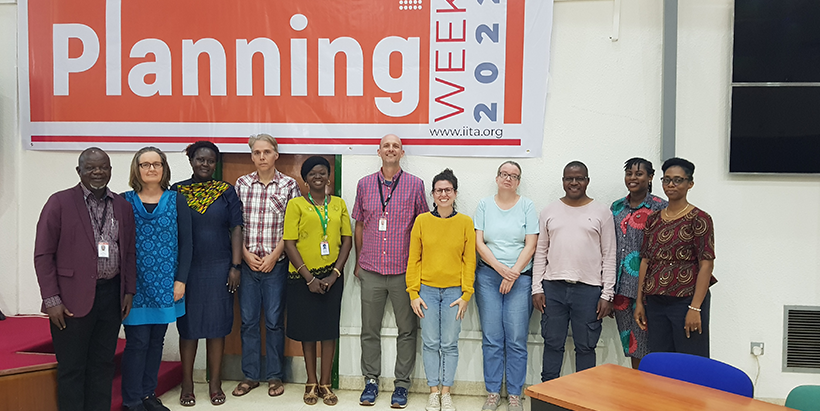
This barrier has been a major challenge as research stories are left untold or sometimes told in a language that the end users or beneficiaries cannot interpret.
With social media being a major channel for telling stories in real time to beneficiaries of agricultural research, understanding how to deploy their research using social media has become imperative for scientists.
Communication channels and methods are evolving, and it is essential for scientists to also adapt to the communication trends as they evolve. While communication specialists support agricultural research and promote impact stories, these results will gain greater visibility when scientists can tell their stories from the research fields.
To address this challenge, the IITA–CGIAR Communication Office organized a social media training for the Institute’s gender scientists on how to grow their social media presence and leverage the various platforms to promote their work.
The virtual training on 13 June had gender scientists from IITA’s hubs and stations across Africa. IITA Communication Assistant Ochuwa Favour Daramola anchored the training.
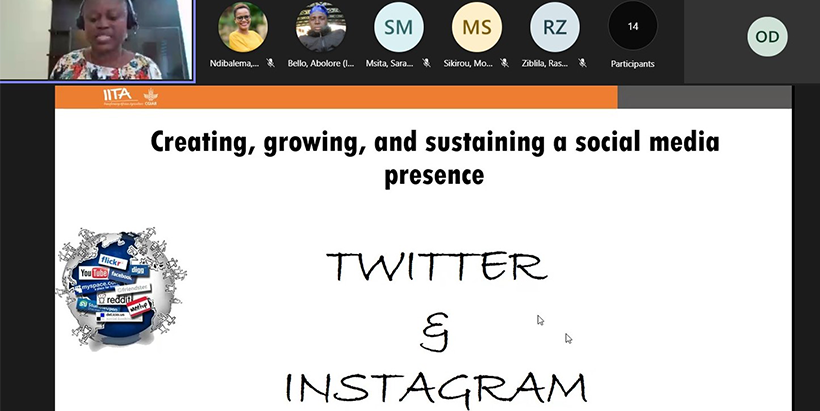
Emphasizing the goal of the training, Daramola stated that the training would help gender scientists understand how to leverage various social media platforms to communicate their research in simple language to the public for more visibility. “The training would focus on two social media platforms—Twitter and Instagram—as the knowledge of these two could be transferred to other social media platforms,” she said.
IITA Communication Officer Timilehin Osunde took the scientists through theory and practical sessions on Twitter and Instagram. She explained what the social media platforms are about, how to create accounts, language to use and avoid on the platforms, and the benefit of these platforms to the agricultural research work. “These social media platforms would help you gain visibility that could lead to interesting collaborations in your work,” she said.
Most scientists admitted previous lax use of their social media accounts, particularly Instagram, which they view as irrelevant for professional use. However, they acknowledged that they now realize how beneficial Instagram could be for promoting their professional work. With this new understanding of the benefit of social media, the scientists also requested training on how to use other social media platforms, such as LinkedIn.
Giving their feedback, Senior Research Supervisor in Cassava Breeding IITA headquarters, Bello Abolore, commended the facilitator for the highly educative and exciting training.
Research Assistant in IITA-Tanzania, Sarah Msita, also said the training was insightful as she now understands how to use social media better. Social Scientist and Gender Specialist in IITA-Ghana, Rashida Ziblila, appreciated the Communication Office for organizing such an impactful training.
Contribute by Ochuwa Favour Daramola
Contribué par
Histoires récentes