
IITA–CGIAR PhD student Michael Landi, with the support of IITA scientists Livia Stavolone, Trushar Shah, and Andreas Gisel and in collaboration with the Swedish University of Agricultural Sciences in Uppsala, Sweden, the University of Fribourg in Switzerland, and the Italian Research Council in Bari, Italy, generated a haplotype-resolved diploid assembly of the cassava cultivar TMEB117, a farmer-preferred cassava cultivar, using PacBio HiFi reads. The high-quality genome assembly was published in December 2023 and is a part of the EpiCass et CassavaNet4Dev projects, both funded by the Swedish Research Council.
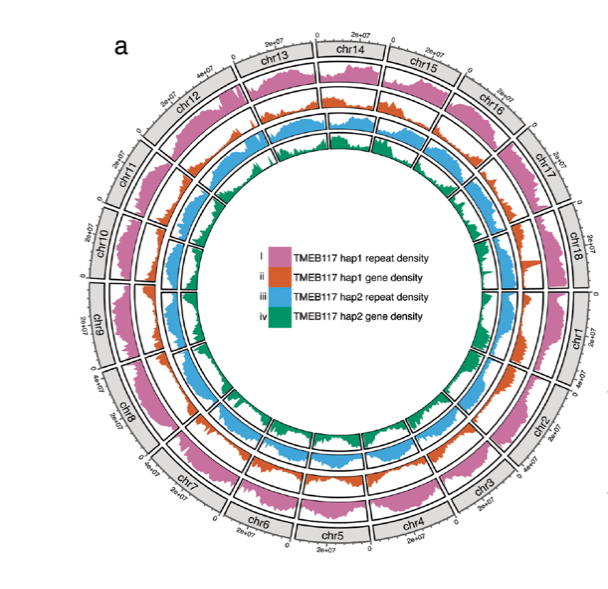
TMEB117 (also called TME117 or isunikankiyan) is a Nigerian cassava landrace highly susceptible to African cassava mosaic virus (ACMV). This genotype served as a reference for ACMV studies, and this high-resolution genome will pave the way for the ongoing investigations in epigenetics and small RNA expression analysis to learn more about the mechanisms of ACMV resistance in cassava and the large variability in storage root yield between plants of the same genotype in the same field. The outcome of these studies will give insight into the molecular mechanisms and create data and knowledge to support future breeding programs.
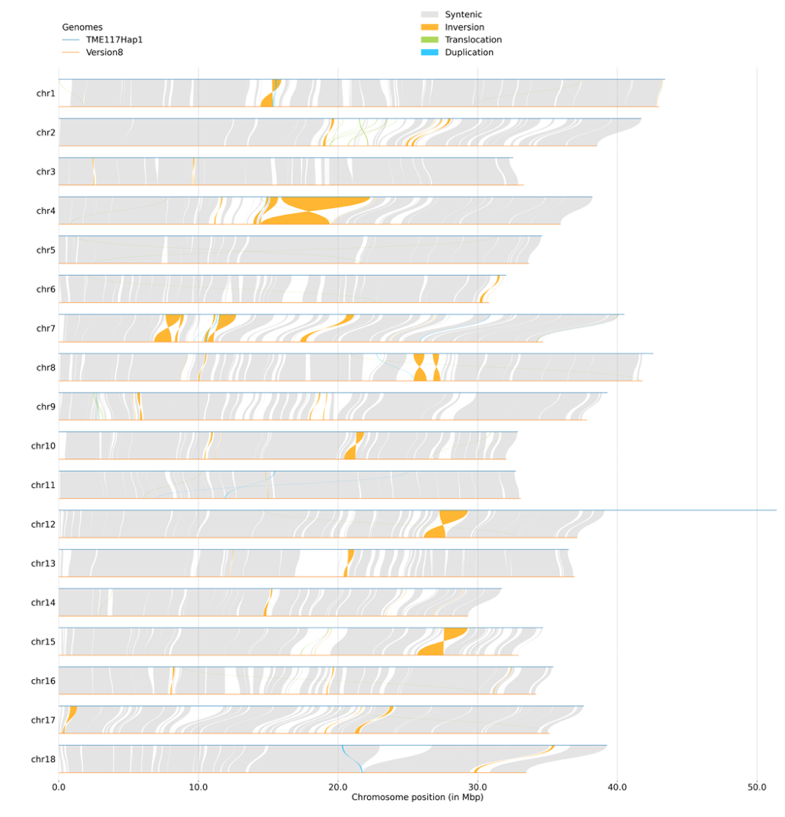
Despite the use of various sequencing technologies over time, there are unresolved gaps in the genome. The reference genome AM560-2, derived from a Colombian cassava line MCol505, has undergone steady improvement over a decade and has had five major releases, with the current version being AM560-2 version 8. While this reference genome benefits the cassava community, it lacks haplotypic separation and does not capture the genetic diversity in African cassava cultivars grown by smallholder farmers due to its homozygous nature.
Recently, attempts have been made to assemble genomes of African cassava lines such as TME3, 60444, TME7, and TME204, using a combination of Illumina short reads, PacBio long reads, bio-nano optical mapping, and chromatin conformation capture (Hi-C) sequence technologies. Only the last two attempts produced high-quality and haplotype-resolved reference genomes of African cassava genotypes.
Contributed by Andreas Gisel
Contribué par
Histoires récentes