
The U.S. National Academy of Medicine (NAM) recently convened the first in a series of four information-gathering workshops to shape the roadmap for transformative action to achieve health for all at net-zero emissions. Titled “The ‘what’ of systems transformation: Anchoring climate action in health,” the two-day event brought together global experts to explore how health can serve as both a foundation and a catalyst for transformative systems change that reduces emissions, enhances climate resilience, and promotes well-being.
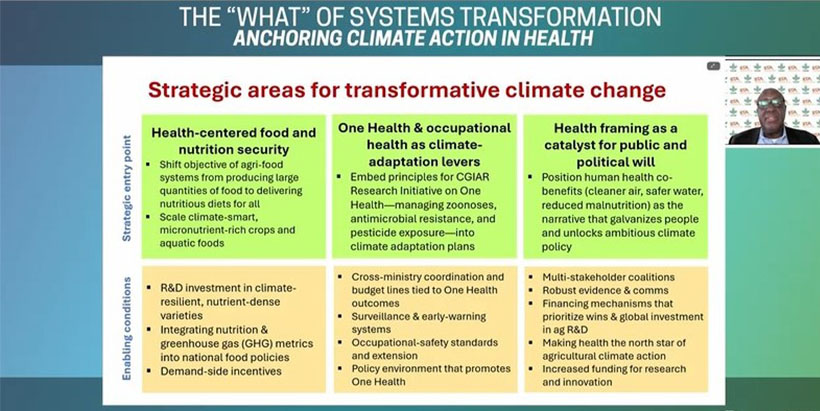
During a session on “Opportunities and challenges for transformative health-centered climate action across high-emitting sectors,” IITA Director General and CGIAR Regional Director for Africa, Dr Simeon Ehui, shared insights on agriculture’s pivotal role in the health-climate nexus.
Dr Ehui emphasized that agriculture must be reimagined through a health-focused lens as a major emitter and a sector deeply impacted by climate change. He illustrated how IITA’s climate-smart research is enabling transformative change by developing and scaling better-performing crop varieties. These farmer-preferred crop varieties are resilient to climate shifts, market demands, and evolving production systems.
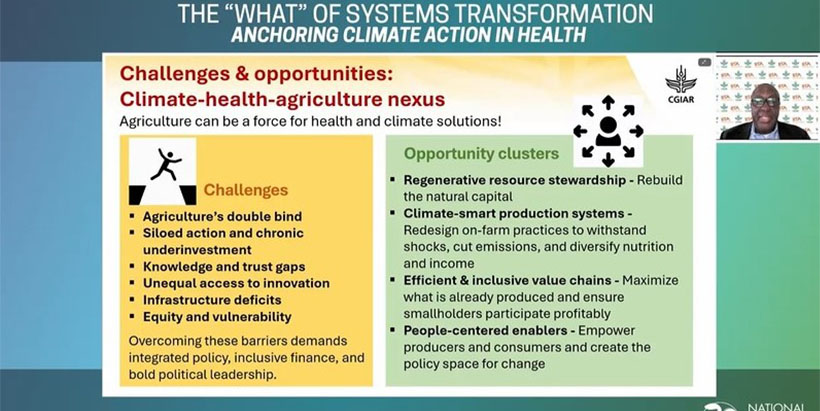
“Health can be a powerful anchor for climate action in agriculture,” Dr Ehui noted. “By prioritizing food systems that enhance nutrition, reduce environmental harm, and support farmer livelihoods, we can create mutually reinforcing solutions that drive progress across sectors.”
The NAM workshop focused on reframing climate action through a health-first approach. Experts identified the global economic sectors—energy, transportation, agriculture, and manufacturing—that are key drivers of climate change and discussed strategies to decarbonize these sectors while maximizing health co-benefits.
Le roadmap for transformative action to achieve health for all at net-zero emissions, spearheaded by NAM, is a bold global initiative designed to place health at the center of climate policy.
The roadmap aims to align economic, environmental, and health priorities for a more sustainable and equitable future by convening cross-sector leaders and leveraging evidence-based strategies.
Contribué par ‘Timilehin Osunde
Contribué par
Histoires récentes