
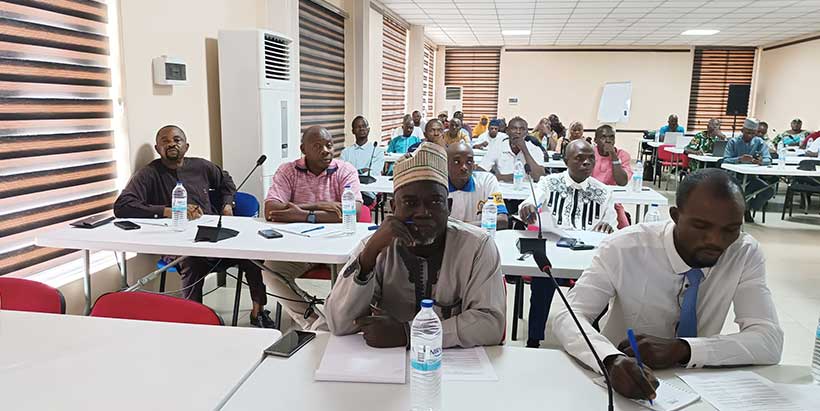
As part of efforts to advance farmer-centred research and data-driven agricultural development, the IITA-led project, “Strengthening Soybean Improvement for Africa,” funded by the Gates Foundation, organized a training workshop for field agents and experts on the implementation and management of Triadic Comparison of Technologies (Tricot) experiments in Nigeria.
The four-day training, themed “High-quality socioeconomic and tricot-specific data collection,” was held at IITA headquarters in Ibadan from 22 to 25 June. The objective was to strengthen the capacity of field agents to generate reliable and high-quality data essential for the success of soybean research and breeding efforts.
Soybean Breeding Research Associate, Adeyinka Adewumi, commenced the workshop with practical sessions on soybean germination tests and the application of Rhizobium inoculants in the field. The participants also received hands-on training on the Tricot methodology, designed to evaluate agricultural technologies directly with farmers and along the value chain.
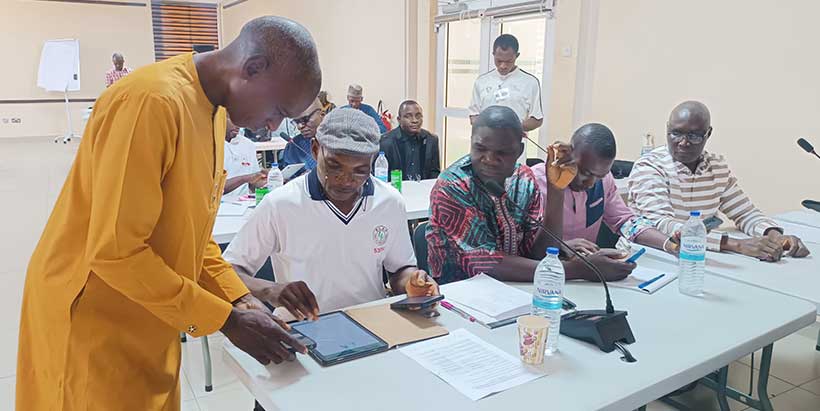
During the workshop, the IITA Agricultural Economist, Adane Tufa, emphasized the critical role of field agents in ensuring accurate and ethical data collection. He provided participants with effective field data collection techniques, including strategies to minimize errors and best practices for conducting structured interviews that capture socioeconomic and agronomic realities. Tufa stressed the need to consider farmers’ backgrounds, language preferences, and communication styles when designing questionnaires. “Errors in data collection are inevitable,” he noted, “but through attention to detail and proper methodology, we can significantly reduce errors and obtain data that truly reflects farmers’ challenges and needs.”
IITA Product Manager for Grain Crops, Dean Muguaani, provided in-depth insights into the Tricot approach and its practical application. He underscored the importance of Tricot’s inclusive, farmer-driven model, which integrates farmers into research processes through citizen-participation mechanisms. According to Muguaani, this approach yields more practical insights and enhances the relevance of scientific decisions for farming communities across sub-Saharan Africa.
The workshop concluded with training on using the ODK Collect app to enhance digital efficiency in field operations. This digital tool allows real-time, accurate field data collection, supports rapid feedback, and facilitates timely, evidence-based interventions for farmers.
Kwara State Coordinator for on-farm Tricot trials, Dr Mumeen Yusuf, expressed his commitment to cascading the knowledge gained to farmers in Kwara State. “The Tricot ‘train-the-trainer’ model is invaluable. I will ensure that farmers under my supervision benefit from this knowledge, which will enhance the project’s impact and contribute to achieving its broader objectives,” he stated.
The training marks a crucial step in equipping field agents with the skills and tools to drive impactful, farmer-inclusive research, ultimately supporting soybean improvement and agricultural development across Africa.
Contribué par Anita Akinyomade
Contribué par
Histoires récentes