
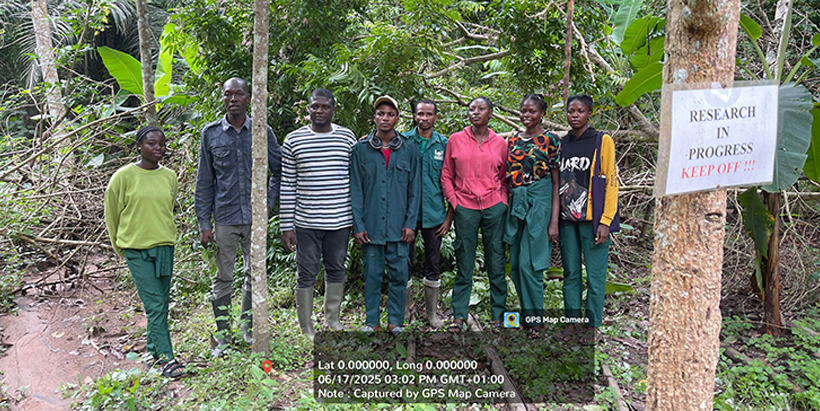
In its continued commitment to conserving Nigeria’s threatened and endangered native trees, the Centre forestier de l'IITA recently embarked on another strategic round of seed collection. This activity, part of the Center’s conservation mission, focused on enriching the live gene bank at its Tree Heritage Park, popularly known as The Noah’s Ark. It also aimed to expand the number of propagation protocols in the Manual of Tree Propagation on the IITA Forest Center website, which is freely downloadable for users to propagate native tree species on their own.
Olukunle Olasupo, IITA Forest Center Field Supervisor, extended the mission to two critical biodiversity hubs: Okomu National Park in Edo State and Queen’s Forest Reserve in Ondo State. The objective was twofold: to collect seeds and cuttings from rare and threatened tree species, and to enrich the Forest Center’s bank of propagation protocols for native tree species.
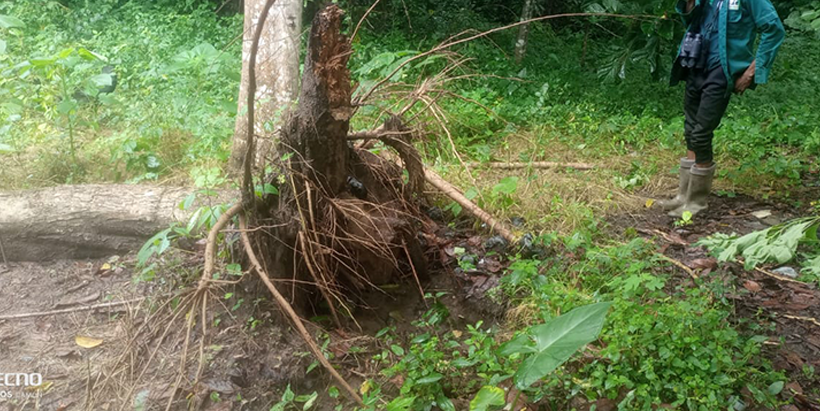
A remarkable coincidence marked the mission at FUTA. In a symbolic twist, a rare Stereospermum acuminatissimum tree, the only surviving tree species remaining on the FUTA campus, had fallen. Olasupo, a passionate conservation expert, took the occasion to train students in various techniques to conserve native tree species. In what Olukunle describes as “a coincidence of nature screaming help, speaking thanks, and reward for labor,” this moment presented the perfect opportunity to educate students on seed and non-seed propagation techniques.
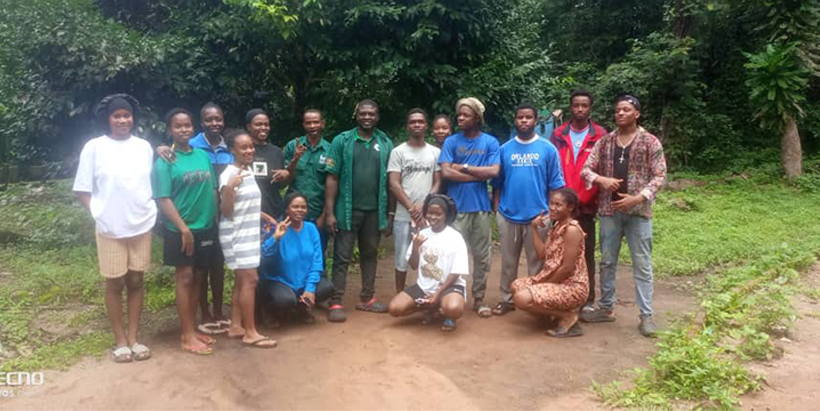
Students of the Department of Forestry and Wildlife Ecotourism, Federal University of Technology, Owerri (FUTO), and the Department of Forestry and Wood Technology, Federal University of Technology, Akure (FUTA) benefited immensely. Hands-on sessions taught them seed sowing, collection, and vegetative propagation techniques such as marcotting (air layering), grafting, budding, and stem-cuttings. These sessions equipped them with the skills needed to support species regeneration to promote biodiversity conservation on a broader scale.
Among the tree species collected for conservation are Maranthes glabra, classified as Vulnerable on the IUCN Red List, Hunteria umbellata, Omphalocarpum procera, et Stereospermum acuminatissimum, a highly medicinal native tree. Each seed and cutting collected contributes to the growing diversity of IITA Forest Center’s Tree Heritage Park, which serves as a sanctuary and a learning ground for conservationists and researchers across Nigeria.
Olukunle also emphasized the role of youth in driving conservation forward. He said, “It’s not just about saving trees—it’s about raising people who can keep saving trees long after we are gone.”
Through this effort, IITA Forest Center continues to preserve Nigeria’s botanical heritage while nurturing the next generation of conservation leaders, planting hope for our environment and future.
Proposé par Folake Oduntan
Theme: Climate change, Biodiversity
Contribué par
Histoires récentes