
NOUVELLES DE L'IITA

COP30 film highlights how Crop Science Centre collaborations are empowering farmers through sustainable innovation
novembre 13, 2025

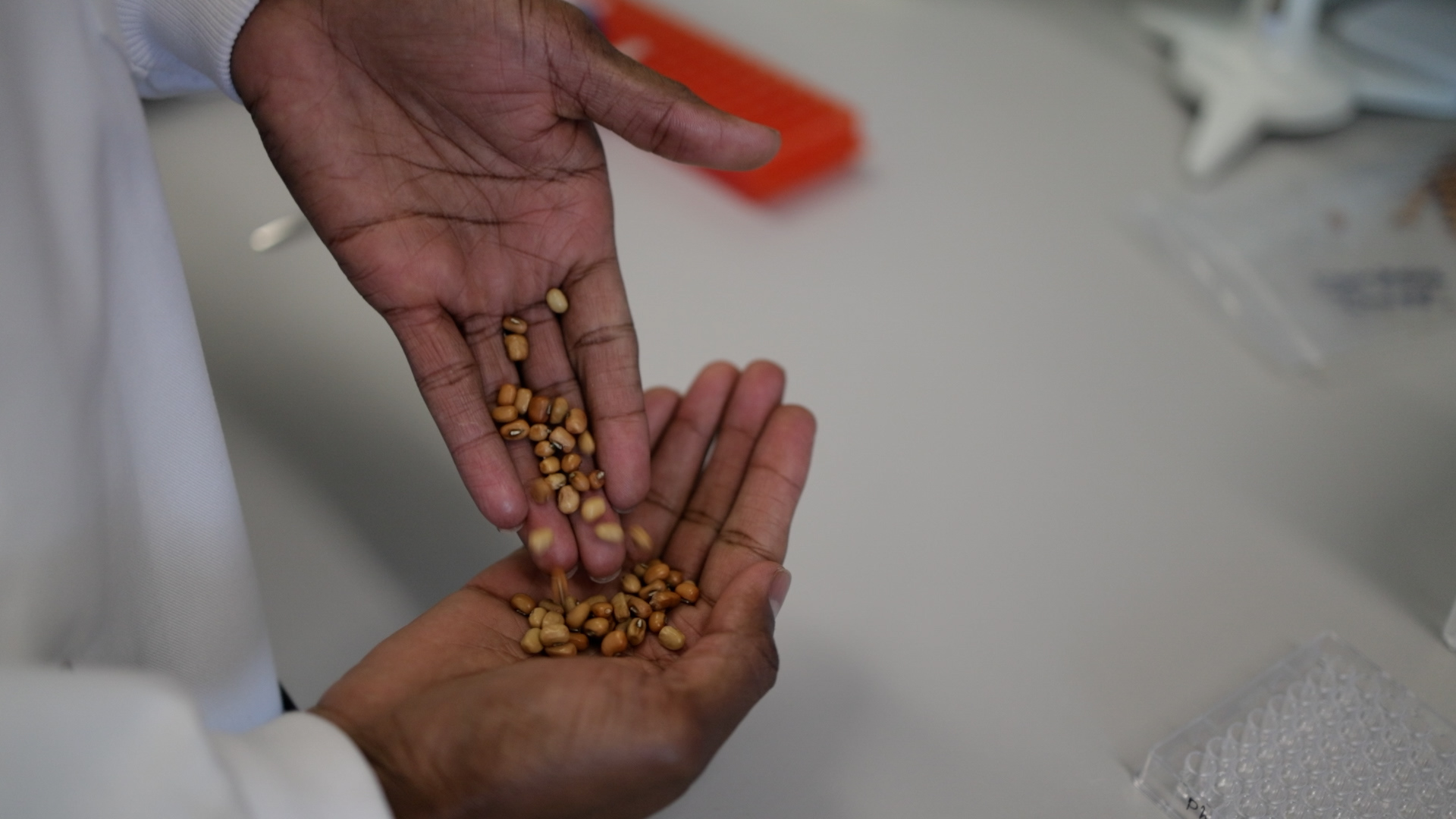
Dr Ahmed Warsame working with cowpea (Vigna unguiculata) at the Crop Science Centre, Cambridge. Filming and images by WebsEdge Science

A new film showcases how the Crop Science Centre (CSC)’s collaboration with partners in the global south is pioneering sustainable solutions in agriculture to feed the world and improve lives.

The film will be premiered at the United Nations Climate Change Conference (COP30) taking place in Belém, Brazil in November 2025.

It shows how CSC’s partnerships with breeders and farmers are translating cutting-edge science into real-world impact, with a focus on developing sustainable alternatives to the high-input agriculture on which we currently rely.

The film launch follows the recent CSC International Partnerships event which brought together breeders, scientists, and funders from Africa, Asia, Europe, and the United States. The event celebrated the power of collaboration and reinforced CSC’s commitment to co-creating research agendas that translate discovery science into real impact in farmers’ fields.

“Making global food production more equitable, sustainable and resilient is core to everything we do at the Crop Science Centre,” said Professor Uta Paszkowski, CSC’s Acting Director and Head of the Cereal symbiosis group.

“This film shows how we are harnessing research innovation to strengthen global food security and make sure the benefits of cutting-edge crop science can reach all farmers,” she said.

“Initiatives like the Crop Science Centre are really core to our sustainability goals at Cambridge and our need to connect with international priorities such as at COP30,” said Professor Bhaskar Vira, Pro-Vice-Chancellor for Sustainability at the University of Cambridge, who features in the film.

The film has been produced in collaboration with global research consortium CGIAR [https://www.cgiar.org/], as part of their ‘With Science We Can’ campaign – a documentary series exploring how we can achieve a food-secure future through scientific innovation.

Sustainable agriculture using nature’s solutions
Researchers at CSC are working with breeders, scientists and farmers around the world to bring nature’s solutions back into agriculture.

“We believe the solutions nature invented hold the key to sustainable agriculture,” said Professor Paszkowski.

“By studying how plants partner with soil microbes, for example, we can design crops that nourish themselves and reduce dependence on chemical inputs.”

As the world’s population grows and climate pressures intensify, global agriculture faces the urgent challenge of producing more food with fewer resources.

At the same time, ecological and climate change problems like greenhouse gas emissions, water scarcity, environmental pollution are having a significant effect on food production.

“The climate change problem in turn feeds into the food production issue, so it’s basically a vicious circle.”

“This vicious circle especially affects smallholder farmers who have less capacity to adapt to the changing climate and are disproportionately affected.”

“Agriculture today needs to be even more sustainable than ever. It is down to us to come in with innovations to make sustainable agriculture viable and affordable for everybody in need,” she said.

A venture with partnerships at the heart
The film highlights the importance of partnerships with local farmers and breeders to develop a sustainable agriculture and secure tomorrow’s global food production.

“Science has to start with farmers and end with the farmer,” said Dr Pearl Abu, Team Lead for the Maize Breeding Programme at the University of Ghana’s West Africa Centre for Crop Improvement (WACCI), one of CSC’s collaborators to appear in the film.

“We need to develop research in partnership with farmers and engage with them before the research starts.”

Dr Abu is working with CSC’s Cereal symbiosis group who are researching fungal symbiosis with a focus on sustainable agriculture for cereal crops to improve maize and rice growth.

“The partnership between the Crop Science Centre and WACCI is a powerful way of making sure that discovery science reaches farmers who are the ones that need it,” she said.

“Local partnerships are essential for translating our research at the Crop Science Centre into the farmers’ fields. We need those local partners who are on the ground with the farmers to think about how the science is going to be relevant in the field,” said Dr Emily Servanté, Postdoctoral Research Associate at CSC.

Turning ideas into impact
Dr Ousmane Boukar reiterates this message. He is a researcher and breeder at the International Institute of Tropical Agriculture (IITA) in Nigeria, which is a CGIAR partnership member working to address food insecurity, malnutrition and poverty in sub-Saharan Africa.

Dr Boukar is working to develop cowpea varieties that can thrive in heat and tolerate the drought conditions which are increasingly challenging farmers in Northern Nigeria and the West African Sahel. Cowpeas are a vital food source and income generator for millions of people in the region.

“Our partnership with the Crop Science Centre is a powerful example of how global science can meet local needs,” he said.

“Farmers know their soil, their seasons and their community better than anyone else. We are not just transferring technology. We are building resilience. The real impact goes beyond the field. It is about building confidence, trust and scientific capacity in African agricultural systems.”

“Ultimately, we want to create a world where farming is profitable, dignified and resilient and where science truly serves the people who feed us all.”

Watch the Crop Science Centre COP30 video:
[https://youtu.be/YNWbNrqozO8?si=YdzJ2LmPTSaFNPlz]

View CGIAR’s full series of COP30 documentaries: [https://youtube.com/playlist?list=PLGVe6BxyFHNWv6Yd5wKmfuA_1osg8VzK3&si=HLPxVnXGgVc1NR2E]

About the Crop Science Centre
The Crop Science Centre is a coalition between the University of Cambridge and Niab, that combines their diverse expertise to create an environment for research excellence, with the capability to apply discoveries to crop improvement in the field.


Contribué par

Recent stories

Aucun article trouvé

Laisser un commentaire

Votre adresse e-mail ne sera pas publiée. Les champs obligatoires sont indiqués avec *

Retour en haut
Olaosebikan, Olamide

Olamide Deborah Nwanze est une chercheuse principale spécialisée dans la recherche sur l'approche "genre" afin d'éclairer les politiques de sélection participative et inclusive, de développement de variétés et de systèmes semenciers concernant les cultures de racines, tubercules et bananes (RTB) au siège de l'Institut International d'Agriculture Tropicale, à Ibadan, au Nigeria. Elle est candidate au doctorat à l'Université d'Ibadan et titulaire d'un master et d'un diplôme d'ingénieur agronome en vulgarisation agricole et développement rural. Olamide est membre du programme African Women in Agricultural Research and Development – Gender Responsive Agricultural Systems Policy (SAISIE DE RÉCOMPENSEet les Chercheuses Sensibles au Genre Équipées pour la Transformation Agricole (SUPER. Elle cherche à appliquer ses apprentissages en matière d’approche genre, recherche sensible au genre, et expertise en développement et examen de politiques pour faciliter l’accès et l’adoption par les femmes, les jeunes, les enfants et les groupes sociaux vulnérables aux innovations agricoles qui garantissent la sécurité alimentaire, nutritionnelle, des revenus et des moyens de subsistance en Afrique. Ses rôles actuels comprennent le mentorat de chercheurs stagiaires, le développement de guides et manuels de formation, la mise en œuvre et l'adaptation de cadres et d'outils genre, l'engagement des acteurs de la chaîne de valeur en tant que partenaires de la science citoyenne, l'examen et la refonte des politiques, la gestion et l'analyse des données. Ses recherches actuelles portent sur les méthodes mixtes ainsi que sur les approches participatives et interdisciplinaires pour saisir et mettre en évidence les dynamiques de genre, les besoins, les préférences et les défis rencontrés par les parties prenantes au sein de la chaîne de valeur des moyens de subsistance agricoles afin de prioriser des stratégies axées sur le genre dans les programmes de sélection, la conception et la mise en œuvre des politiques.

À l'IITA, elle contribue à la mise en œuvre du CGIAR Initiative d'Élevage Accéléré et Innovation génétique Programmes ; recherche participative et genre au sein des Prochaine Génération ManiocHarvestPlusRTBAliments, et Tricot-ClimMob 1000Fermes Projets ; et la communication des connaissances sur le genre via le Série de webinaires G-LENS, vidéo documentaire, notes de politiquepublications, et blogs.


Publications récentes

de Sousa, K., van Etten, J., Manners, R. Bello, A., Teeken, B., Olaosebikan, O., et al. 2024. L'approche tricot : un cadre agile pour les essais décentralisés à la ferme soutenus par la science citoyenne. Une rétrospective. Agron. Sustain. Dev. 44, 8. https://doi.org/10.1007/s13593-023-00937-1

Madu, T., Onwuka, S., Nwafor, S., Onyemauwa, N., Ejechi, M., Ofoeze, M., Ukeje, B., Eluagu, C., Olaosebikan, O., Okoye, B., 2024. Les études sur les consommateurs inclusifs en matière de genre améliorent l'amélioration du manioc au Nigeria dans : Frontiers in Sociology, volume 9, numéro : 1224504, doi : 10.3389/fsoc.2024.1224504

Olaosebikan, O. ; Bello, A. ; Utoblo, O. ; Okoye, B. ; Olutegbe, N. ; Garner, E. ; Teeken, B. ; Bryan, E. ; Forsythe, L. ; Cole, S. ; Madu, T. 2023. Facteurs de stress et résilience au sein de la chaîne de valeur du manioc au Nigeria : Caractéristiques préférées des variétés de manioc et stratégies de réponse des hommes et des femmes pour informer l'amélioration variétale. Sustainability 15, 7837. https://doi.org/10.3390/su15107837

Okoye, B., Ofoeze, M., Ejechi, M., Onwuka, S., Nwafor, S., Onyemauwa, N., Ukeje, B., Eluagu, C., Obidiegwu, J.*, Olaosebikan, O., Madu, T.* 2023. Priorisation des traits préférés dans la chaîne de valeur de l'igname au Nigeria : une analyse de la situation en matière de genre in: Frontiers in Sociology, volume 8, numéro : 1232626, pages 1 – 9, ISSN 2297-7775, 2023. https://www.frontiersin.org/articles/10.3389/fsoc.2023.1232626/full

Olaosebikan, O., Bello, A. A., de Sousa, K., Ndjouenkeu, R., Adesokan, M., Alamu, E. O., Agbona, A., van Etten, J., Kegah, F. N.*, Dufour, D., Bouniol, A., Teeken, B. 2023. Acceptabilité par les consommateurs des produits alimentaires à base de gari-eba de manioc dans des contextes culturels et environnementaux variés en utilisant l'approche triade de comparaison des technologies (tricot) dans : Journal of the Science of Food and Agriculture,

Teeken, B., Olaosebikan, O., Bello, A. A., Madu, T.*, Cole, S. M. 2023. Évaluation qualitative de la positionnalité et des préférences des dyades en relation avec les activités liées au manioc : travailler avec des scientifiques citoyens du procès tricot https://hdl.handle.net/10568/138326 Type : Manuel

Bouniol, A., Ceballos, H., Bello, A. A., Teeken, B., Olaosebikan, O., Owoade, D., Agbona, A., Fotso Kuate, A., Madu, T.*, Okoye, B.*, Ofoeze, M.*, Nwafor, S.*, Onyemauwa, N.*, Adinsi, L.*, Forsythe, L., Dufour, D. 2023. Impact variétal sur le travail des femmes, la charge de travail et la pénibilité associée dans le traitement des plantes à racines, tubercules et bananes : focus sur le manioc en Afrique subsaharienne dans : Journal of the Science of Food and Agriculture, pages 1 – 25, ISSN 0022-5142,

Bello, A. A., Agbona, A., Olaosebikan, O., Edughaen, G., Dufour, D., Bouniol, A., Iluebbey, P., Ndjouenkeu, R.*, Rabbi, I. Y., Teeken, B. 2023. Effets génétiques et environnementaux sur la productivité de la transformation et le rendement des produits alimentaires : la pénibilité du travail des femmes dans : Journal of the Science of Food and Agriculture, pages 1 – 32, ISSN 0022-5142, 5

Cavicchioli, M., Zimbiti, T., Teeken, B., Nwanze, D.O., Liani, M., Parkes, E. & Bello, A. 2023. Rapport sur la formation en sélection génétique sensible au genre à l'IITA. Genetic Resources Center, IITA-HQ, Ibadan, 21-23 septembre 2022. Ibadan, Nigéria : IITA, (34 p.).https://hdl.handle.net/10568/131368

Agbona, A. Peteti P., Teeken B., Olaosebikan O. Bello, A. A., Parkes, E., Rabbi, I. Y., Mueller, L., Egesi, C., Kulakow, P. 2022. Gestion des données dans les programmes d'amélioration des cultures RTB africaines multidisciplinaires. In : Williamson, H.F., Leonelli, S. (eds) Towards Responsible Plant Data Linkage: Data Challenges for Agricultural Research and Development. Springer, Cham. https://doi.org/10.1007/978-3-031-13276-6_5

Lora Forsythe, Pricilla Marimo, Sarah Mayanja, Olamide D. Olaosebikan, Esme Stuart, Bela Teeken, Benjamin Okoye, Tessy Madu, (2021). Analyse transversale du genre dans RTBfoods Étape 2 Cartographie des genres sur les produits RTB. Comprendre les moteurs des préférences en matière de traits et le développement de profils de produits RTB multi-utilisateurs, WP1. Londres, Royaume-Uni : Rapport scientifique de terrain RTBfoods, 30 p.

Teeken, B., Garner, E., Agbona, A., Balogun, I., Olaosebikan, O., Bello, A., Madu, T., Okoye, B., Egesi, C., Kulakow, P. et Tufan, H.A. 2021. Au-delà des “ traits des femmes ” : explorer comment le genre, les différences sociales et les caractéristiques des ménages influencent les préférences pour les traits. Frontiers Systèmes alimentaires durables 5:740926. https://doi.org/10.3389/fsufs.2021.740926

Teeken, B., Agbona, A., Bello, A., Olaosebikan, O., Alamu, E., Adesokan, M., Awoyale, W., Madu, T., Okoye, B., Chijioke, U., Owoade, D., Okoro, M., Bouniol, A., Dufour, D., Hershey, C., Rabbi, I., Maziya‐Dixon, B., Egesi, C., Tufan, H. et Kulakow, P. (020. Comprendre les préférences variétales du manioc par le classement par paires du gari-eba et du fufu préparés par des agriculteurs-transformateurs locaux. Int J Food Sci Technol. https://doi.org/10.1111/ijfs.14862

Bela Teeken, Olamide Olaosebikan, Ireti Balogun, Benjamin Okoye, Tessy Madu, Steven Cole, Abolore Bello, Elizabeth Parkes. (2020). Pilotage des outils de profil client et produit G+ pour l'amélioration sensible au genre du manioc au Nigeria. Nigeria : Institut international d'agriculture tropicale (IIAT). https://hdl.handle.net/20.500.11766/13000