Ogun State, IITA, and Partners strengthen collaboration to advance digital agriculture through OGFIMS
9 décembre 2025
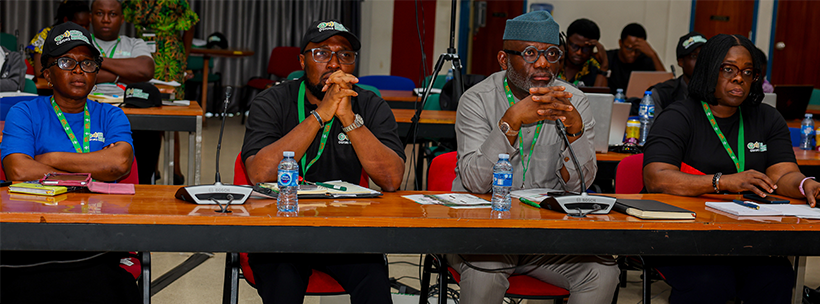
Left to Right: Permanent Secretary, Ministry of Agriculture and Food Security, Dr. Kehinde Jokotoye; the Honorable Commissioner for Agriculture and Food Security, Bolu Owotomo; Honorable Commissioner for Finance/Chief Economic Adviser/OGSTEP PSC Chairman, Dapo Okubadejo; and OGSTEP Project Coordinator, Ms. Mosun Owo-Odusi, at the OGFIMS project review meeting.IITA–CGIAR accueilli le Ogun State Farmers Information Management System (OGFIMS) Project Review Meeting and Team Retreat at its headquarters from 23 to 25 October. The event brought together the project implementation team, key stakeholders from the Ogun State Government, and the Ogun State Economic Transformation Project (OGSTEP), sponsored by the Banque mondiale, to assess progress and reinforce collaboration toward achieving digital agricultural transformation in Ogun State.
The OGFIMS is a digital farmer and VCA registry and platform that supports digital extension, market linkages, and online interactive features, enabling farmers to connect directly with service providers, off-takers, and value chain development firms. This system is designed to strengthen agribusiness growth and improve the livelihoods of farmers in Ogun State.
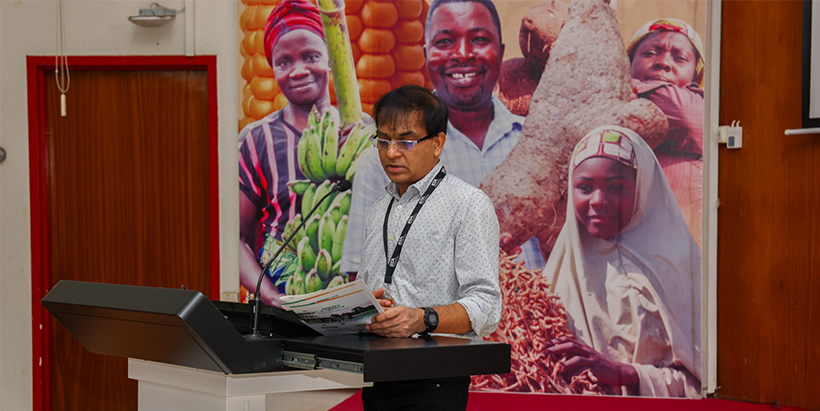
The OGFIMS project lead at IITA, Dr Lava Kumar, while giving an update on project development, also highlighted the genesis of the project, starting with a bidding process to act as a technical consultant for the development of a digital farmer registry in 2021, and subsequent expansion of the scope to make OGFIMS a multi-modular platform. Besides the development of the OGFIMS, the project also established the OGFIMS control room at the Ministry of Agriculture and Food Security in Abeokuta.
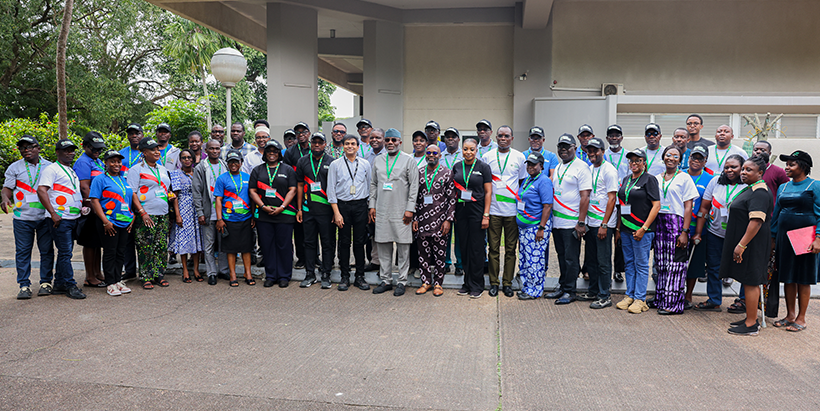
IITA representatives, Ogun State/OGFIMS representatives and participants of the review meeting.
He said “co-creation” as a central plank of implementation, with frequent interaction with OGSTEP and Ministry Representatives to ensure user-centric fit-for-purpose design. He also mentioned that the approach used for digital registration was effective and ensured broad coverage in a short time.
The Honorable Commissioner for Agriculture and Food Security of Ogun State, Bolu Owotomo, described OGFIMS as a dependable tool for communicating with farmers and a veritable source of data on their activities, which supports government interventions. He revealed that the platform has already registered more than 160,000 farmers and agricultural value-chain actors across the State, serving as a strategic tool supporting the state’s goal on enhancing food production and improving farmers’ livelihoods. He added that a platform of this kind is first in Nigeria.
Welcoming the visiting team, IITA West Africa Hub Director, Professor Michael Abberton, IITA Deputy Director General, Corporate Services, Hilde Koper, and Head of IITA’s Project Development Unit, Kayode Awobajo, commended the Ogun State Government for prioritizing digital transformation in agriculture. They reaffirmed IITA’s commitment to supporting data-driven systems that empower smallholder farmers.
The OGFIMS project lead at IITA, Dr Lava Kumar, giving an update on the project development during the review meeting.
Representing the Ogun State delegation, OGSTEP Project Coordinator Mosun Owo-Odusi reiterated the government’s vision to modernize agricultural value chains, extension services, and strengthen digital delivery through OGFIMS. She stated that OGFIMS is one of the key initiatives of the economic transformation agenda. Dr Oluseyi Olugbire, Agriculture Manager, OGSTEP, lauded the team effort in ensuring the progress of this interdisciplinary project.
An innovation showcase featured cutting-edge IITA technologies being scaled in Nigeria and across Africa under the Technologies pour la Transformation Agricole en Afrique (TAAT), Special Agro-Industrial Processing Zones (SAPZ), and Food Systems Resilience Program (FSRP) initiatives. These innovations include improved crop varieties, strengthening of the seed system, site-specific agronomy, soil fertility management, integrated pest management, value addition, and digital solutions for agricultural transformation.
The OGFIMS review sessions featured presentations by Dr Kumar, Owo-Odusi, and Commissioner Owotomo, who highlighted project milestones and farmer-centered innovations. Demonstrations of self-registration, e-extension, e-marketing, and weather advisory services were led by IITA Digital Media and Web Manager, Tunde Ajayi; Mobile App features were demonstrated by IITA IT Infrastructure Associate, Busayo Ogunya; and Communication Features were displayed by Lydia Olufunmilola and Hector Igboko.
A high-level panel discussion examined how OGFIMS can enhance data-driven decision-making, extension delivery, and farmer services. Panellists included Honorable Commissioner for Finance/Chief Economic Adviser/OGSTEP Project Steering Committee Chairman, Dapo Okubadejo; Commissioner Owotomo; Special Adviser to the Governor on ICT, Dayo Abiodun; Special Adviser to the Governor on Agriculture, Angel-Adelaja Kuye; Permanent Secretary, Ministry of Agriculture and Food Security, Jokotoye Kehinde; and Owo-Odusi.
Group discussions also explored sustainability, funding, expansion, and integration with Ogun State’s broader digital infrastructure.
A roundtable session showcased complementary innovations to strengthen OGFIMS outcomes, including improved, high-yielding crop varieties by Head of Breeding, Dr Hapson Mushoriwa; cassava varieties for food and processing by Cassava Breeding Program Lead, Dr Ismail Rabbi; technical support to SAPZ by Product Manager, Dr Dean Muungani; remote sensing for crop mapping and weather alerts by GIS Support Services Manager, and Alabi Tunrayo; AKILIMO: site-specific digital agronomy advisor by Akinniyi Olufemi. The meeting also showcased the achievements of another OGSTEP project, “cassava value chain development,” led by Prof. Lateef Sanni and 2025 Africa Food Prize Winner, Dr Mercy Diebiru-Ojo of IITA.
Participants also toured IITA’s Germplasm Health, Virology and Diagnostics Unit, the Genetic Resource Center (GRC), and the Semi-Autotrophic Hydroponics (SAH) Facility, where innovations such as the Seed Tracker were demonstrated.
In an interview, Honorable Okubadejo commended IITA’s role in supporting the OGFIMS project, describing it as “a unique platform, the first of its kind in Nigeria.” He emphasized that the system enables the government to measure impact across value chains and identify appropriate interventions. “Continued collaboration with IITA is important, and we have already identified areas for further engagement,” he said.
The workshop concluded with agreement on next steps, including institutionalizing OGFIMS for performance measurement, capacity building for farmers to adopt improved varieties, leveraging remote sensing for crop mapping and weather advisories, and preparing for the public launch of OGFIMS.
Through this partnership, Ogun State and IITA are positioning digital agriculture as a cornerstone for improving productivity, farmer incomes, and agribusiness growth; setting a model for other regions in Africa to emulate.
The workshop that attracted the senior executes from the Ogun State government, OGSTEP and IITA served as a strategic retreat providing an opportunity to reflect on how digital tools can drive agricultural development, enhance service delivery, and leverage complementary strengths to amplify impact for farmers and agribusinesses in the state
Contribué par Ochuwa Favour Daramola
Olamide Deborah Nwanze est une chercheuse principale spécialisée dans la recherche sur l'approche "genre" afin d'éclairer les politiques de sélection participative et inclusive, de développement de variétés et de systèmes semenciers concernant les cultures de racines, tubercules et bananes (RTB) au siège de l'Institut International d'Agriculture Tropicale, à Ibadan, au Nigeria. Elle est candidate au doctorat à l'Université d'Ibadan et titulaire d'un master et d'un diplôme d'ingénieur agronome en vulgarisation agricole et développement rural. Olamide est membre du programme African Women in Agricultural Research and Development – Gender Responsive Agricultural Systems Policy (SAISIE DE RÉCOMPENSEet les Chercheuses Sensibles au Genre Équipées pour la Transformation Agricole (SUPER. Elle cherche à appliquer ses apprentissages en matière d’approche genre, recherche sensible au genre, et expertise en développement et examen de politiques pour faciliter l’accès et l’adoption par les femmes, les jeunes, les enfants et les groupes sociaux vulnérables aux innovations agricoles qui garantissent la sécurité alimentaire, nutritionnelle, des revenus et des moyens de subsistance en Afrique. Ses rôles actuels comprennent le mentorat de chercheurs stagiaires, le développement de guides et manuels de formation, la mise en œuvre et l'adaptation de cadres et d'outils genre, l'engagement des acteurs de la chaîne de valeur en tant que partenaires de la science citoyenne, l'examen et la refonte des politiques, la gestion et l'analyse des données. Ses recherches actuelles portent sur les méthodes mixtes ainsi que sur les approches participatives et interdisciplinaires pour saisir et mettre en évidence les dynamiques de genre, les besoins, les préférences et les défis rencontrés par les parties prenantes au sein de la chaîne de valeur des moyens de subsistance agricoles afin de prioriser des stratégies axées sur le genre dans les programmes de sélection, la conception et la mise en œuvre des politiques.
de Sousa, K., van Etten, J., Manners, R. Bello, A., Teeken, B., Olaosebikan, O., et al. 2024. L'approche tricot : un cadre agile pour les essais décentralisés à la ferme soutenus par la science citoyenne. Une rétrospective. Agron. Sustain. Dev. 44, 8. https://doi.org/10.1007/s13593-023-00937-1
Madu, T., Onwuka, S., Nwafor, S., Onyemauwa, N., Ejechi, M., Ofoeze, M., Ukeje, B., Eluagu, C., Olaosebikan, O., Okoye, B., 2024. Les études sur les consommateurs inclusifs en matière de genre améliorent l'amélioration du manioc au Nigeria dans : Frontiers in Sociology, volume 9, numéro : 1224504, doi : 10.3389/fsoc.2024.1224504
Olaosebikan, O. ; Bello, A. ; Utoblo, O. ; Okoye, B. ; Olutegbe, N. ; Garner, E. ; Teeken, B. ; Bryan, E. ; Forsythe, L. ; Cole, S. ; Madu, T. 2023. Facteurs de stress et résilience au sein de la chaîne de valeur du manioc au Nigeria : Caractéristiques préférées des variétés de manioc et stratégies de réponse des hommes et des femmes pour informer l'amélioration variétale. Sustainability 15, 7837. https://doi.org/10.3390/su15107837
Okoye, B., Ofoeze, M., Ejechi, M., Onwuka, S., Nwafor, S., Onyemauwa, N., Ukeje, B., Eluagu, C., Obidiegwu, J.*, Olaosebikan, O., Madu, T.* 2023. Priorisation des traits préférés dans la chaîne de valeur de l'igname au Nigeria : une analyse de la situation en matière de genre in: Frontiers in Sociology, volume 8, numéro : 1232626, pages 1 – 9, ISSN 2297-7775, 2023. https://www.frontiersin.org/articles/10.3389/fsoc.2023.1232626/full
Olaosebikan, O., Bello, A. A., de Sousa, K., Ndjouenkeu, R., Adesokan, M., Alamu, E. O., Agbona, A., van Etten, J., Kegah, F. N.*, Dufour, D., Bouniol, A., Teeken, B. 2023. Acceptabilité par les consommateurs des produits alimentaires à base de gari-eba de manioc dans des contextes culturels et environnementaux variés en utilisant l'approche triade de comparaison des technologies (tricot) dans : Journal of the Science of Food and Agriculture,
Teeken, B., Olaosebikan, O., Bello, A. A., Madu, T.*, Cole, S. M. 2023. Évaluation qualitative de la positionnalité et des préférences des dyades en relation avec les activités liées au manioc : travailler avec des scientifiques citoyens du procès tricot https://hdl.handle.net/10568/138326 Type : Manuel
Bouniol, A., Ceballos, H., Bello, A. A., Teeken, B., Olaosebikan, O., Owoade, D., Agbona, A., Fotso Kuate, A., Madu, T.*, Okoye, B.*, Ofoeze, M.*, Nwafor, S.*, Onyemauwa, N.*, Adinsi, L.*, Forsythe, L., Dufour, D. 2023. Impact variétal sur le travail des femmes, la charge de travail et la pénibilité associée dans le traitement des plantes à racines, tubercules et bananes : focus sur le manioc en Afrique subsaharienne dans : Journal of the Science of Food and Agriculture, pages 1 – 25, ISSN 0022-5142,
Bello, A. A., Agbona, A., Olaosebikan, O., Edughaen, G., Dufour, D., Bouniol, A., Iluebbey, P., Ndjouenkeu, R.*, Rabbi, I. Y., Teeken, B. 2023. Effets génétiques et environnementaux sur la productivité de la transformation et le rendement des produits alimentaires : la pénibilité du travail des femmes dans : Journal of the Science of Food and Agriculture, pages 1 – 32, ISSN 0022-5142, 5
Cavicchioli, M., Zimbiti, T., Teeken, B., Nwanze, D.O., Liani, M., Parkes, E. & Bello, A. 2023. Rapport sur la formation en sélection génétique sensible au genre à l'IITA. Genetic Resources Center, IITA-HQ, Ibadan, 21-23 septembre 2022. Ibadan, Nigéria : IITA, (34 p.).https://hdl.handle.net/10568/131368
Agbona, A. Peteti P., Teeken B., Olaosebikan O. Bello, A. A., Parkes, E., Rabbi, I. Y., Mueller, L., Egesi, C., Kulakow, P. 2022. Gestion des données dans les programmes d'amélioration des cultures RTB africaines multidisciplinaires. In : Williamson, H.F., Leonelli, S. (eds) Towards Responsible Plant Data Linkage: Data Challenges for Agricultural Research and Development. Springer, Cham. https://doi.org/10.1007/978-3-031-13276-6_5
Lora Forsythe, Pricilla Marimo, Sarah Mayanja, Olamide D. Olaosebikan, Esme Stuart, Bela Teeken, Benjamin Okoye, Tessy Madu, (2021). Analyse transversale du genre dans RTBfoods Étape 2 Cartographie des genres sur les produits RTB. Comprendre les moteurs des préférences en matière de traits et le développement de profils de produits RTB multi-utilisateurs, WP1. Londres, Royaume-Uni : Rapport scientifique de terrain RTBfoods, 30 p.
Teeken, B., Garner, E., Agbona, A., Balogun, I., Olaosebikan, O., Bello, A., Madu, T., Okoye, B., Egesi, C., Kulakow, P. et Tufan, H.A. 2021. Au-delà des “ traits des femmes ” : explorer comment le genre, les différences sociales et les caractéristiques des ménages influencent les préférences pour les traits. Frontiers Systèmes alimentaires durables 5:740926. https://doi.org/10.3389/fsufs.2021.740926
Teeken, B., Agbona, A., Bello, A., Olaosebikan, O., Alamu, E., Adesokan, M., Awoyale, W., Madu, T., Okoye, B., Chijioke, U., Owoade, D., Okoro, M., Bouniol, A., Dufour, D., Hershey, C., Rabbi, I., Maziya‐Dixon, B., Egesi, C., Tufan, H. et Kulakow, P. (020. Comprendre les préférences variétales du manioc par le classement par paires du gari-eba et du fufu préparés par des agriculteurs-transformateurs locaux. Int J Food Sci Technol.https://doi.org/10.1111/ijfs.14862
Bela Teeken, Olamide Olaosebikan, Ireti Balogun, Benjamin Okoye, Tessy Madu, Steven Cole, Abolore Bello, Elizabeth Parkes. (2020). Pilotage des outils de profil client et produit G+ pour l'amélioration sensible au genre du manioc au Nigeria. Nigeria : Institut international d'agriculture tropicale (IIAT). https://hdl.handle.net/20.500.11766/13000