
NOUVELLES DE L'IITA

Catalyzing change through youth capacity building to unlock Africa’s soybean potential
janvier 12, 2026

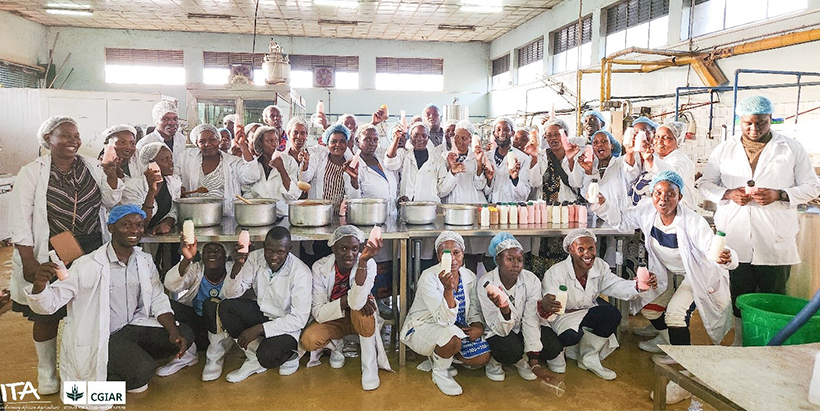
Participants pose for a group photo at the Makerere Food Technology and Business Incubation Centre (FTBIC) pilot plant.

In Uganda, value addition and product development are crucial for enhancing agribusiness competitiveness and sustainability. However, many youths and women in agri-food enterprises face challenges in processing, product formulation, and quality assurance, limiting their ability to meet market standards and scale their businesses. To address this, IITACGIAR, through the Technologies pour la Transformation Agricole en Afrique (TAAT) Soybean Compact and ENABLE TAAT Youth Compact, in collaboration with Makerere University and Smart Foods Uganda Limited, organized a 5-day Training-of-Trainers (ToT) workshop on Food Processing and Value Addition under the TAAT Soybean project. This training hosted by Makerere University’s Department of Food Technology and Nutrition in Kampala, Uganda brought together 60 youths, women and men. The training objectives were multifaceted, focusing on strengthening technical skills in formulating diverse soy-based products, building knowledge and competencies in Good Hygiene and Manufacturing Practices (GHP/GMP), and equipping trainees with practical experience in the manufacturing of soy-based products.
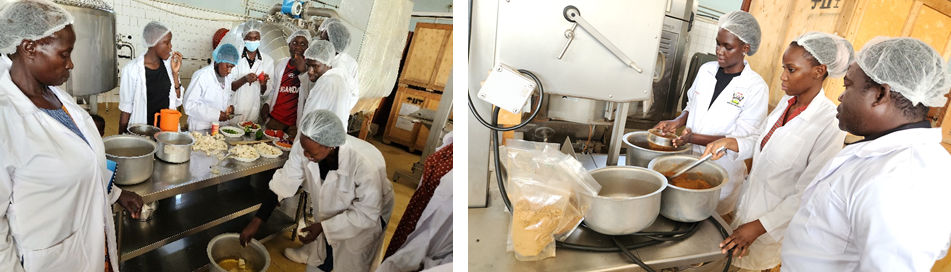
Participants learning how to prepare soy fortified "Daddies".
Participants learning how to prepare soy fortified “Daddies”.

Africa strategy (2016-2025) aims to boost agricultural productivity across Africa by rapidly delivering proven technologies to millions of farmers. TAAT also seeks to generate an additional 120 million metric tons (MT) of agricultural produce and improve the livelihoods of over 40 million smallholder farmers across Africa by 2025. Specifically, the TAAT Soybean Compact focuses on building capacity and providing technical assistance to National Agricultural Research and Extension Services (NARES) and the private sector, enhancing soybean production and productivity for improved nutrition and income.
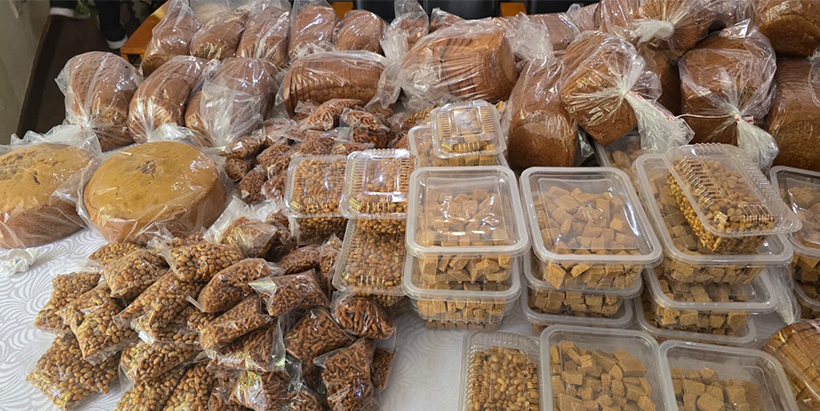
Soy fortified products made by the trainees.

The training utilized a mix of theoretical instruction and rigorous hands-on practical sessions in the Makerere Food Technology and Business Incubation Centre (FTBIC) pilot plants, covering various aspects of soy-based product manufacturing. Experts emphasized the delicate balance of temperature and ratios required for dairy alternatives, protein concentration and coagulation techniques, and fortifying common snacks with soy flour to increase nutritional value. Participants learned about soy milk and yoghurt processing, using a ratio of 1 cup of soybean to 6 cups of water, and pasteurizing the milk at 90°C to 100°C to inactivate trypsin inhibitors and destroy harmful microorganisms. They also learned about tofu production, focusing on protein concentration and coagulation techniques, including the use of Magnesium Chloride as a coagulant. Additionally, participants learned about soy-enriched baking, experimenting with substitution levels of soy flour in bread and snacks, and dry processing of soy flour and coffee, involving roasting, grinding, and hygienic packaging.
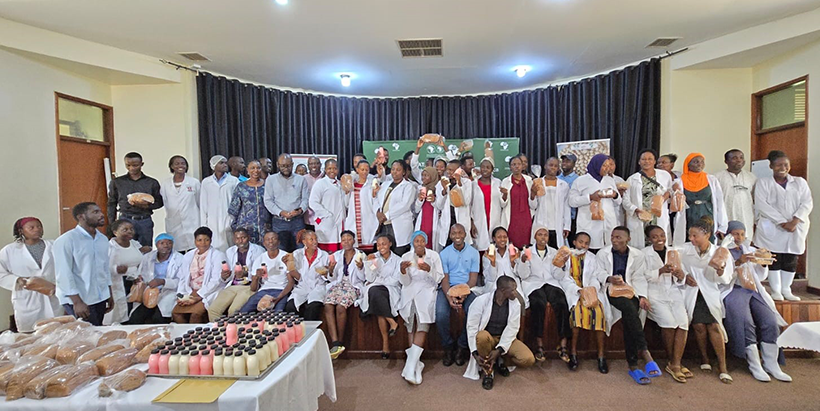
Trainees graduate and pose to showcase the soy-based products they made.

Facilitators emphasized the importance of collaboration, innovation, and food safety, setting the stage for a new wave of agripreneurs to make their mark. Martin Ssali, Director of Smart Foods Ltd, encouraged young minds to adopt a mindset of abundance, reminding them that “there is enough space for everyone to fly,” and urging them to collaborate rather than compete. Prof. Ivan Mukiisa Muzira, Head of the Department of Food Technology and Nutrition at Makerere University, drove home the crucial point that food safety is the cornerstone of the food business, extending an open invitation to participants to utilize the university’s facilities, saying, “This equipment belongs to you… Don’t let that knowledge stay in those books.”
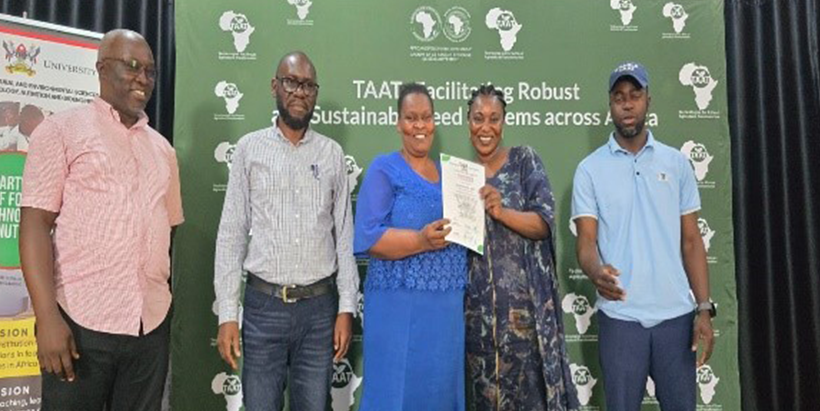
Certificates being awarded to trainees.

Emphasizing the power of partnerships, John Obaniyi of IITA-ENABLE TAAT Youth Compact challenged participants to innovate and compete with established brands, noting, “Starting alone might be challenging.’ ‘What happens when you have a partner? You can share the burden.”

The way forward involves the youth translating the skills and knowledge gained from the training program into viable agribusiness ventures. Participants are expected to start small-scale production using the formulations developed, leveraging access to FTBIC equipment for initial production runs. Strategic partnerships with Makerere University and Smart Foods Ltd will provide market connections and opportunities for growth. A monitoring and learning framework will track performance, technology adoption, and enterprise growth, guiding future interventions and scaling strategies. With this support, the 60 certified trainers are poised to make a significant impact on their communities, contributing to the growth of the soybean value chain and improving nutrition and income levels.

Contributed by Moureen Awori (IITA-Uganda), Welissa Mulei (IITA-Kenya/TAAT), Beckie Nakabugo (IITA-Uganda/TAAT), Oluwaseun Omikunle (IITA-Nigeria/TAAT), John Obaniyi (IITA-Nigeria/TAAT), Ivan Mukiisa Muzira (Makerere University) and Martin Ssali (Smart Foods Ltd).


Contribué par

Nouvelles connexes

Aucun article trouvé

Laisser un commentaire

Votre adresse e-mail ne sera pas publiée. Les champs obligatoires sont indiqués avec *

Retour en haut
Olaosebikan, Olamide

Olamide Deborah Nwanze est une chercheuse principale spécialisée dans la recherche sur l'approche "genre" afin d'éclairer les politiques de sélection participative et inclusive, de développement de variétés et de systèmes semenciers concernant les cultures de racines, tubercules et bananes (RTB) au siège de l'Institut International d'Agriculture Tropicale, à Ibadan, au Nigeria. Elle est candidate au doctorat à l'Université d'Ibadan et titulaire d'un master et d'un diplôme d'ingénieur agronome en vulgarisation agricole et développement rural. Olamide est membre du programme African Women in Agricultural Research and Development – Gender Responsive Agricultural Systems Policy (SAISIE DE RÉCOMPENSEet les Chercheuses Sensibles au Genre Équipées pour la Transformation Agricole (SUPER. Elle cherche à appliquer ses apprentissages en matière d’approche genre, recherche sensible au genre, et expertise en développement et examen de politiques pour faciliter l’accès et l’adoption par les femmes, les jeunes, les enfants et les groupes sociaux vulnérables aux innovations agricoles qui garantissent la sécurité alimentaire, nutritionnelle, des revenus et des moyens de subsistance en Afrique. Ses rôles actuels comprennent le mentorat de chercheurs stagiaires, le développement de guides et manuels de formation, la mise en œuvre et l'adaptation de cadres et d'outils genre, l'engagement des acteurs de la chaîne de valeur en tant que partenaires de la science citoyenne, l'examen et la refonte des politiques, la gestion et l'analyse des données. Ses recherches actuelles portent sur les méthodes mixtes ainsi que sur les approches participatives et interdisciplinaires pour saisir et mettre en évidence les dynamiques de genre, les besoins, les préférences et les défis rencontrés par les parties prenantes au sein de la chaîne de valeur des moyens de subsistance agricoles afin de prioriser des stratégies axées sur le genre dans les programmes de sélection, la conception et la mise en œuvre des politiques.

À l'IITA, elle contribue à la mise en œuvre du CGIAR Initiative d'Élevage Accéléré et Innovation génétique Programmes ; recherche participative et genre au sein des Prochaine Génération ManiocHarvestPlusRTBAliments, et Tricot-ClimMob 1000Fermes Projets ; et la communication des connaissances sur le genre via le Série de webinaires G-LENS, vidéo documentaire, notes de politiquepublications, et blogs.


Publications récentes

de Sousa, K., van Etten, J., Manners, R. Bello, A., Teeken, B., Olaosebikan, O., et al. 2024. L'approche tricot : un cadre agile pour les essais décentralisés à la ferme soutenus par la science citoyenne. Une rétrospective. Agron. Sustain. Dev. 44, 8. https://doi.org/10.1007/s13593-023-00937-1

Madu, T., Onwuka, S., Nwafor, S., Onyemauwa, N., Ejechi, M., Ofoeze, M., Ukeje, B., Eluagu, C., Olaosebikan, O., Okoye, B., 2024. Les études sur les consommateurs inclusifs en matière de genre améliorent l'amélioration du manioc au Nigeria dans : Frontiers in Sociology, volume 9, numéro : 1224504, doi : 10.3389/fsoc.2024.1224504

Olaosebikan, O. ; Bello, A. ; Utoblo, O. ; Okoye, B. ; Olutegbe, N. ; Garner, E. ; Teeken, B. ; Bryan, E. ; Forsythe, L. ; Cole, S. ; Madu, T. 2023. Facteurs de stress et résilience au sein de la chaîne de valeur du manioc au Nigeria : Caractéristiques préférées des variétés de manioc et stratégies de réponse des hommes et des femmes pour informer l'amélioration variétale. Sustainability 15, 7837. https://doi.org/10.3390/su15107837

Okoye, B., Ofoeze, M., Ejechi, M., Onwuka, S., Nwafor, S., Onyemauwa, N., Ukeje, B., Eluagu, C., Obidiegwu, J.*, Olaosebikan, O., Madu, T.* 2023. Priorisation des traits préférés dans la chaîne de valeur de l'igname au Nigeria : une analyse de la situation en matière de genre in: Frontiers in Sociology, volume 8, numéro : 1232626, pages 1 – 9, ISSN 2297-7775, 2023. https://www.frontiersin.org/articles/10.3389/fsoc.2023.1232626/full

Olaosebikan, O., Bello, A. A., de Sousa, K., Ndjouenkeu, R., Adesokan, M., Alamu, E. O., Agbona, A., van Etten, J., Kegah, F. N.*, Dufour, D., Bouniol, A., Teeken, B. 2023. Acceptabilité par les consommateurs des produits alimentaires à base de gari-eba de manioc dans des contextes culturels et environnementaux variés en utilisant l'approche triade de comparaison des technologies (tricot) dans : Journal of the Science of Food and Agriculture,

Teeken, B., Olaosebikan, O., Bello, A. A., Madu, T.*, Cole, S. M. 2023. Évaluation qualitative de la positionnalité et des préférences des dyades en relation avec les activités liées au manioc : travailler avec des scientifiques citoyens du procès tricot https://hdl.handle.net/10568/138326 Type : Manuel

Bouniol, A., Ceballos, H., Bello, A. A., Teeken, B., Olaosebikan, O., Owoade, D., Agbona, A., Fotso Kuate, A., Madu, T.*, Okoye, B.*, Ofoeze, M.*, Nwafor, S.*, Onyemauwa, N.*, Adinsi, L.*, Forsythe, L., Dufour, D. 2023. Impact variétal sur le travail des femmes, la charge de travail et la pénibilité associée dans le traitement des plantes à racines, tubercules et bananes : focus sur le manioc en Afrique subsaharienne dans : Journal of the Science of Food and Agriculture, pages 1 – 25, ISSN 0022-5142,

Bello, A. A., Agbona, A., Olaosebikan, O., Edughaen, G., Dufour, D., Bouniol, A., Iluebbey, P., Ndjouenkeu, R.*, Rabbi, I. Y., Teeken, B. 2023. Effets génétiques et environnementaux sur la productivité de la transformation et le rendement des produits alimentaires : la pénibilité du travail des femmes dans : Journal of the Science of Food and Agriculture, pages 1 – 32, ISSN 0022-5142, 5

Cavicchioli, M., Zimbiti, T., Teeken, B., Nwanze, D.O., Liani, M., Parkes, E. & Bello, A. 2023. Rapport sur la formation en sélection génétique sensible au genre à l'IITA. Genetic Resources Center, IITA-HQ, Ibadan, 21-23 septembre 2022. Ibadan, Nigéria : IITA, (34 p.).https://hdl.handle.net/10568/131368

Agbona, A. Peteti P., Teeken B., Olaosebikan O. Bello, A. A., Parkes, E., Rabbi, I. Y., Mueller, L., Egesi, C., Kulakow, P. 2022. Gestion des données dans les programmes d'amélioration des cultures RTB africaines multidisciplinaires. In : Williamson, H.F., Leonelli, S. (eds) Towards Responsible Plant Data Linkage: Data Challenges for Agricultural Research and Development. Springer, Cham. https://doi.org/10.1007/978-3-031-13276-6_5

Lora Forsythe, Pricilla Marimo, Sarah Mayanja, Olamide D. Olaosebikan, Esme Stuart, Bela Teeken, Benjamin Okoye, Tessy Madu, (2021). Analyse transversale du genre dans RTBfoods Étape 2 Cartographie des genres sur les produits RTB. Comprendre les moteurs des préférences en matière de traits et le développement de profils de produits RTB multi-utilisateurs, WP1. Londres, Royaume-Uni : Rapport scientifique de terrain RTBfoods, 30 p.

Teeken, B., Garner, E., Agbona, A., Balogun, I., Olaosebikan, O., Bello, A., Madu, T., Okoye, B., Egesi, C., Kulakow, P. et Tufan, H.A. 2021. Au-delà des “ traits des femmes ” : explorer comment le genre, les différences sociales et les caractéristiques des ménages influencent les préférences pour les traits. Frontiers Systèmes alimentaires durables 5:740926. https://doi.org/10.3389/fsufs.2021.740926

Teeken, B., Agbona, A., Bello, A., Olaosebikan, O., Alamu, E., Adesokan, M., Awoyale, W., Madu, T., Okoye, B., Chijioke, U., Owoade, D., Okoro, M., Bouniol, A., Dufour, D., Hershey, C., Rabbi, I., Maziya‐Dixon, B., Egesi, C., Tufan, H. et Kulakow, P. (020. Comprendre les préférences variétales du manioc par le classement par paires du gari-eba et du fufu préparés par des agriculteurs-transformateurs locaux. Int J Food Sci Technol. https://doi.org/10.1111/ijfs.14862

Bela Teeken, Olamide Olaosebikan, Ireti Balogun, Benjamin Okoye, Tessy Madu, Steven Cole, Abolore Bello, Elizabeth Parkes. (2020). Pilotage des outils de profil client et produit G+ pour l'amélioration sensible au genre du manioc au Nigeria. Nigeria : Institut international d'agriculture tropicale (IIAT). https://hdl.handle.net/20.500.11766/13000