
Emerald Forest Reserve designated global Key Biodiversity Area (KBA) following IITA Forest Center–led scientific assessments
12 janvier 2026
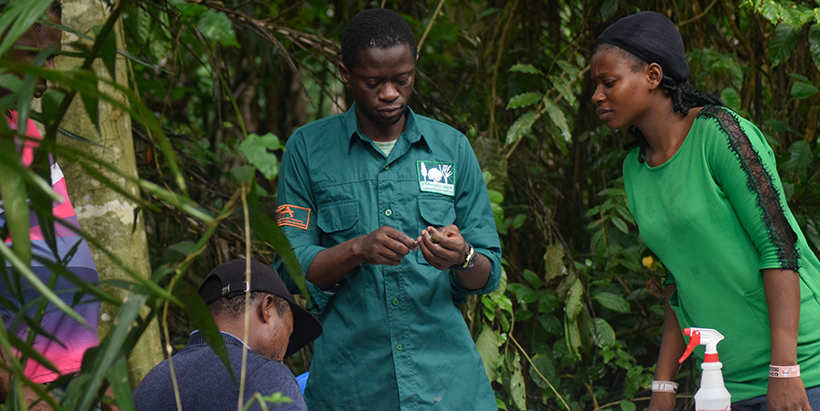 The Emerald Forest Reserve (EFR), located in Ikoyi-Osun, Osun State, Nigeria, has been officially designated a global Key Biodiversity Area (KBA), following years of rigorous, IITA Forest Center–led scientific research and biodiversity monitoring contribution. The designation, endorsed in 2024 by the global KBA Partnership, coordinated by the KBA Secretariat with BirdLife International as a core partner, recognizes EFR’s exceptional ecological value and its critical role in conserving globally significant species.
The Emerald Forest Reserve is located within the Abayomi Farm Estates, owned and managed by the Abayomi family for over two decades. The Abayomi family has demonstrated unwavering commitment to biodiversity conservation safeguarding a 120 hectares indigenous forest using pragmatic, community-based conservation approaches. Working closely with local communities and conservation partners—including the IITA Forest Center—the family helped halt logging, hunting, and poaching by transforming former loggers and hunters into custodians of the forest, supporting them with alternative livelihoods such as palm oil processing, beekeeping, agroforestry, furniture making, and tree seedling production.
Central to the KBA designation is the Emerald Forest Reserve’s importance for the conservation of the endemic and endangered Ibadan Malimbe (Malimbus Ibadanensis). Through long-term ornithological monitoring, the IITA Forest Center documented repeated sightings, acoustic calls, nesting attempts, and breeding behavior of the species within the reserve. These records represent some of the most comprehensive and scientifically validated evidence of the species’ persistence in the wild.
Bird monitoring surveys conducted quarterly over several years by the IITA Forest Center scientists, in collaboration with the A. P. Leventis Ornithological Research Institute, produced peer-reviewed publications that formed the backbone of the KBA nomination. These studies confirmed that the Emerald Forest Reserve supports a unique assemblage of Guinea–Congo forest bird species, including breeding populations of rare and restricted-range birds.
The designation, drawing on long-term biodiversity research, peer-reviewed scientific outputs, and standardized KBA assessment protocols, followed a scientifically rigorous nomination led by IITA-CGIAR, with Dr Adewale Awoyemi, IITA Forest Center Manager, serving as the Proposer. This was done alongside Ademola Ajayi, IITA Forest Center Field Supervisor; Dr Stella Egbe, Nigerian Conservation Foundation (NCF) Senior Conservation Manager; and Professor Shiiwua Manu, Professor of Ornithology, Department of Zoology, University of Jos; as co-proposers.
Speaking on the designation in Ibadan, Dr Awoyemi said, “This recognition reflects the strength of IITA Forest Center’s research efforts in identifying, documenting, and validating sites of global biodiversity importance. The Emerald Forest Reserve exemplifies how robust research, when combined with local stewardship, can deliver outcomes of international conservation relevance.”
“The scientific outputs generated by the IITA Forest Center and funded by A. G. Leventis Foundation were instrumental in demonstrating that the Emerald Forest Reserve meets global KBA criteria. Beyond species discovery, the research highlighted the forest’s broader biodiversity value and its role as a refuge for migratory and resident wildlife,” he added.
The BirdLife International Partner in Nigeria, the Nigerian Conservation Foundation (NCF), facilitated national-level coordination and stakeholder engagement during the review process. Congratulating all parties, NCF Director General, Dr Joseph Onoja, described the designation as a milestone for Nigeria’s biodiversity conservation efforts and noted its relevance to national and international biodiversity commitments.
“It is indeed exciting to have EFR as the first newly assessed and nominated KBA in Nigeria. We at NCF are happy with the coordination we provided to make this a reality, and we hope more sites like this across Nigeria will follow suit,” Dr Onoja said.
According to Dr Modupe Ladipo, one of the Directors of the Emerald Forest Reserve, the discovery and documentation of the Ibadan Malimbe was a turning point for the forest’s global recognition. She noted that repeated surveys by IITA Forest Center and its partners not only confirmed the species’ presence, but also recorded nesting structures and the first-ever acoustic documentation of its call. These findings demonstrated that the Emerald Forest Reserve provides a viable and recovering habitat for a species once feared to be disappearing.
The Nigeria Convention on Biological Diversity commended the development, highlighting that, ‘The designation of Emerald Forest Reserve as a KBA is a laudable achievement as it holds a significant population of the threatened and endemic Ibadan Malimbe (Malimbus Ibadanensis). Nigeria as signatory to the Convention on Biological Diversity is delighted at the concerted efforts of all these stakeholders to map out additional sites as KBAs in the country. All these ensure that Nigeria achieve its goals and targets in the National Biodiversity Strategies and Action Plans (NBSAP) to support global efforts to protect biodiversity, halt species declines, prevent habitat loss and preserve the ecosystem services.’
The Emerald Forest Reserve is scheduled to formally celebrate its KBA designation on 22 January 2026, bringing together conservation stakeholders, community representatives, and partner institutions. The milestone underscores the importance of science-driven conservation and reaffirms IITA Forest Center’s leadership in advancing biodiversity research and protection in Nigeria.
All scientific data, analyses, and publications underpinning the KBA nomination were generated through IITA-led research programs and remain the intellectual property of the International Institute of Tropical Agriculture. These outputs form part of IITA’s broader mandate to advance science-based conservation, landscape restoration, and biodiversity knowledge in Africa.
À propos du Centre Forestier de l'IITA
The IITA Forest Center manages forest resources for conservation, research, and education within the 1,000-hectare IITA campus in Ibadan, of which approximately 350 hectares are designated a forest reserve. Recognized as an Important Bird Area (IBA) by BirdLife International, the IITA Forest supports exceptional biodiversity, including over 450 plant species, 272 bird species, and the endemic Ibadan Malimbe. IITA’s forest research has resulted in internationally accredited conservation achievements, including ArbNet Level II accreditation for its Tree Heritage Park.
About the Emerald Forest Reserve
The Emerald Forest Reserve is a 120-hectare indigenous rainforest located within the Abayomi Farm Estates at Aworin, Ikoyi-Osun, Osun State. The reserve has been protected for over two decades through local stewardship, community ranger programmes, and conservation-oriented land management. In addition to biodiversity protection, EFR supports environmental education, wildlife rescue initiatives, and nature-based livelihood activities. Today, EFR stands as a refuge for rich biodiversity, including endemic and endangered bird species, primates such as Cercopithecus mona, reptiles like Python regius, and ecologically important tree species such as Pterygota macrocarpa, Lophira alata, and Afzelia africana.
Relations médias
Katherine Lopez
Head of Communications, IITA
Email: k.lopez@cgiar.org
The Emerald Forest Reserve (EFR), located in Ikoyi-Osun, Osun State, Nigeria, has been officially designated a global Key Biodiversity Area (KBA), following years of rigorous, IITA Forest Center–led scientific research and biodiversity monitoring contribution. The designation, endorsed in 2024 by the global KBA Partnership, coordinated by the KBA Secretariat with BirdLife International as a core partner, recognizes EFR’s exceptional ecological value and its critical role in conserving globally significant species.
The Emerald Forest Reserve is located within the Abayomi Farm Estates, owned and managed by the Abayomi family for over two decades. The Abayomi family has demonstrated unwavering commitment to biodiversity conservation safeguarding a 120 hectares indigenous forest using pragmatic, community-based conservation approaches. Working closely with local communities and conservation partners—including the IITA Forest Center—the family helped halt logging, hunting, and poaching by transforming former loggers and hunters into custodians of the forest, supporting them with alternative livelihoods such as palm oil processing, beekeeping, agroforestry, furniture making, and tree seedling production.
Central to the KBA designation is the Emerald Forest Reserve’s importance for the conservation of the endemic and endangered Ibadan Malimbe (Malimbus Ibadanensis). Through long-term ornithological monitoring, the IITA Forest Center documented repeated sightings, acoustic calls, nesting attempts, and breeding behavior of the species within the reserve. These records represent some of the most comprehensive and scientifically validated evidence of the species’ persistence in the wild.
Bird monitoring surveys conducted quarterly over several years by the IITA Forest Center scientists, in collaboration with the A. P. Leventis Ornithological Research Institute, produced peer-reviewed publications that formed the backbone of the KBA nomination. These studies confirmed that the Emerald Forest Reserve supports a unique assemblage of Guinea–Congo forest bird species, including breeding populations of rare and restricted-range birds.
The designation, drawing on long-term biodiversity research, peer-reviewed scientific outputs, and standardized KBA assessment protocols, followed a scientifically rigorous nomination led by IITA-CGIAR, with Dr Adewale Awoyemi, IITA Forest Center Manager, serving as the Proposer. This was done alongside Ademola Ajayi, IITA Forest Center Field Supervisor; Dr Stella Egbe, Nigerian Conservation Foundation (NCF) Senior Conservation Manager; and Professor Shiiwua Manu, Professor of Ornithology, Department of Zoology, University of Jos; as co-proposers.
Speaking on the designation in Ibadan, Dr Awoyemi said, “This recognition reflects the strength of IITA Forest Center’s research efforts in identifying, documenting, and validating sites of global biodiversity importance. The Emerald Forest Reserve exemplifies how robust research, when combined with local stewardship, can deliver outcomes of international conservation relevance.”
“The scientific outputs generated by the IITA Forest Center and funded by A. G. Leventis Foundation were instrumental in demonstrating that the Emerald Forest Reserve meets global KBA criteria. Beyond species discovery, the research highlighted the forest’s broader biodiversity value and its role as a refuge for migratory and resident wildlife,” he added.
The BirdLife International Partner in Nigeria, the Nigerian Conservation Foundation (NCF), facilitated national-level coordination and stakeholder engagement during the review process. Congratulating all parties, NCF Director General, Dr Joseph Onoja, described the designation as a milestone for Nigeria’s biodiversity conservation efforts and noted its relevance to national and international biodiversity commitments.
“It is indeed exciting to have EFR as the first newly assessed and nominated KBA in Nigeria. We at NCF are happy with the coordination we provided to make this a reality, and we hope more sites like this across Nigeria will follow suit,” Dr Onoja said.
According to Dr Modupe Ladipo, one of the Directors of the Emerald Forest Reserve, the discovery and documentation of the Ibadan Malimbe was a turning point for the forest’s global recognition. She noted that repeated surveys by IITA Forest Center and its partners not only confirmed the species’ presence, but also recorded nesting structures and the first-ever acoustic documentation of its call. These findings demonstrated that the Emerald Forest Reserve provides a viable and recovering habitat for a species once feared to be disappearing.
The Nigeria Convention on Biological Diversity commended the development, highlighting that, ‘The designation of Emerald Forest Reserve as a KBA is a laudable achievement as it holds a significant population of the threatened and endemic Ibadan Malimbe (Malimbus Ibadanensis). Nigeria as signatory to the Convention on Biological Diversity is delighted at the concerted efforts of all these stakeholders to map out additional sites as KBAs in the country. All these ensure that Nigeria achieve its goals and targets in the National Biodiversity Strategies and Action Plans (NBSAP) to support global efforts to protect biodiversity, halt species declines, prevent habitat loss and preserve the ecosystem services.’
The Emerald Forest Reserve is scheduled to formally celebrate its KBA designation on 22 January 2026, bringing together conservation stakeholders, community representatives, and partner institutions. The milestone underscores the importance of science-driven conservation and reaffirms IITA Forest Center’s leadership in advancing biodiversity research and protection in Nigeria.
All scientific data, analyses, and publications underpinning the KBA nomination were generated through IITA-led research programs and remain the intellectual property of the International Institute of Tropical Agriculture. These outputs form part of IITA’s broader mandate to advance science-based conservation, landscape restoration, and biodiversity knowledge in Africa.
À propos du Centre Forestier de l'IITA
The IITA Forest Center manages forest resources for conservation, research, and education within the 1,000-hectare IITA campus in Ibadan, of which approximately 350 hectares are designated a forest reserve. Recognized as an Important Bird Area (IBA) by BirdLife International, the IITA Forest supports exceptional biodiversity, including over 450 plant species, 272 bird species, and the endemic Ibadan Malimbe. IITA’s forest research has resulted in internationally accredited conservation achievements, including ArbNet Level II accreditation for its Tree Heritage Park.
About the Emerald Forest Reserve
The Emerald Forest Reserve is a 120-hectare indigenous rainforest located within the Abayomi Farm Estates at Aworin, Ikoyi-Osun, Osun State. The reserve has been protected for over two decades through local stewardship, community ranger programmes, and conservation-oriented land management. In addition to biodiversity protection, EFR supports environmental education, wildlife rescue initiatives, and nature-based livelihood activities. Today, EFR stands as a refuge for rich biodiversity, including endemic and endangered bird species, primates such as Cercopithecus mona, reptiles like Python regius, and ecologically important tree species such as Pterygota macrocarpa, Lophira alata, and Afzelia africana.
Relations médias
Katherine Lopez
Head of Communications, IITA
Email: k.lopez@cgiar.org
Folake Oduntan IITA Forest Center Communication Email: g.oduntan@cgiar.org
Contribué par
Histoires récentes
Aucun article trouvé