NOUVELLES DE L'IITA

Nigeria’s youth development Minister visits IITA, explores partnerships to advance youth agribusiness
février 27, 2026
Dr Simeon Ehui with Honorable Minister Ayodele Olawande Wisdom during discussions.
Nigeria’s Minister for Youth Development, Honorable Ayodele Olawande Wisdom visited the IITACGIAR recently, where he was received by the Director General, Dr Siméon Ehui, and engaged with scientists and members of the IITA Youth in Agribusiness (IYA) program led by Aline Mugisho. During the visit, Honorable Olawande Wisdom held discussions with IITA leadership, researchers, and the youth agripreneurs to explore strategic partnership opportunities aimed at strengthening youth-led agribusiness, fostering innovation, and expanding employment opportunities across the agricultural sector in Nigeria.
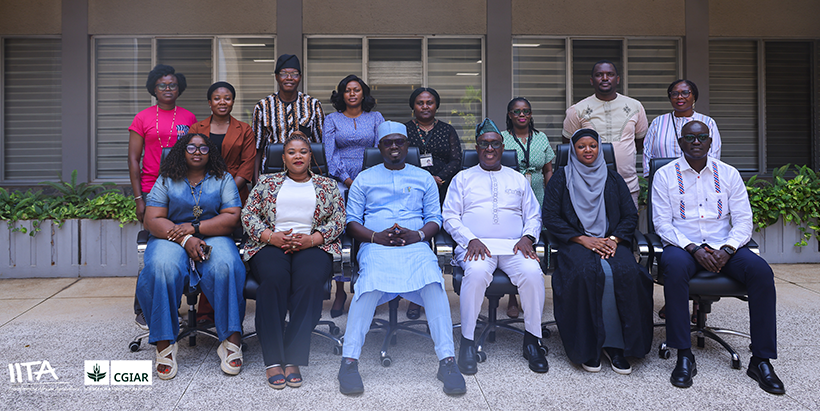
Dr Simeon Ehui with Honorable Minister Ayodele Olawande Wisdom with the IITA team, and the Ministry of Youth Development delegation.
Speaking with the Minister on how IITA prioritizes youth and policy engagement as part of its 2024-2030 Strategy, Dr Ehui said the institute is committed to working with governments in Africa to foster youth development and transform food systems. “We remain committed to turning ambition into action, through partnerships that place youth at the center of food systems and transformation,” Dr Ehui said. Highlighting the critical role of agriculture as a driver of sustainable development and national prosperity, particularly for young people, Deputy Director General Partnerships for Delivery and Scaling, Dr Tahirou Abdoulaye spoke on some of the existing innovations that align with the agricultural transformation agenda in Nigeria.
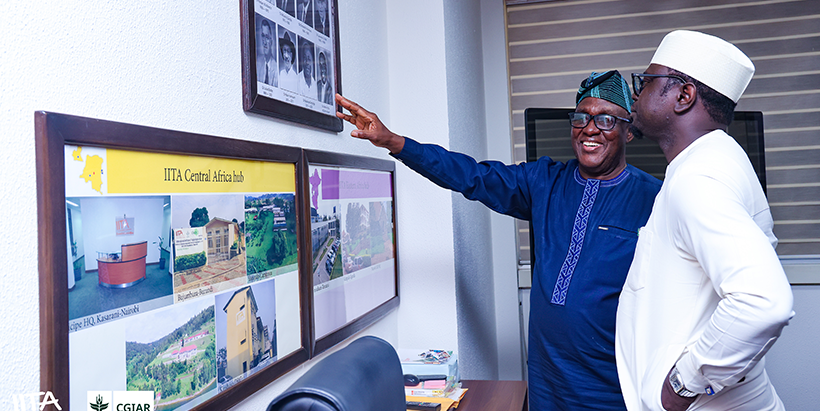
Dr Simeon Ehui giving the Honorable Minister Ayodele Olawande Wisdom a history of IITA's leadership during his visit to IITA headquarters in Ibadan.
Dr Simeon Ehui giving the Honorable Minister Ayodele Olawande Wisdom a history of IITA’s leadership during his visit to IITA headquarters in Ibadan.
Participants discussed how science, entrepreneurship, and policy alignment can accelerate youth participation in agribusiness and ensure that empowerment initiatives deliver sustainable, measurable impact.

…Minister applauds IITA Youth in Agribusiness

During his visit to the Youth in Agribusiness Office (IYA), the Minister, accompanied by Dr Ehui and some staff of the institute, expressed his satisfaction with IYA’s giant strides in empowering young people to thrive in agriculture, while stating the readiness of the ministry to work with the unit. He said during his remarks that unemployment remained one of the factors fueling insecurity, noting however that the collaboration with the IITA would help to curb crime and create wealth for more young people. “We are partnering with you to drive the engagement of young people in agriculture so that majority of them would be properly engaged.” He stated, “There are five cardinal areas we are targeting; Sport, Tech, Agriculture, Education, and Creative, so that at the end of the day, we will be able to reach out to a lot of young people. Your initiative at IYA has the potential to shake the continent, and so we can leverage it to get many youths equipped with various skills.” “What you are doing is supporting many young people to build a strong foundation and we want to be part of it. Nobody will change Nigeria or Africa for us. Despite the challenges we face as a country, a lot of farmers are making money. And people need to know that it takes time to build wealth.” Meanwhile, the Minister pointed out that the Nigerian Youth Academy (NiYA) launched by President Bola Tinubu had become a strong platform for equipping people with various marketable skills. He said the initiative creates a platform for training and creating a digital community. Speaking on the impact of his first visit to IITA-CGIAR, the Minister said seven days after he visited the IITA Abuja Station in December, the various enterprises and the dignified way of farming motivated him to set up a fish pond. “I’m a proud fish pond owner now,” he stated. “I’m starting small, so you can count me as one of your participants. What gave me the inspiration was everything I was shown at the Abuja Station.” “The IYA has done a lot, and you have equally shown that farming can be done with dignity. Our founding fathers were not in thousands; they were a few people who were determined to create change, and they gave it whatever it required. They were not part of this jet age. They didn’t have the technologies and innovations we now have access to. That means we can do lot with what is available now.” After his roundtable discussion with the IYA team, the Minister visited an exhibition by past project beneficiaries showcasing their various products, before heading to the enterprises run by the unit. From the screenhouses for various horticultural crops to the feed formulation facility, fish hatchery and fish ponds, Honorable Olawande Wisdom, who was visibly impressed, commended the IYA team for setting a strong example. The Chief Executive Officer, IYA, Ms Aline Mugisho, pointed out that IITA-CGIAR is primarily a research organization with research outcomes that are sometimes technical. She, however, noted that young farmers were being positioned as catalysts for spreading solutions both in rural and urban settings. “Looking at how our technologies can be scaled by young people; we can change the agri-food system.” She added, “The farming population is also aging, and the younger ones entering the space are not necessarily equipped, whether with the knowledge or resources required. Thus, countries need to invest in these kinds of activities in partnership with organisations like IITA-CGIAR.” Engagements during the Minister’s visit has reaffirmed IITA-CGIAR’s commitment to empowering Africa’s next generation of agricultural leaders through research, capacity development, and collaboration with government and private sector partners, while underscoring the importance of aligning youth-focused agricultural initiatives with national development priorities to maximize impact. The visit concluded with a shared commitment to deepen collaboration and create pathways for young Nigerians to thrive in agriculture through innovation, enterprise development, and strategic partnerships. Contributed by Jesutofunmi Robinson and ‘Timilehin Osunde

Contribué par

Nouvelles connexes

Aucun article trouvé

Laisser un commentaire

Votre adresse e-mail ne sera pas publiée. Les champs obligatoires sont indiqués avec *

Retour en haut
Olaosebikan, Olamide

Olamide Deborah Nwanze est une chercheuse principale spécialisée dans la recherche sur l'approche "genre" afin d'éclairer les politiques de sélection participative et inclusive, de développement de variétés et de systèmes semenciers concernant les cultures de racines, tubercules et bananes (RTB) au siège de l'Institut International d'Agriculture Tropicale, à Ibadan, au Nigeria. Elle est candidate au doctorat à l'Université d'Ibadan et titulaire d'un master et d'un diplôme d'ingénieur agronome en vulgarisation agricole et développement rural. Olamide est membre du programme African Women in Agricultural Research and Development – Gender Responsive Agricultural Systems Policy (SAISIE DE RÉCOMPENSEet les Chercheuses Sensibles au Genre Équipées pour la Transformation Agricole (SUPER. Elle cherche à appliquer ses apprentissages en matière d’approche genre, recherche sensible au genre, et expertise en développement et examen de politiques pour faciliter l’accès et l’adoption par les femmes, les jeunes, les enfants et les groupes sociaux vulnérables aux innovations agricoles qui garantissent la sécurité alimentaire, nutritionnelle, des revenus et des moyens de subsistance en Afrique. Ses rôles actuels comprennent le mentorat de chercheurs stagiaires, le développement de guides et manuels de formation, la mise en œuvre et l'adaptation de cadres et d'outils genre, l'engagement des acteurs de la chaîne de valeur en tant que partenaires de la science citoyenne, l'examen et la refonte des politiques, la gestion et l'analyse des données. Ses recherches actuelles portent sur les méthodes mixtes ainsi que sur les approches participatives et interdisciplinaires pour saisir et mettre en évidence les dynamiques de genre, les besoins, les préférences et les défis rencontrés par les parties prenantes au sein de la chaîne de valeur des moyens de subsistance agricoles afin de prioriser des stratégies axées sur le genre dans les programmes de sélection, la conception et la mise en œuvre des politiques.

À l'IITA, elle contribue à la mise en œuvre du CGIAR Initiative d'Élevage Accéléré et Innovation génétique Programmes ; recherche participative et genre au sein des Prochaine Génération ManiocHarvestPlusRTBAliments, et Tricot-ClimMob 1000Fermes Projets ; et la communication des connaissances sur le genre via le Série de webinaires G-LENS, vidéo documentaire, notes de politiquepublications, et blogs.


Publications récentes

de Sousa, K., van Etten, J., Manners, R. Bello, A., Teeken, B., Olaosebikan, O., et al. 2024. L'approche tricot : un cadre agile pour les essais décentralisés à la ferme soutenus par la science citoyenne. Une rétrospective. Agron. Sustain. Dev. 44, 8. https://doi.org/10.1007/s13593-023-00937-1

Madu, T., Onwuka, S., Nwafor, S., Onyemauwa, N., Ejechi, M., Ofoeze, M., Ukeje, B., Eluagu, C., Olaosebikan, O., Okoye, B., 2024. Les études sur les consommateurs inclusifs en matière de genre améliorent l'amélioration du manioc au Nigeria dans : Frontiers in Sociology, volume 9, numéro : 1224504, doi : 10.3389/fsoc.2024.1224504

Olaosebikan, O. ; Bello, A. ; Utoblo, O. ; Okoye, B. ; Olutegbe, N. ; Garner, E. ; Teeken, B. ; Bryan, E. ; Forsythe, L. ; Cole, S. ; Madu, T. 2023. Facteurs de stress et résilience au sein de la chaîne de valeur du manioc au Nigeria : Caractéristiques préférées des variétés de manioc et stratégies de réponse des hommes et des femmes pour informer l'amélioration variétale. Sustainability 15, 7837. https://doi.org/10.3390/su15107837

Okoye, B., Ofoeze, M., Ejechi, M., Onwuka, S., Nwafor, S., Onyemauwa, N., Ukeje, B., Eluagu, C., Obidiegwu, J.*, Olaosebikan, O., Madu, T.* 2023. Priorisation des traits préférés dans la chaîne de valeur de l'igname au Nigeria : une analyse de la situation en matière de genre in: Frontiers in Sociology, volume 8, numéro : 1232626, pages 1 – 9, ISSN 2297-7775, 2023. https://www.frontiersin.org/articles/10.3389/fsoc.2023.1232626/full

Olaosebikan, O., Bello, A. A., de Sousa, K., Ndjouenkeu, R., Adesokan, M., Alamu, E. O., Agbona, A., van Etten, J., Kegah, F. N.*, Dufour, D., Bouniol, A., Teeken, B. 2023. Acceptabilité par les consommateurs des produits alimentaires à base de gari-eba de manioc dans des contextes culturels et environnementaux variés en utilisant l'approche triade de comparaison des technologies (tricot) dans : Journal of the Science of Food and Agriculture,

Teeken, B., Olaosebikan, O., Bello, A. A., Madu, T.*, Cole, S. M. 2023. Évaluation qualitative de la positionnalité et des préférences des dyades en relation avec les activités liées au manioc : travailler avec des scientifiques citoyens du procès tricot https://hdl.handle.net/10568/138326 Type : Manuel

Bouniol, A., Ceballos, H., Bello, A. A., Teeken, B., Olaosebikan, O., Owoade, D., Agbona, A., Fotso Kuate, A., Madu, T.*, Okoye, B.*, Ofoeze, M.*, Nwafor, S.*, Onyemauwa, N.*, Adinsi, L.*, Forsythe, L., Dufour, D. 2023. Impact variétal sur le travail des femmes, la charge de travail et la pénibilité associée dans le traitement des plantes à racines, tubercules et bananes : focus sur le manioc en Afrique subsaharienne dans : Journal of the Science of Food and Agriculture, pages 1 – 25, ISSN 0022-5142,

Bello, A. A., Agbona, A., Olaosebikan, O., Edughaen, G., Dufour, D., Bouniol, A., Iluebbey, P., Ndjouenkeu, R.*, Rabbi, I. Y., Teeken, B. 2023. Effets génétiques et environnementaux sur la productivité de la transformation et le rendement des produits alimentaires : la pénibilité du travail des femmes dans : Journal of the Science of Food and Agriculture, pages 1 – 32, ISSN 0022-5142, 5

Cavicchioli, M., Zimbiti, T., Teeken, B., Nwanze, D.O., Liani, M., Parkes, E. & Bello, A. 2023. Rapport sur la formation en sélection génétique sensible au genre à l'IITA. Genetic Resources Center, IITA-HQ, Ibadan, 21-23 septembre 2022. Ibadan, Nigéria : IITA, (34 p.).https://hdl.handle.net/10568/131368

Agbona, A. Peteti P., Teeken B., Olaosebikan O. Bello, A. A., Parkes, E., Rabbi, I. Y., Mueller, L., Egesi, C., Kulakow, P. 2022. Gestion des données dans les programmes d'amélioration des cultures RTB africaines multidisciplinaires. In : Williamson, H.F., Leonelli, S. (eds) Towards Responsible Plant Data Linkage: Data Challenges for Agricultural Research and Development. Springer, Cham. https://doi.org/10.1007/978-3-031-13276-6_5

Lora Forsythe, Pricilla Marimo, Sarah Mayanja, Olamide D. Olaosebikan, Esme Stuart, Bela Teeken, Benjamin Okoye, Tessy Madu, (2021). Analyse transversale du genre dans RTBfoods Étape 2 Cartographie des genres sur les produits RTB. Comprendre les moteurs des préférences en matière de traits et le développement de profils de produits RTB multi-utilisateurs, WP1. Londres, Royaume-Uni : Rapport scientifique de terrain RTBfoods, 30 p.

Teeken, B., Garner, E., Agbona, A., Balogun, I., Olaosebikan, O., Bello, A., Madu, T., Okoye, B., Egesi, C., Kulakow, P. et Tufan, H.A. 2021. Au-delà des “ traits des femmes ” : explorer comment le genre, les différences sociales et les caractéristiques des ménages influencent les préférences pour les traits. Frontiers Systèmes alimentaires durables 5:740926. https://doi.org/10.3389/fsufs.2021.740926

Teeken, B., Agbona, A., Bello, A., Olaosebikan, O., Alamu, E., Adesokan, M., Awoyale, W., Madu, T., Okoye, B., Chijioke, U., Owoade, D., Okoro, M., Bouniol, A., Dufour, D., Hershey, C., Rabbi, I., Maziya‐Dixon, B., Egesi, C., Tufan, H. et Kulakow, P. (020. Comprendre les préférences variétales du manioc par le classement par paires du gari-eba et du fufu préparés par des agriculteurs-transformateurs locaux. Int J Food Sci Technol. https://doi.org/10.1111/ijfs.14862

Bela Teeken, Olamide Olaosebikan, Ireti Balogun, Benjamin Okoye, Tessy Madu, Steven Cole, Abolore Bello, Elizabeth Parkes. (2020). Pilotage des outils de profil client et produit G+ pour l'amélioration sensible au genre du manioc au Nigeria. Nigeria : Institut international d'agriculture tropicale (IIAT). https://hdl.handle.net/20.500.11766/13000