
Nouveau partenariat pour renforcer la santé des sols et sécuriser les moyens de subsistance de 1,5 million d'agriculteurs sahéliens
6 mars 2026
IBADAN, NIGERIA — 26 février 2026 — The Soil Values Program and the Regional Hub for Fertilizer and Soil Health for West Africa and the Sahel today announced a formal partnership. They signed a Memorandum of Understanding (MoU) to coordinate soil health interventions across West Africa and the Sahel. The partnership will enhance collaboration, minimize duplication of effort, and deliver lasting impact in the region.
This agreement unites the Regional Hub’s technical consortium with the Soil Values Program’s implementation platform in the Sahel. Consortium partners include IITA, IFDC, OCP Africa, APNI, UM6P, and ISRIC.
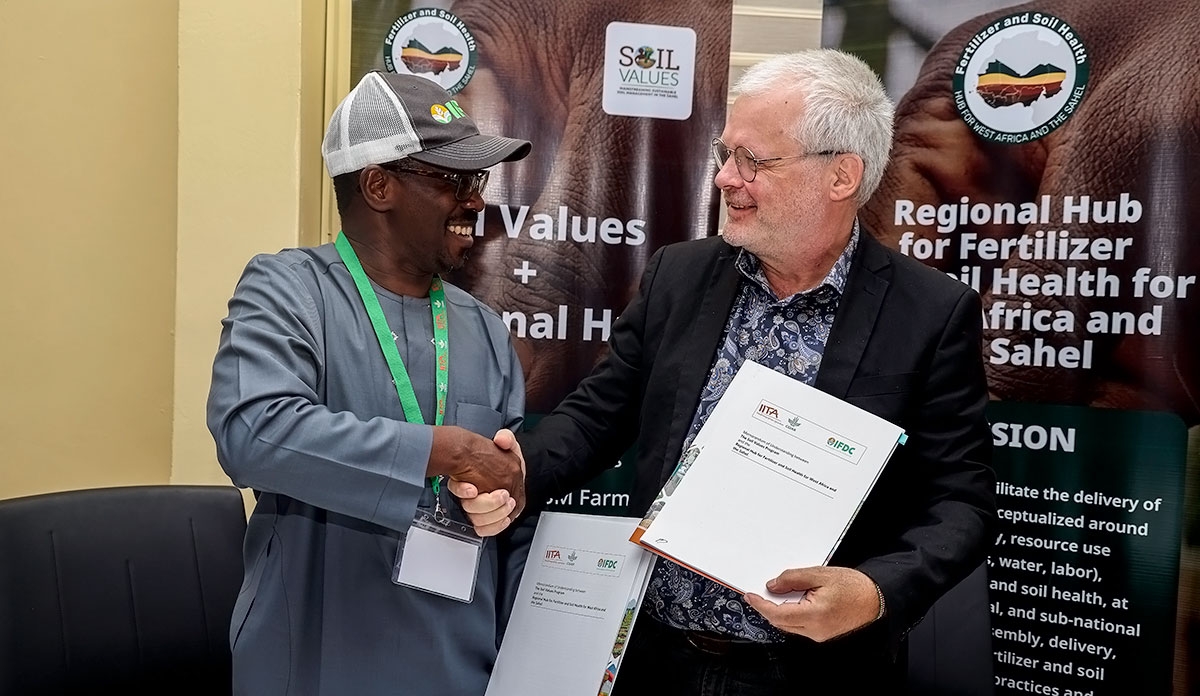 The collaboration aims to restore 2 million hectares of degraded land and strengthen the livelihoods of 1.5 million smallholder farmers in the region.
The MoU was signed at IITA headquarters in Ibadan by Alain Sy Traoré, Program Director of the Soil Values Program, and Dr. Bernard Vanlauwe, Deputy Director General, Research for Development (R4D), IITA.
The partnership aligns with regional soil health frameworks, including the Lomé Declaration on Fertilizer and Soil Health (2023), the Nairobi Declaration (2024), and the ECOWAS Soil Health Roadmap (2023–2033). It also establishes a framework to operationalize collaboration at scale.
Under the agreement, the Regional Hub will align its 20 technical functions with the Soil Values Program’s nine strategic pillars. This enables integrated planning, shared data systems, and coordinated implementation across countries.
“I firmly believe that together we are far stronger than we are individually. This agreement deepens our collaboration and elevates our shared vision for soil health beyond individual initiatives, positioning us to drive impact at regional and global levels,” said Dr. Bernard Vanlauwe, Deputy Director General, Research for Development (R4D), IITA.
To date, the Regional Hub intentionally moderated its engagement in parts of the Sahel — including Burkina Faso and Niger. The goal was to avoid overlapping with Soil Values Program activities. The MoU resolves that constraint and clarifies roles and responsibilities. Now, both initiatives can confidently expand under a coordinated approach.
“In the past, we deliberately moderated the Hub’s engagement in the Sahel to avoid approaching the same stakeholders with overlapping agendas. This MoU resolves that potential confusion and allows us to move forward in a coordinated and coherent manner,” Dr. Vanlauwe added.
“The true value of this agreement is that it establishes an official, ongoing commitment between our institutions—regardless of leadership changes,” said Alain Sy Traoré, Program Director, Soil Values Program.
Under the partnership, both initiatives commit to:
The collaboration aims to restore 2 million hectares of degraded land and strengthen the livelihoods of 1.5 million smallholder farmers in the region.
The MoU was signed at IITA headquarters in Ibadan by Alain Sy Traoré, Program Director of the Soil Values Program, and Dr. Bernard Vanlauwe, Deputy Director General, Research for Development (R4D), IITA.
The partnership aligns with regional soil health frameworks, including the Lomé Declaration on Fertilizer and Soil Health (2023), the Nairobi Declaration (2024), and the ECOWAS Soil Health Roadmap (2023–2033). It also establishes a framework to operationalize collaboration at scale.
Under the agreement, the Regional Hub will align its 20 technical functions with the Soil Values Program’s nine strategic pillars. This enables integrated planning, shared data systems, and coordinated implementation across countries.
“I firmly believe that together we are far stronger than we are individually. This agreement deepens our collaboration and elevates our shared vision for soil health beyond individual initiatives, positioning us to drive impact at regional and global levels,” said Dr. Bernard Vanlauwe, Deputy Director General, Research for Development (R4D), IITA.
To date, the Regional Hub intentionally moderated its engagement in parts of the Sahel — including Burkina Faso and Niger. The goal was to avoid overlapping with Soil Values Program activities. The MoU resolves that constraint and clarifies roles and responsibilities. Now, both initiatives can confidently expand under a coordinated approach.
“In the past, we deliberately moderated the Hub’s engagement in the Sahel to avoid approaching the same stakeholders with overlapping agendas. This MoU resolves that potential confusion and allows us to move forward in a coordinated and coherent manner,” Dr. Vanlauwe added.
“The true value of this agreement is that it establishes an official, ongoing commitment between our institutions—regardless of leadership changes,” said Alain Sy Traoré, Program Director, Soil Values Program.
Under the partnership, both initiatives commit to:
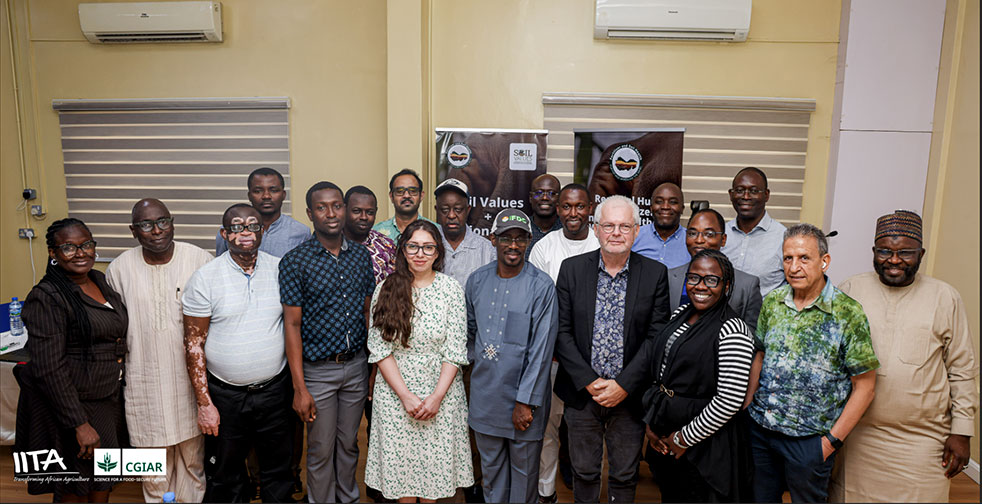 By leveraging over €300 million in private and development capital, the program aims to shift soil health efforts from traditional aid models to sustainable investment. Seventy percent of implementation will be delivered by local partners. This ensures ownership, resilience, and lasting outcomes. Performance-based assessments guide annual contracts and continued engagement with partners delivering results.
“One of the reasons I am particularly proud of this program is the strength of our knowledge partners. Soil health transformation is complex and multi-dimensional, but with partners of this calibre, we have built a foundation that gives us both credibility and a strong pathway to success,” said Alain Sy Traoré, Program Director, Soil Values Program.
The partnership will focus on four strategic areas of collaboration:
By leveraging over €300 million in private and development capital, the program aims to shift soil health efforts from traditional aid models to sustainable investment. Seventy percent of implementation will be delivered by local partners. This ensures ownership, resilience, and lasting outcomes. Performance-based assessments guide annual contracts and continued engagement with partners delivering results.
“One of the reasons I am particularly proud of this program is the strength of our knowledge partners. Soil health transformation is complex and multi-dimensional, but with partners of this calibre, we have built a foundation that gives us both credibility and a strong pathway to success,” said Alain Sy Traoré, Program Director, Soil Values Program.
The partnership will focus on four strategic areas of collaboration:
The collaboration aims to restore 2 million hectares of degraded land and strengthen the livelihoods of 1.5 million smallholder farmers in the region.
The MoU was signed at IITA headquarters in Ibadan by Alain Sy Traoré, Program Director of the Soil Values Program, and Dr. Bernard Vanlauwe, Deputy Director General, Research for Development (R4D), IITA.
The partnership aligns with regional soil health frameworks, including the Lomé Declaration on Fertilizer and Soil Health (2023), the Nairobi Declaration (2024), and the ECOWAS Soil Health Roadmap (2023–2033). It also establishes a framework to operationalize collaboration at scale.
Under the agreement, the Regional Hub will align its 20 technical functions with the Soil Values Program’s nine strategic pillars. This enables integrated planning, shared data systems, and coordinated implementation across countries.
“I firmly believe that together we are far stronger than we are individually. This agreement deepens our collaboration and elevates our shared vision for soil health beyond individual initiatives, positioning us to drive impact at regional and global levels,” said Dr. Bernard Vanlauwe, Deputy Director General, Research for Development (R4D), IITA.
To date, the Regional Hub intentionally moderated its engagement in parts of the Sahel — including Burkina Faso and Niger. The goal was to avoid overlapping with Soil Values Program activities. The MoU resolves that constraint and clarifies roles and responsibilities. Now, both initiatives can confidently expand under a coordinated approach.
“In the past, we deliberately moderated the Hub’s engagement in the Sahel to avoid approaching the same stakeholders with overlapping agendas. This MoU resolves that potential confusion and allows us to move forward in a coordinated and coherent manner,” Dr. Vanlauwe added.
“The true value of this agreement is that it establishes an official, ongoing commitment between our institutions—regardless of leadership changes,” said Alain Sy Traoré, Program Director, Soil Values Program.
Under the partnership, both initiatives commit to:
- Gouvernance partagée : Participation conjointe aux structures de leadership stratégique et de prise de décision pour renforcer l'alignement et la responsabilité.
- Systèmes de données unifiés : Adopter des outils de données standardisés et activés par l'IA en utilisant les principes FAIR — Facilement trouvables, Accessibles, Interopérables et Réutilisables (Findable, Accessible, Interoperable, Reusable). Ces outils génèrent des informations cohérentes sur les sols à travers les pays.
- Rôles géographiques clairs : Le programme des valeurs du sol dirigera la mise en œuvre au Sahel (Burkina Faso, Mali, Niger, nord du Nigeria), tandis que le Hub régional fournira la plateforme technique plus large à travers l'Afrique de l'Ouest.
By leveraging over €300 million in private and development capital, the program aims to shift soil health efforts from traditional aid models to sustainable investment. Seventy percent of implementation will be delivered by local partners. This ensures ownership, resilience, and lasting outcomes. Performance-based assessments guide annual contracts and continued engagement with partners delivering results.
“One of the reasons I am particularly proud of this program is the strength of our knowledge partners. Soil health transformation is complex and multi-dimensional, but with partners of this calibre, we have built a foundation that gives us both credibility and a strong pathway to success,” said Alain Sy Traoré, Program Director, Soil Values Program.
The partnership will focus on four strategic areas of collaboration:
- Partage de données et de connaissances : Outils partagés, tableaux de bord, ensembles de données et publications conjointes pour renforcer la prise de décision fondée sur des données probantes.
- Renforcement des capacités : Formation harmonisée et soutien coordonné aux institutions nationales et aux systèmes de vulgarisation.
- Engagement politique : Contributions coordonnées aux dialogues sur les politiques et plaidoyer conjoint pour l'investissement dans la santé des sols.
- Mobilisation des ressources : Collecte de fonds conjointe et engagement des donateurs pour une plus grande échelle et un plus grand impact.
Contribué par
Histoires récentes
Aucun article trouvé