
NOUVELLES DE L'IITA

The Federal University of Agriculture and Entrepreneurship, explores partnership to build future agricultural entrepreneurs
juillet 24, 2026
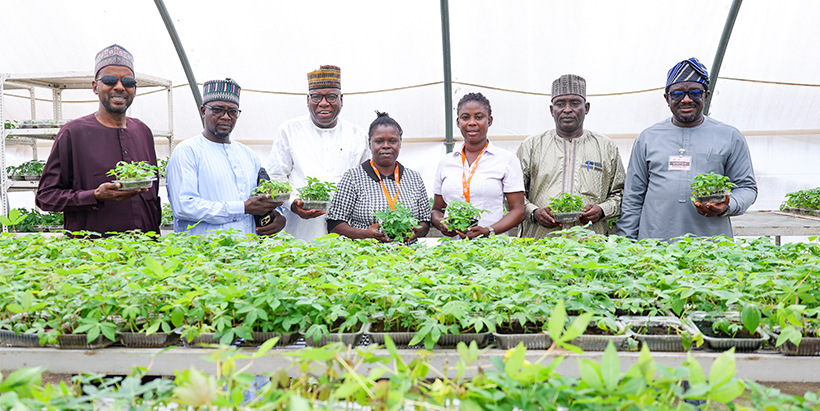
FUAEB delegates tour IITA's Semi-Autotrophic Hydroponics (SAH) screenhouse learning about innovative cassava seed multiplication technologies that support rapid production of clean planting materials.
FUAEB delegates tour IITA’s Semi-Autotrophic Hydroponics (SAH) screenhouse learning about innovative cassava seed multiplication technologies that support rapid production of clean planting materials.

Delegates from the newly established Federal University of Agriculture and Entrepreneurship, Bama (FUAEB), Borno State, visited IITACGIAR from 19–23 July to explore strategic partnerships and technical collaborations to develop a new generation of self-reliant, innovative, and economically productive graduates. As Nigeria continues to seek innovative solutions to youth unemployment, food insecurity, and economic empowerment, FUAEB is charting an ambitious course to produce graduates who are economically independent.

The delegation, led by Professor Garba Ngala Mohammed, included the Vice-Chancellor of FUAEB, Professor Tijjani Kalli, and other university officials was met by Professor Michael Abberton, Director West Africa Hub, and Head of IITA Genetic Resources Center. According to the delegation, the visit was inspired by the contribution of the Borno State Governor, His Excellency, Babagana Zulum, to leverage IITA’s decades of experience in agricultural research, innovation, capacity development, and technology delivery to establish a strong foundation for the new institution.

“The focus is to ensure that the products of this university become job creators and not job seekers,” members of the delegation emphasized during the interactions. They highlighted how FUAEB can leverage the flexibility provided by the National Universities Commission’s Core Curriculum and Minimum Academic Standards (CCMAS), which allows universities to develop up to 30 per cent of their curricula to reflect local priorities and institutional goals. For FUAEB, this presents an opportunity to embed entrepreneurship, hands-on learning, and agribusiness management into their academic programs.
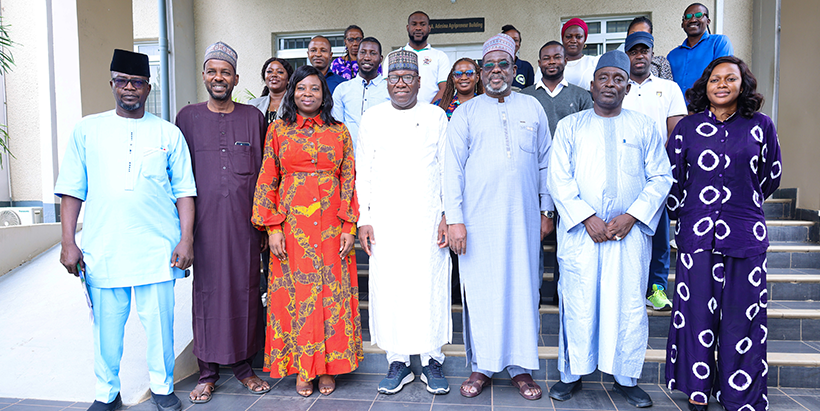
FUAEB delegates with IITA Deputy Director General, Partnerships for Delivery and Scaling, Dr Tahirou Abdoulaye, and representatives of the IITA Youth in Agribusiness (IYA) and Capacity Development Office after discussions on entrepreneurship-driven agricultural education, capacity-building models, and agribusiness development for raising job creators in the agrifood sector.

During the week, the delegation explored IITA’s world-class facilities, engaged with several IITA research and support units, and learned about research innovations that have transformed agriculture across Africa and that align with academic training modules. Discussions covered crop science, soil health, germplasm health, fisheries and aquaculture, livestock development, food science and nutrition, genetic resource conservation, biosciences, mechanization, capacity building, and agribusiness development.

At the Genetic Resources Center (GRC), visitors learned about IITA’s role in conserving vital crop diversity, including cassava, yam, banana, plantain, cowpea, Bambara groundnut amongst others. The center maintains valuable landraces and genetic materials in trust for the Food and Agriculture Organization (FAO), making them freely available for global crop improvement efforts.

The delegation also visited the Bioscience Center, where opportunities for student training, researcher exchanges, and capacity-building in biotechnology and modern breeding techniques were presented. They learned how advanced molecular tools and marker-assisted breeding are accelerating crop improvement. At the Regional Hub for Fertilizer and Soil Health, the team expressed particular interest in exploring future collaborations to support soil health assessments and sustainable land management initiatives for the university and the wider agricultural landscape of Borno State.

The visitors also interacted with experts from the Food and Nutrition Sciences Laboratory (FNSL), where discussions focused on food safety, product development, consumer preference studies, and breeding crops for improved nutritional quality. The laboratory’s work on High-Quality Cassava Flour and nutrition-sensitive innovations generated particular interest as potential areas for student learning and research collaboration.

Recognizing fisheries and aquaculture as a strategic growth area, the delegation met with WorldFish representatives to discuss curriculum development, research opportunities, and practical training models. Similarly, interactions with scientists from the International Livestock Research Institute (ILRI) emphasized the importance of integrating practical feed production, value addition, and agribusiness skills into academic programs to ensure graduates are equipped to establish successful enterprises.

The discussions also explored adapting IITA Youth Agripreneur (IYA) models and agribusiness hub concepts to support entrepreneurship training at FUAEB. The delegation also toured IITA’s Research Farm Unit, where they observed modern agricultural machinery and mechanization technologies that support efficient crop production. Discussions explored opportunities for technical support in developing the university’s farm infrastructure and practical training facilities.

At the end of the visit, the delegates identified several priority areas of collaboration in a future Memorandum of Understanding (MoU), including curriculum development, staff and student exchanges, industrial training placements, sabbatical opportunities for lecturers, laboratory development, manpower capacity building, crop resilience research, soil health management, fisheries, livestock development, and agribusiness incubation.

Describing the engagement as highly productive, members of the delegation expressed optimism that the emerging partnership would help position the Federal University of Agriculture and Entrepreneurship, Bama, as a center of excellence for agricultural innovation, entrepreneurship, and youth empowerment in Nigeria.

As FUAEB prepares to admit its first students, the proposed collaboration with IITA is expected to provide valuable technical expertise, practical training models, and research support to nurture a new generation of agricultural entrepreneurs capable of driving economic growth, food security, and sustainable development in Borno State and beyond.


Retour en haut
Olaosebikan, Olamide

Olamide Deborah Nwanze est une chercheuse principale spécialisée dans la recherche sur l'approche "genre" afin d'éclairer les politiques de sélection participative et inclusive, de développement de variétés et de systèmes semenciers concernant les cultures de racines, tubercules et bananes (RTB) au siège de l'Institut International d'Agriculture Tropicale, à Ibadan, au Nigeria. Elle est candidate au doctorat à l'Université d'Ibadan et titulaire d'un master et d'un diplôme d'ingénieur agronome en vulgarisation agricole et développement rural. Olamide est membre du programme African Women in Agricultural Research and Development – Gender Responsive Agricultural Systems Policy (SAISIE DE RÉCOMPENSEet les Chercheuses Sensibles au Genre Équipées pour la Transformation Agricole (SUPER. Elle cherche à appliquer ses apprentissages en matière d’approche genre, recherche sensible au genre, et expertise en développement et examen de politiques pour faciliter l’accès et l’adoption par les femmes, les jeunes, les enfants et les groupes sociaux vulnérables aux innovations agricoles qui garantissent la sécurité alimentaire, nutritionnelle, des revenus et des moyens de subsistance en Afrique. Ses rôles actuels comprennent le mentorat de chercheurs stagiaires, le développement de guides et manuels de formation, la mise en œuvre et l'adaptation de cadres et d'outils genre, l'engagement des acteurs de la chaîne de valeur en tant que partenaires de la science citoyenne, l'examen et la refonte des politiques, la gestion et l'analyse des données. Ses recherches actuelles portent sur les méthodes mixtes ainsi que sur les approches participatives et interdisciplinaires pour saisir et mettre en évidence les dynamiques de genre, les besoins, les préférences et les défis rencontrés par les parties prenantes au sein de la chaîne de valeur des moyens de subsistance agricoles afin de prioriser des stratégies axées sur le genre dans les programmes de sélection, la conception et la mise en œuvre des politiques.

À l'IITA, elle contribue à la mise en œuvre du CGIAR Initiative d'Élevage Accéléré et Innovation génétique Programmes ; recherche participative et genre au sein des Prochaine Génération ManiocHarvestPlusRTBAliments, et Tricot-ClimMob 1000Fermes Projets ; et la communication des connaissances sur le genre via le Série de webinaires G-LENS, vidéo documentaire, notes de politiquepublications, et blogs.


Publications récentes

de Sousa, K., van Etten, J., Manners, R. Bello, A., Teeken, B., Olaosebikan, O., et al. 2024. L'approche tricot : un cadre agile pour les essais décentralisés à la ferme soutenus par la science citoyenne. Une rétrospective. Agron. Sustain. Dev. 44, 8. https://doi.org/10.1007/s13593-023-00937-1

Madu, T., Onwuka, S., Nwafor, S., Onyemauwa, N., Ejechi, M., Ofoeze, M., Ukeje, B., Eluagu, C., Olaosebikan, O., Okoye, B., 2024. Les études sur les consommateurs inclusifs en matière de genre améliorent l'amélioration du manioc au Nigeria dans : Frontiers in Sociology, volume 9, numéro : 1224504, doi : 10.3389/fsoc.2024.1224504

Olaosebikan, O. ; Bello, A. ; Utoblo, O. ; Okoye, B. ; Olutegbe, N. ; Garner, E. ; Teeken, B. ; Bryan, E. ; Forsythe, L. ; Cole, S. ; Madu, T. 2023. Facteurs de stress et résilience au sein de la chaîne de valeur du manioc au Nigeria : Caractéristiques préférées des variétés de manioc et stratégies de réponse des hommes et des femmes pour informer l'amélioration variétale. Sustainability 15, 7837. https://doi.org/10.3390/su15107837

Okoye, B., Ofoeze, M., Ejechi, M., Onwuka, S., Nwafor, S., Onyemauwa, N., Ukeje, B., Eluagu, C., Obidiegwu, J.*, Olaosebikan, O., Madu, T.* 2023. Priorisation des traits préférés dans la chaîne de valeur de l'igname au Nigeria : une analyse de la situation en matière de genre in: Frontiers in Sociology, volume 8, numéro : 1232626, pages 1 – 9, ISSN 2297-7775, 2023. https://www.frontiersin.org/articles/10.3389/fsoc.2023.1232626/full

Olaosebikan, O., Bello, A. A., de Sousa, K., Ndjouenkeu, R., Adesokan, M., Alamu, E. O., Agbona, A., van Etten, J., Kegah, F. N.*, Dufour, D., Bouniol, A., Teeken, B. 2023. Acceptabilité par les consommateurs des produits alimentaires à base de gari-eba de manioc dans des contextes culturels et environnementaux variés en utilisant l'approche triade de comparaison des technologies (tricot) dans : Journal of the Science of Food and Agriculture,

Teeken, B., Olaosebikan, O., Bello, A. A., Madu, T.*, Cole, S. M. 2023. Évaluation qualitative de la positionnalité et des préférences des dyades en relation avec les activités liées au manioc : travailler avec des scientifiques citoyens du procès tricot https://hdl.handle.net/10568/138326 Type : Manuel

Bouniol, A., Ceballos, H., Bello, A. A., Teeken, B., Olaosebikan, O., Owoade, D., Agbona, A., Fotso Kuate, A., Madu, T.*, Okoye, B.*, Ofoeze, M.*, Nwafor, S.*, Onyemauwa, N.*, Adinsi, L.*, Forsythe, L., Dufour, D. 2023. Impact variétal sur le travail des femmes, la charge de travail et la pénibilité associée dans le traitement des plantes à racines, tubercules et bananes : focus sur le manioc en Afrique subsaharienne dans : Journal of the Science of Food and Agriculture, pages 1 – 25, ISSN 0022-5142,

Bello, A. A., Agbona, A., Olaosebikan, O., Edughaen, G., Dufour, D., Bouniol, A., Iluebbey, P., Ndjouenkeu, R.*, Rabbi, I. Y., Teeken, B. 2023. Effets génétiques et environnementaux sur la productivité de la transformation et le rendement des produits alimentaires : la pénibilité du travail des femmes dans : Journal of the Science of Food and Agriculture, pages 1 – 32, ISSN 0022-5142, 5

Cavicchioli, M., Zimbiti, T., Teeken, B., Nwanze, D.O., Liani, M., Parkes, E. & Bello, A. 2023. Rapport sur la formation en sélection génétique sensible au genre à l'IITA. Genetic Resources Center, IITA-HQ, Ibadan, 21-23 septembre 2022. Ibadan, Nigéria : IITA, (34 p.).https://hdl.handle.net/10568/131368

Agbona, A. Peteti P., Teeken B., Olaosebikan O. Bello, A. A., Parkes, E., Rabbi, I. Y., Mueller, L., Egesi, C., Kulakow, P. 2022. Gestion des données dans les programmes d'amélioration des cultures RTB africaines multidisciplinaires. In : Williamson, H.F., Leonelli, S. (eds) Towards Responsible Plant Data Linkage: Data Challenges for Agricultural Research and Development. Springer, Cham. https://doi.org/10.1007/978-3-031-13276-6_5

Lora Forsythe, Pricilla Marimo, Sarah Mayanja, Olamide D. Olaosebikan, Esme Stuart, Bela Teeken, Benjamin Okoye, Tessy Madu, (2021). Analyse transversale du genre dans RTBfoods Étape 2 Cartographie des genres sur les produits RTB. Comprendre les moteurs des préférences en matière de traits et le développement de profils de produits RTB multi-utilisateurs, WP1. Londres, Royaume-Uni : Rapport scientifique de terrain RTBfoods, 30 p.

Teeken, B., Garner, E., Agbona, A., Balogun, I., Olaosebikan, O., Bello, A., Madu, T., Okoye, B., Egesi, C., Kulakow, P. et Tufan, H.A. 2021. Au-delà des “ traits des femmes ” : explorer comment le genre, les différences sociales et les caractéristiques des ménages influencent les préférences pour les traits. Frontiers Systèmes alimentaires durables 5:740926. https://doi.org/10.3389/fsufs.2021.740926

Teeken, B., Agbona, A., Bello, A., Olaosebikan, O., Alamu, E., Adesokan, M., Awoyale, W., Madu, T., Okoye, B., Chijioke, U., Owoade, D., Okoro, M., Bouniol, A., Dufour, D., Hershey, C., Rabbi, I., Maziya‐Dixon, B., Egesi, C., Tufan, H. et Kulakow, P. (020. Comprendre les préférences variétales du manioc par le classement par paires du gari-eba et du fufu préparés par des agriculteurs-transformateurs locaux. Int J Food Sci Technol. https://doi.org/10.1111/ijfs.14862

Bela Teeken, Olamide Olaosebikan, Ireti Balogun, Benjamin Okoye, Tessy Madu, Steven Cole, Abolore Bello, Elizabeth Parkes. (2020). Pilotage des outils de profil client et produit G+ pour l'amélioration sensible au genre du manioc au Nigeria. Nigeria : Institut international d'agriculture tropicale (IIAT). https://hdl.handle.net/20.500.11766/13000