
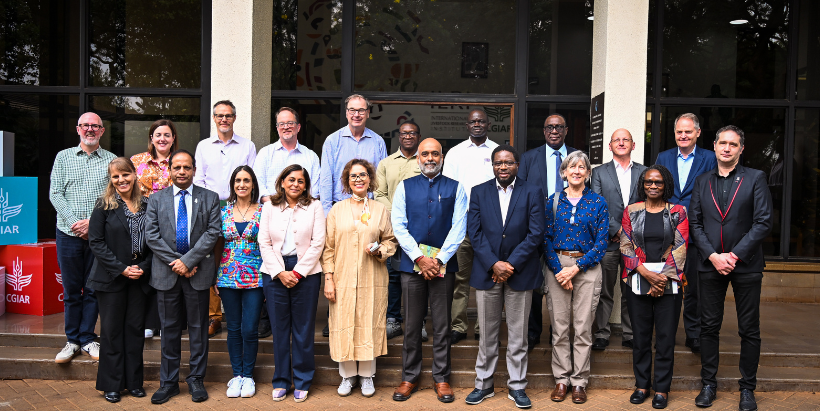
CGIAR recently hosted Dr Hari Menon, President for Global Growth and Opportunity at the Gates Foundation, and members of the CGIAR Global Leadership Team for an engagement focused on the impact of the foundation’s investments in agricultural research and innovation. The visit provided an opportunity for IITA-CGIAR to demonstrate how strategic investments are translating into scientific advances, policy influence, capacity development, and technologies with potential to deliver meaningful benefits to farmers and consumers. Among the highlights were IITA’s work in genome editing, scientific stewardship, and gender-responsive crop improvement, including the Yam Optimized Architecture through Gene Editing (YOAGE) project, which places the needs and priorities of women farmers at the center of technology development.
Furthermore, IITA showcased its gene-edited, bacterial wilt-resistant banana, which has been approved in Kenya for field testing as a conventional crop. The achievement was presented as a powerful example of science informing policy and enabling innovation. The growing interest from Rwanda, including its move to develop genome editing guidelines as it explores access to such innovations, further demonstrates how scientific advances can influence policy beyond national borders.
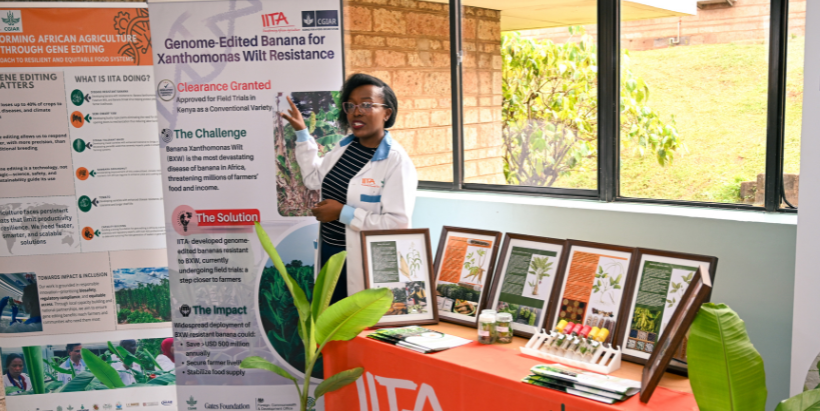
The engagement also highlighted IITA’s role in strengthening Africa’s scientific ecosystem through training, mentorship, partnerships, and stewardship systems that support the responsible development and deployment of emerging technologies.
Directeur général de l'IITA Dr Siméon Ehui emphasized the importance of demonstrating measurable impact from research investments, noting, “Our responsibility is not only to generate excellent science, but to ensure that science translates into solutions, stronger institutions, informed policies, and tangible benefits for farmers.”
Reflecting on the engagement, Dr Ismahane Elouafi, CGIAR Executive Managing Director, underscored the importance of connecting research investment with real-world outcomes, noting, “The value of CGIAR investments is ultimately demonstrated through the innovations, partnerships, and capacities they enable. IITA’s work illustrates how science can move from the laboratory to policy and, ultimately, towards impact on the ground.”
The visit reinforced the strategic value of continued investment in CGIAR research. It highlighted IITA’s growing role in translating scientific innovation into policy influence, capacity strengthening, and agricultural transformation across Africa.
Contribué par
Rose-Harriet Okech