
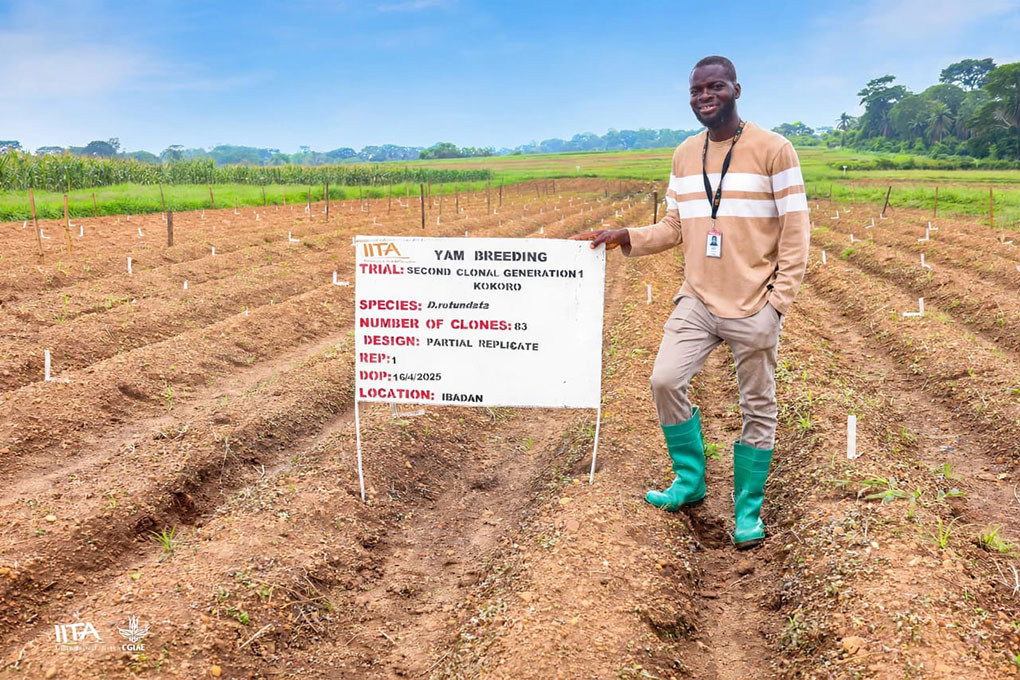
Developing improved yam varieties is a time-intensive process that involves identifying desirable traits, selecting superior breeding lines, and assessing their performance over several growing seasons. However, the scarcity of genomic resources has constrained breeders’ ability to make precise, data-driven selection decisions.
At IITA, Dr Sourou Angelot Paterne Agre is helping to address this challenge by developing genetic resources and molecular tools to make yam breeding more precise and efficient. His contributions have earned him the 2026 Japan International Award for Young Agricultural Researchers for his work on “Transforming yam production in Africa through integrated breeding, genomics, and innovation.”
When Dr Agre began working on yam nearly a decade ago, genomic resources for the crop were scarce. Working with IITA’s yam breeding team and research partners, he contributes to research that expands scientists’ understanding of yam’s genetic diversity and has helped develop molecular markers linked to important agronomic and tuber-quality traits.
Building the genetic foundation
An important part of Dr Agre’s work has involved investigating the genetic diversity and evolutionary origins of white Guinea yam, one of Africa’s most important food crops. His contributions to studies published in Scientific Reports and the Proceedings of the National Academy of Sciences in 2020 helped strengthen the scientific foundation for understanding the crop’s genetic variation and evolutionary history.
This knowledge is important because genetic diversity provides raw material for crop improvement. Understanding the differences among yam varieties and their genetic characteristics can help breeders identify useful traits and make better-informed decisions when selecting materials for crossing and further evaluation.
Building on this foundation, Dr Agre also contributed to the development of KASP molecular markers, described in a 2024 étudier published in The Plant Genome. These markers help translate genomic information into practical tools for routine breeding by enabling scientists to identify genetic variations associated with desirable traits.
By complementing conventional field evaluations with genetic information, the markers provide breeders with additional tools to screen plant materials, identify promising candidates, and make more targeted selection decisions. This can improve the efficiency of breeding programs by helping scientists narrow down the materials requiring further evaluation.