

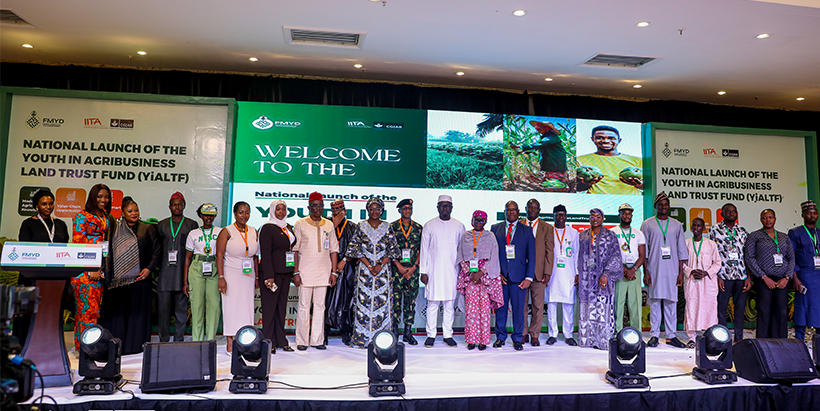
The Federal Ministry of Youth Development, in partnership with IITA–CGIAR, has launched the Youth in Agribusiness Land Trust Fund (YiALTF) initiative to boost youths’ access to arable land for sustainable agribusiness ventures.
The initiative, launched recently in Abuja, aims to reduce youth unemployment by providing pathways for them to access land, build sustainable agribusinesses, create jobs, and contribute to food security and economic growth.
The Minister of Youth Development, Ayodele Olawande, who launched the initiative, said Nigeria’s huge population, with about 70 percent under the age of 30, means the country’s future depends on what is done to support them. He said agriculture became a focus because of its potential to create millions of jobs, improve food production, reduce poverty, and grow the economy, especially with value chain maximization.
He stated, “Many of our youths are making progress in businesses, sports, entertainment, and many other sectors, but many are still struggling with unemployment. We have several talents, but the problem is access to opportunities and support.
“That was why, about a year ago, I asked the Ministry of Youth Development to review all our assets and development centers across the country. Many of these centers have a large expanse of land that can be used productively, which led to the creation of the Youth in Agribusiness Land Trust Fund.

“Our goal is clear; we want to transform all the youth development centers into active agricultural hubs. However, one major challenge is access to land, which this initiative aims to eliminate. In addition to access to land, we want to train more than 6 million Nigerian youths over the next 3 years and provide them with access to technologies, mentorship, business support, and markets. We want to support at least 500,000 youth-led agribusinesses and connect them to both local and international markets.
“During the development of this program, I visited the IITA, and what I saw was very encouraging. I saw many young people building successful businesses and creating jobs for themselves. I saw young people changing their communities through agriculture. Those experiences encouraged us to push this initiative. Our partnership with IITA is therefore very important because together we are working to expand the opportunities for young Nigerians.”
He stressed that since access to land for young people is just as important as access to finance, training, technologies, equipment, markets, and strong partnerships, financial institutions and development partners have an important role to play.
In his remarks, IITA Director-General, Dr Simeon Ehui, described land as one of the persistent barriers preventing young people from participation in agriculture, noting, however, that the initiative was a step in the right direction.
He added, “Nigeria possesses one of the youngest populations in the world and some of the most abundant agricultural resources on the African continent. Yet, millions of talented and ambitious young people remain excluded from agriculture because they lack access to productive assets, particularly land. For many aspiring agripreneurs, access to finance, technology, and markets becomes meaningless when access to land remains out of reach. The Youth in Agribusiness Land Trust Fund directly addresses this challenge.
At IITA, we are proud to partner with the Federal Ministry of Youth Development in this historic milestone. Our commitment is to help ensure that access to land is matched with the science, innovation, skills, technologies, mentorship, and market connections required for young people to succeed. We want young people to see agriculture not as a last resort, but as a modern, profitable, technology-driven business.
“This initiative aligns strongly with IITA’s mission of transforming African agriculture through science, innovation, and partnerships. It also contributes directly to Nigeria’s ambitions for food security, economic diversification, youth employment, and inclusive growth.”
The DG pointed out that the future of agriculture in Africa depends on the continent’s ability to attract, retain, and empower young people. He added that the impact of the initiative could also stimulate rural economies, attract private-sector investment, reduce poverty, and open pathways for many young Nigerians to move from limited opportunities to productive employment, entrepreneurship, and wealth creation.
He added, “Ultimately, our vision is not only to create successful agribusinesses, but also to build successful communities. As we launch this initiative, let us remember that the true measure of our success will not be the number of hectares placed in a trust, but the number of lives transformed, the number of enterprises created, the jobs generated, and the communities empowered.”
The Minister of Budget and National Planning, Senator Abubakar Bagudu, stressed the need to mobilize more young people to embrace agribusiness, noting that the transition from nativity to modernization in agriculture requires the infusion of skill set and technology.
He called on the youth to organize themselves, interrogate ideas, and take advantage of the numerous opportunities in agribusiness. “These opportunities still abound because we are still scratching the surface,” he added. “About 80 percent to 90 percent of agriculture relies on rain-fed agriculture, so even the provision of irrigation is a major opportunity. The same goes for fishing, the livestock sector, and basic processing.
“We also have to focus on land organization, because without organization, land, as we have seen, can be a source of conflict rather than a source of opportunities.”
In his goodwill message, the Director-General of the National Youth Service Corps, Brigadier General Olakunle Nafiu,described the Youth in Agribusiness Land Trust Fund as a testament to the collective commitment to empowering the next generation and fostering innovation in Nigeria’s agricultural sector.
He added that the initiative would catalyze enabling corps members to translate their passion and agro-allied training in the NYSC’s entrepreneurship program into tangible agribusiness opportunities.
Dignitaries who gave remarks included representatives of the governors of Edo and Kaduna states; Senior Special Adviser to the President on Youth Initiatives, Titilope Gbadamosi; MD/CEO, Bank of Agriculture, Ayodeji Sotinrin; Divisional Head, Agribusiness and Non-Oil Exports, FCMB, Kudzai Gumunyu; and the Group Head, Public Sector, Abuja Division, First Bank of Nigeria, Hajia Hama Muhammed.
In her remarks, the CEO of the IITA Youth in Agribusiness Unit (IYA), Aline Mugisho, expressed the IYA’s readiness to partner with the Ministry of Youth Development to implement the initiative. She pointed out that the IYA had built competence, experience, and capacity to drive young people’s involvement in agribusiness.
She expressed hope that the initiative would improve structured, inclusive, and sustainable access to land for agribusiness development.
Stakeholders present at the event were development partners, financial institutions, representatives of governors, heads of ministries, departments and agencies, relevant civil society organizations, corps members, and select youths.
The event also featured an exhibition by some participants of IYA.
Contribué par
Contributed by Babatunde Ajaja and Jesutofunmi Robinson
Histoires récentes