
Agroecological concepts and principles have gained importance in scientific, agricultural, and policy fields in recent years.
In the South-Kivu province – in the Democratic Republic of the Congo –, some research institutions, academia, NGOs, and farmers’ organizations are currently carrying out various activities and programs relating to agroecology. Part of these activities are carried out in partnership while others are implemented in a stand-alone manner.
In line with the DELIBERATE project, for instance, the International Institute of Tropical Agriculture (IITA) and the Swiss Federal Institute of Technology Zurich (ETH Zurich) jointly embarked on research undertakings in agroecology in the South-Kivu province.
This also applies for CANALLS Project, in which several national and international partners are engaged in the joint search for solution approaches towards an agroecological transition. Some local universities – including the Catholic University of Bukavu (UCB), the Université officielle de Bukavu (UOB) and the Université évangélique en Afrique (UEA) – also administer diploma (Degree) curricula in agroecology.
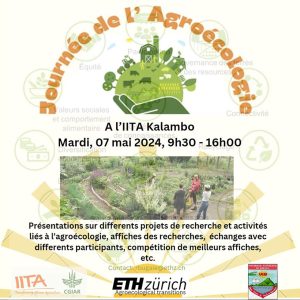
Hence, in a bid to share the results of the research carried out, IITA and ETH Zurich – in collaboration with the Catholic University of Bukavu (UCB) – are organizing an Agroecology Day, under the DELIBERATE project which sets a nexus between quality deliberative discussion regarding soybean and coffee value chains and the ecological “food footprints” in South-Kivu and Kasaï provinces.
It is in that light that a Conference is planned, as a forum for sharing experiences and knowledge on agroecology, so as to have a wholesome picture of activities relating to this area in the South-Kivu.
The said Conference will be held on 7 mai 2024, at the Olusegun Obasanjo Research Campus (IITA Station) in Kalambo, South-Kivu, and is expecting about 120 attendees.
It is worth noting that, as side events of the Conference proceedings, two workshops are planned in collaboration with soy and coffee producer organizations, for the purpose of strengthening the cooperatives’ potential and discuss the roles and ways of improving the peasant organizations’ functioning for sustainability.
Contribué par
Histoires récentes