
NEWS

IITA-CGIAR mobilizes for greater impact at Work Planning Week 2026: Calls for stronger investment in science and delivery
novembre 20, 2026

Halfway through its 2024–2030 strategy, IITA-CGIAR reaffirms  commitment to continue leading groundbreaking research and integrated investments in agricultural development across continents during its annual Work Planning Week (WPW), held 15 – 20 November.

Opening the 2026 Work Planning Week, themed “IITA strategy 2024–2030: Halfway there – taking stock and thinking ahead,” IITA Director General and CGIAR Regional Director for Continental Africa, Dr Simeon Ehui, called for renewed institutional commitment to translating scientific achievements into tangible benefits for farmers, strengthening strategic partnerships, and securing IITA’s financial sustainability as the Institute looks towards 2027 and beyond.
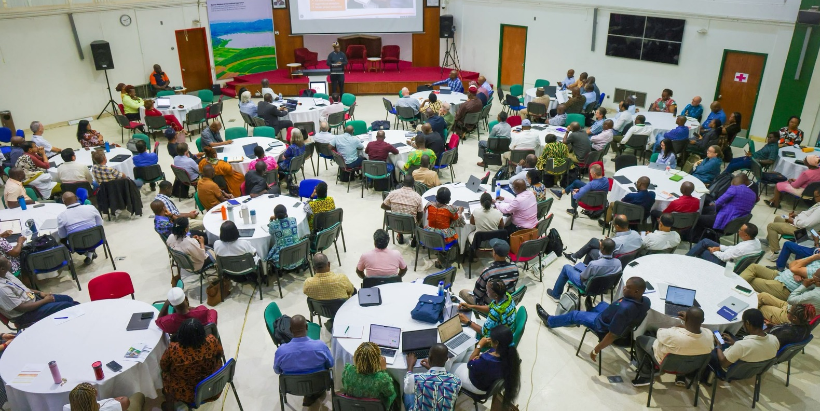
IITA staff and scientists at WPW2026 set to review achievements, align priorities, and mobilize for greater impact in coming years.
IITA DG, Dr Simeon Ehui, opening the session of interactions for WPW2026 with eight priority messages to guide the Institute’s advancement in 2027 and beyond.

Reflecting on his recent engagements representing IITA at major international and continental platforms, including the Food Systems Forum in Kigali, the World Agri-Food Innovation Conference in Beijing, AgriConnect Compact engagements, and African Development Bank–CGIAR discussions in Abidjan, Dr Ehui highlighted growing interest from African governments and development partners in IITA’s scientific expertise. He stressed the importance of converting these expressions of interest into credible partnerships, funded programs, and practical interventions that respond to countries’ agricultural development priorities.

Against the backdrop of increasing competition for research funding, he emphasized the need for stronger resource mobilization, diversified funding partnerships, and demonstrable research outcomes. He also underscored the importance of investing in IITA’s people, strengthening staff welfare across its headquarters, hubs, and stations, and ensuring that institutional safeguards keep pace with the Institute’s expanding research portfolio.

Dr Ehui identified eight messages to guide the Institute: ensuring scientific progress responds to farmers’ needs and choices; delivering innovations at scale and demonstrating lasting benefits; translating partnerships into financed implementation; prioritizing financial sustainability; broadening fundraising efforts; making IITA a better place to work; strengthening institutional safeguards; and using IITA@60 to build the case for future investment.

He distilled his message into three overarching priorities: strengthen our finances, support our people, and build strong partnerships.

Science that must pay its way

Quality research cannot be sustained without adequate resources for the people, laboratories, research facilities, ICT infrastructure, and institutional services that underpin it. Echoing this message, IITA Deputy Director General, Research for Development (R4D), Dr Bernard Vanlauwe, presented the status of R4D under the banner “Halfway on the road to 2030.” He said the scope of IITA’s science areas and programs remains relevant for Africa’s transformation, and that the Institute’s climate and nutrition work is gaining momentum.
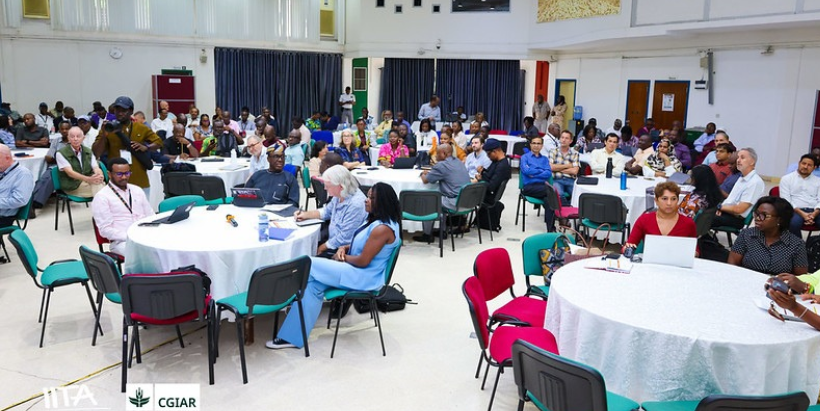
IITA DG, Dr Simeon Ehui, opening the session of interactions for WPW2026 with eight priority messages to guide the Institute’s advancement in 2027 and beyond.
IITA staff and scientists at WPW2026 set to review achievements, align priorities, and mobilize for greater impact in coming years.

Dr Vanlauwe pointed out that new frontiers are opening to expanded investment in gene editing, supported by growing acceptance across sub-Saharan Africa. He also highlighted a joint IITA–IRRI agronomic microbiome innovation hub and a new “science of scaling” agenda, which seeks early feedback on how research solutions perform in the real world before they are rolled out.

The funding picture, he indicated, is mixed. IITA has weathered reductions in official development assistance and has maintained its level of research scientists, national research staff and MSc and PhD students for five years. Yet he cautioned that research fundraising must be increased and diversified. A strategic R&D fund is under discussion, but it can only happen if full cost recovery is applied across the Institute. He also called for a concerted push to raise the Institute’s publication rate in top scientific journals.

To make research deliver, IITA is building a pipeline that carries promising results from the laboratory to the field. At its center are the Impact Bundles: country-specific packages that combine proven innovations, scaling models, partnerships and a clear delivery plan into a single offer IITA can take to governments and funders. Vanlauwe said the bundles will also shape the next generation of research questions.

A year of delivery, in numbers

While R4D set the scientific compass, IITA Deputy Director General, Partnerships for Delivery and Scaling, Dr Tahirou Abdoulaye, showed how far the Institute has traveled in turning partnerships into resources. IITA mobilized USD 134.25 million through 46 funded projects between November 2025 and October 2026, with a further USD 145.18 million in the pipeline. About 95 percent of that pipeline carries at least a 50 percent probability of success.

In his presentation, he noted that the Mastercard Foundation has approved I-Youth Phase 2, a USD 76 million program for 2026–2031 launched in Ibadan, which aims to place 450,000 young people in work across Nigeria, Sierra Leone and Liberia. A second Mastercard Foundation-funded initiative, REAP, worth about USD 52.3 million to IITA, will see the Institute lead work in Nigeria and Zambia, and a youth employment platform from the fourth quarter of 2026.

On technology delivery, TAAT III was launched in Nairobi with a USD 14.1 million African Development Fund grant, with IITA serving as executing agency for 16 partner institutions. In Angola, the African Development Bank approved a USD 211.4 million agricultural value chain loan, with the TAAT consortium allocated USD 44.3 million. The TAAT e-catalog now holds 214 technology profiles, up from 181 in May.

Dr Abdoulaye also reported on the Institute’s five hubs, from the launch of the Nigeria Agriconnect program in Ibadan and a seed-sector assessment in Zambia to a USD 1.2 million agricultural value chains project signed in the DR Congo and the supply of plantain and cassava planting materials from Cameroon to Gabon. In capacity development, IITA currently supports 205 graduate fellows and has hosted 1,075 interns. Its Business Incubation Platform is transitioning into IITA-Business Innovation Development (BID), a social enterprise.

Looking to 2027, he said the focus will be on project execution, anchored by three critical units: Development and Scaling, the Product Pipeline Development Unit and the Business Development Office.

Beyond the plenaries, the week combined strategy, science, and community. Working groups led by hub directors examined practical routes to operationalizing the Impact Bundles across Central, Eastern, Southern, Western and Sahel Africa, with feedback presented in plenary. Presentations on the strategic research portfolios in Genetic Innovation, Resilient Agri-food Systems and Systems Transformation were paired with early-career researchers.

With IITA approaching its 60th anniversary in 2027, Dr Ehui emphasized that the milestone is an opportunity to connect six decades of the Institute’s scientific legacy with future investments, stronger partnerships, and Africa-led agricultural transformation.


Contribué par

Anuoluwa Oyeleye and Folake Oduntan

Retour en haut
Olaosebikan, Olamide

Olamide Deborah Nwanze est une chercheuse principale spécialisée dans la recherche sur l'approche "genre" afin d'éclairer les politiques de sélection participative et inclusive, de développement de variétés et de systèmes semenciers concernant les cultures de racines, tubercules et bananes (RTB) au siège de l'Institut International d'Agriculture Tropicale, à Ibadan, au Nigeria. Elle est candidate au doctorat à l'Université d'Ibadan et titulaire d'un master et d'un diplôme d'ingénieur agronome en vulgarisation agricole et développement rural. Olamide est membre du programme African Women in Agricultural Research and Development – Gender Responsive Agricultural Systems Policy (SAISIE DE RÉCOMPENSEet les Chercheuses Sensibles au Genre Équipées pour la Transformation Agricole (SUPER. Elle cherche à appliquer ses apprentissages en matière d’approche genre, recherche sensible au genre, et expertise en développement et examen de politiques pour faciliter l’accès et l’adoption par les femmes, les jeunes, les enfants et les groupes sociaux vulnérables aux innovations agricoles qui garantissent la sécurité alimentaire, nutritionnelle, des revenus et des moyens de subsistance en Afrique. Ses rôles actuels comprennent le mentorat de chercheurs stagiaires, le développement de guides et manuels de formation, la mise en œuvre et l'adaptation de cadres et d'outils genre, l'engagement des acteurs de la chaîne de valeur en tant que partenaires de la science citoyenne, l'examen et la refonte des politiques, la gestion et l'analyse des données. Ses recherches actuelles portent sur les méthodes mixtes ainsi que sur les approches participatives et interdisciplinaires pour saisir et mettre en évidence les dynamiques de genre, les besoins, les préférences et les défis rencontrés par les parties prenantes au sein de la chaîne de valeur des moyens de subsistance agricoles afin de prioriser des stratégies axées sur le genre dans les programmes de sélection, la conception et la mise en œuvre des politiques.

À l'IITA, elle contribue à la mise en œuvre du CGIAR Initiative d'Élevage Accéléré et Innovation génétique Programmes ; recherche participative et genre au sein des Prochaine Génération Manioc, HarvestPlus, RTBAliments, et Tricot-ClimMob 1000Fermes Projets ; et la communication des connaissances sur le genre via le Série de webinaires G-LENS, vidéo documentaire, notes de politique, publications, et blogs.


Publications récentes

de Sousa, K., van Etten, J., Manners, R. Bello, A., Teeken, B., Olaosebikan, O., et al. 2024. L'approche tricot : un cadre agile pour les essais décentralisés à la ferme soutenus par la science citoyenne. Une rétrospective. Agron. Sustain. Dev. 44, 8. https://doi.org/10.1007/s13593-023-00937-1

Madu, T., Onwuka, S., Nwafor, S., Onyemauwa, N., Ejechi, M., Ofoeze, M., Ukeje, B., Eluagu, C., Olaosebikan, O., Okoye, B., 2024. Les études sur les consommateurs inclusifs en matière de genre améliorent l'amélioration du manioc au Nigeria dans : Frontiers in Sociology, volume 9, numéro : 1224504, doi : 10.3389/fsoc.2024.1224504

Olaosebikan, O. ; Bello, A. ; Utoblo, O. ; Okoye, B. ; Olutegbe, N. ; Garner, E. ; Teeken, B. ; Bryan, E. ; Forsythe, L. ; Cole, S. ; Madu, T. 2023. Facteurs de stress et résilience au sein de la chaîne de valeur du manioc au Nigeria : Caractéristiques préférées des variétés de manioc et stratégies de réponse des hommes et des femmes pour informer l'amélioration variétale. Sustainability 15, 7837. https://doi.org/10.3390/su15107837

Okoye, B., Ofoeze, M., Ejechi, M., Onwuka, S., Nwafor, S., Onyemauwa, N., Ukeje, B., Eluagu, C., Obidiegwu, J.*, Olaosebikan, O., Madu, T.* 2023. Priorisation des traits préférés dans la chaîne de valeur de l'igname au Nigeria : une analyse de la situation en matière de genre in: Frontiers in Sociology, volume 8, numéro : 1232626, pages 1 – 9, ISSN 2297-7775, 2023. https://www.frontiersin.org/articles/10.3389/fsoc.2023.1232626/full

Olaosebikan, O., Bello, A. A., de Sousa, K., Ndjouenkeu, R., Adesokan, M., Alamu, E. O., Agbona, A., van Etten, J., Kegah, F. N.*, Dufour, D., Bouniol, A., Teeken, B. 2023. Acceptabilité par les consommateurs des produits alimentaires à base de gari-eba de manioc dans des contextes culturels et environnementaux variés en utilisant l'approche triade de comparaison des technologies (tricot) dans : Journal of the Science of Food and Agriculture,

Teeken, B., Olaosebikan, O., Bello, A. A., Madu, T.*, Cole, S. M. 2023. Évaluation qualitative de la positionnalité et des préférences des dyades en relation avec les activités liées au manioc : travailler avec des scientifiques citoyens du procès tricot https://hdl.handle.net/10568/138326 Type : Manuel

Bouniol, A., Ceballos, H., Bello, A. A., Teeken, B., Olaosebikan, O., Owoade, D., Agbona, A., Fotso Kuate, A., Madu, T.*, Okoye, B.*, Ofoeze, M.*, Nwafor, S.*, Onyemauwa, N.*, Adinsi, L.*, Forsythe, L., Dufour, D. 2023. Impact variétal sur le travail des femmes, la charge de travail et la pénibilité associée dans le traitement des plantes à racines, tubercules et bananes : focus sur le manioc en Afrique subsaharienne dans : Journal of the Science of Food and Agriculture, pages 1 – 25, ISSN 0022-5142,

Bello, A. A., Agbona, A., Olaosebikan, O., Edughaen, G., Dufour, D., Bouniol, A., Iluebbey, P., Ndjouenkeu, R.*, Rabbi, I. Y., Teeken, B. 2023. Effets génétiques et environnementaux sur la productivité de la transformation et le rendement des produits alimentaires : la pénibilité du travail des femmes dans : Journal of the Science of Food and Agriculture, pages 1 – 32, ISSN 0022-5142, 5

Cavicchioli, M., Zimbiti, T., Teeken, B., Nwanze, D.O., Liani, M., Parkes, E. & Bello, A. 2023. Rapport sur la formation en sélection génétique sensible au genre à l'IITA. Genetic Resources Center, IITA-HQ, Ibadan, 21-23 septembre 2022. Ibadan, Nigéria : IITA, (34 p.).https://hdl.handle.net/10568/131368

Agbona, A. Peteti P., Teeken B., Olaosebikan O. Bello, A. A., Parkes, E., Rabbi, I. Y., Mueller, L., Egesi, C., Kulakow, P. 2022. Gestion des données dans les programmes d'amélioration des cultures RTB africaines multidisciplinaires. In : Williamson, H.F., Leonelli, S. (eds) Towards Responsible Plant Data Linkage: Data Challenges for Agricultural Research and Development. Springer, Cham. https://doi.org/10.1007/978-3-031-13276-6_5

Lora Forsythe, Pricilla Marimo, Sarah Mayanja, Olamide D. Olaosebikan, Esme Stuart, Bela Teeken, Benjamin Okoye, Tessy Madu, (2021). Analyse transversale du genre dans RTBfoods Étape 2 Cartographie des genres sur les produits RTB. Comprendre les moteurs des préférences en matière de traits et le développement de profils de produits RTB multi-utilisateurs, WP1. Londres, Royaume-Uni : Rapport scientifique de terrain RTBfoods, 30 p.

Teeken, B., Garner, E., Agbona, A., Balogun, I., Olaosebikan, O., Bello, A., Madu, T., Okoye, B., Egesi, C., Kulakow, P. et Tufan, H.A. 2021. Au-delà des “ traits des femmes ” : explorer comment le genre, les différences sociales et les caractéristiques des ménages influencent les préférences pour les traits. Frontiers Systèmes alimentaires durables 5:740926. https://doi.org/10.3389/fsufs.2021.740926

Teeken, B., Agbona, A., Bello, A., Olaosebikan, O., Alamu, E., Adesokan, M., Awoyale, W., Madu, T., Okoye, B., Chijioke, U., Owoade, D., Okoro, M., Bouniol, A., Dufour, D., Hershey, C., Rabbi, I., Maziya‐Dixon, B., Egesi, C., Tufan, H. et Kulakow, P. (020. Comprendre les préférences variétales du manioc par le classement par paires du gari-eba et du fufu préparés par des agriculteurs-transformateurs locaux. Int J Food Sci Technol. https://doi.org/10.1111/ijfs.14862

Bela Teeken, Olamide Olaosebikan, Ireti Balogun, Benjamin Okoye, Tessy Madu, Steven Cole, Abolore Bello, Elizabeth Parkes. (2020). Pilotage des outils de profil client et produit G+ pour l'amélioration sensible au genre du manioc au Nigeria. Nigeria : Institut international d'agriculture tropicale (IIAT). https://hdl.handle.net/20.500.11766/13000