NOUVELLES DE L'IITA

IITA’s innovations are attracting growing interest in the Democratic Republic of the Congo
août 13, 2026
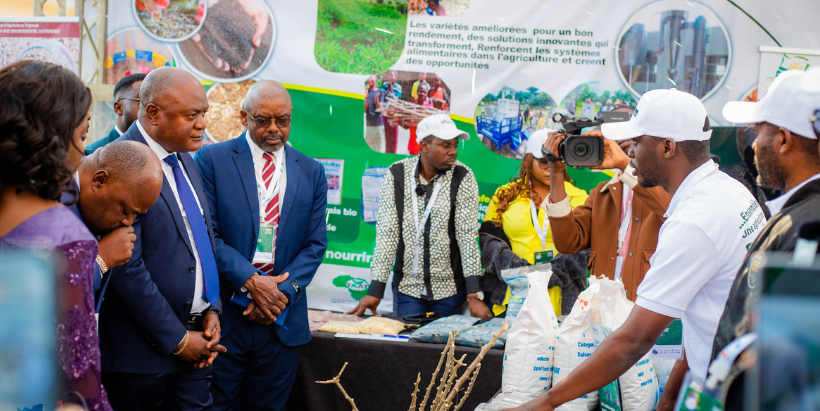
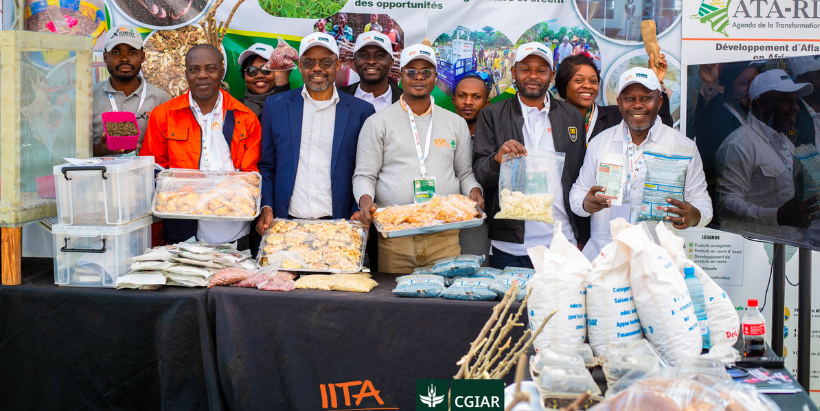
IITA Stand at the GSAD 2026, Lualaba, Kolwezi-DRC.

IITACGIAR‘s innovations continue to generate growing interest in the Democratic Republic of the Congo (DRC). Requests for partnerships, technical support, and scaling of its technologies are multiplying around its innovative solutions, which contribute to the sustainable transformation of agrifood systems and food security in the DRC.

Based on this development, from July 16 to 18, 2026, in Kolwezi, in the province of Lualaba, IITA took part in the 5th edition of the Grand Salon of Agribusiness and Digital in Africa, a major event bringing together public decision-makers, private sector, technical and financial partners, researchers, and entrepreneurs around the agricultural transformation of the DRC. Held under the theme “Agriculture, Mines and Technologies (AgriTech)”, this event highlighted synergies among these sectors to promote innovation, stimulate job creation, enhance local resources, and contribute to a sustainable future in the Democratic Republic of Congo.

IITA’s participation is fully in line with its mission to promote sustainable food systems, accelerate the adoption of agricultural innovations, and strengthen strategic partnerships to support agricultural transformation.

GSAD participants visiting the IITA stand.

Through its stand, IITA showcased a wide range of innovative technologies and solutions to address challenges in food security, agricultural productivity, agrifood processing, and job creation.

Visitors discovered, among other things, Aflasafe™, a biological technology for combating aflatoxins in maize, peanuts, and sorghum; NoduMax®, a biofertilizer that promotes soil fertility and biological nitrogen fixation in soybeans; improved seeds and high-quality seed systems; and improved cassava varieties and quality planting materials.

IITA also showcased the Black Soldier Fly technology, which transforms organic waste into larvae, a locally produced, sustainable, and protein-rich source of animal feed, while also producing an organic fertilizer (frass) from the residual organic matter processed by the larvae, thereby contributing to the sustainable improvement of soil fertility.

The booth also showcased innovations developed within the framework of the Cassava Value Chain Development (CVCD), including semi-autotrophic hydroponic (SAH) technology, several improved, high-yielding, disease- and pest-resistant cassava varieties (Obama, Ilona, Lumono, and Liyayi), as well as high-quality cassava flour (HQCF) and its derivative products including bread made from 10% HQCF and 90% wheat flour, waffles and doughnuts made from 50% HQCF, and starch flakes made from 100% cassava starch, illustrating the numerous opportunities for adding value to this crop.

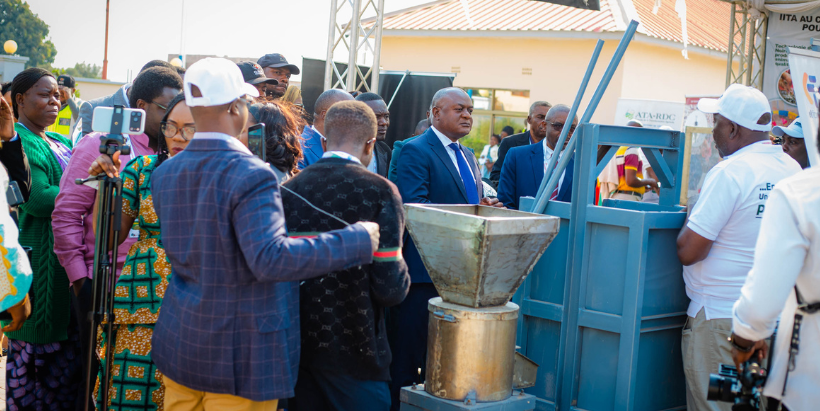
Showcase of cassava processing equipment.

Equipment for good agricultural practices and cassava processing, including a weeder, a grater, a press, and a hammer mill, was also on display. Finally, digital agriculture, traceability, and decision-support solutions, such as SeedTracker, were presented.

Over the three days of the trade fair, the IITA booth welcomed several hundred visitors, including national and provincial authorities, representatives of mining companies, technical and financial partners, universities, farmers’ organizations, and numerous young entrepreneurs. Several opportunities for collaboration were identified in seed systems, mechanization, cassava processing, digital agriculture, and bio-inputs.

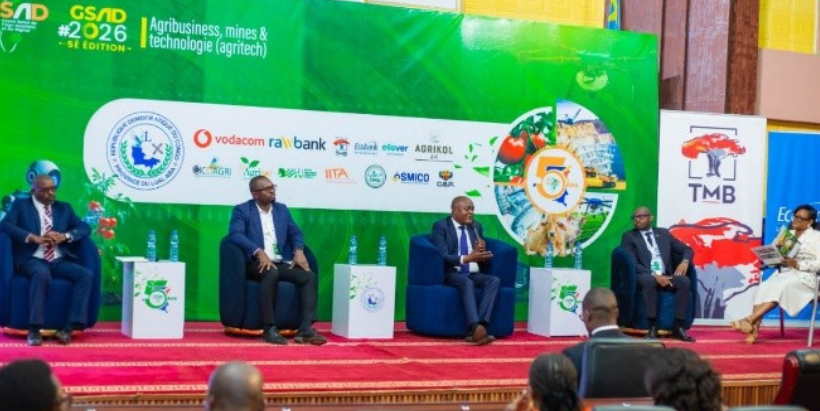
During the high-level panels, IITA experts highlighted the Institute’s contributions to the sustainable transformation of agriculture in the DRC. Dr Joseph Atehnkeng presented IITA’s experience in developing agricultural value chains, seed systems, agrifood processing, and public-private partnerships; Dr Christopher Suh outlined IITA’s innovative solutions, including biofertilizers and sustainable soil management technologies to reduce dependence on imported inputs; while Dr Adebowale Abdul-Rasaq and Ir. Simon Lukombo presented IITA’s innovations in the cassava value chain, processing technologies, and business models that promote youth entrepreneurship and inclusive development.

Through these interventions, IITA experts demonstrated how agricultural research, technological innovation, and public-private partnerships can contribute to the industrialization of value chains, the development of local solutions to global challenges, and the creation of sustainable jobs.

IITA experts participating in the panel discussion.

Alongside the conferences and the exhibition, the IITA team held several bilateral meetings with the authorities of the Lualaba Provincial Government, the technical services of the Ministry of Agriculture, financial institutions, universities, farmers’ organizations, and development partners to explore new opportunities for collaboration.

Through its participation in GSAD 2026, IITA reaffirms its commitment to supporting the Democratic Republic of Congo in modernizing its agriculture through research, innovation, and strategic partnerships. By bringing together producers, investors, public authorities, and the private sector around proven solutions, the Institute helps build more resilient, competitive, and job-creating food systems for the benefit of rural communities.


Retour en haut
Olaosebikan, Olamide

Olamide Deborah Nwanze est une chercheuse principale spécialisée dans la recherche sur l'approche "genre" afin d'éclairer les politiques de sélection participative et inclusive, de développement de variétés et de systèmes semenciers concernant les cultures de racines, tubercules et bananes (RTB) au siège de l'Institut International d'Agriculture Tropicale, à Ibadan, au Nigeria. Elle est candidate au doctorat à l'Université d'Ibadan et titulaire d'un master et d'un diplôme d'ingénieur agronome en vulgarisation agricole et développement rural. Olamide est membre du programme African Women in Agricultural Research and Development – Gender Responsive Agricultural Systems Policy (SAISIE DE RÉCOMPENSEet les Chercheuses Sensibles au Genre Équipées pour la Transformation Agricole (SUPER. Elle cherche à appliquer ses apprentissages en matière d’approche genre, recherche sensible au genre, et expertise en développement et examen de politiques pour faciliter l’accès et l’adoption par les femmes, les jeunes, les enfants et les groupes sociaux vulnérables aux innovations agricoles qui garantissent la sécurité alimentaire, nutritionnelle, des revenus et des moyens de subsistance en Afrique. Ses rôles actuels comprennent le mentorat de chercheurs stagiaires, le développement de guides et manuels de formation, la mise en œuvre et l'adaptation de cadres et d'outils genre, l'engagement des acteurs de la chaîne de valeur en tant que partenaires de la science citoyenne, l'examen et la refonte des politiques, la gestion et l'analyse des données. Ses recherches actuelles portent sur les méthodes mixtes ainsi que sur les approches participatives et interdisciplinaires pour saisir et mettre en évidence les dynamiques de genre, les besoins, les préférences et les défis rencontrés par les parties prenantes au sein de la chaîne de valeur des moyens de subsistance agricoles afin de prioriser des stratégies axées sur le genre dans les programmes de sélection, la conception et la mise en œuvre des politiques.

À l'IITA, elle contribue à la mise en œuvre du CGIAR Initiative d'Élevage Accéléré et Innovation génétique Programmes ; recherche participative et genre au sein des Prochaine Génération ManiocHarvestPlusRTBAliments, et Tricot-ClimMob 1000Fermes Projets ; et la communication des connaissances sur le genre via le Série de webinaires G-LENS, vidéo documentaire, notes de politiquepublications, et blogs.


Publications récentes

de Sousa, K., van Etten, J., Manners, R. Bello, A., Teeken, B., Olaosebikan, O., et al. 2024. L'approche tricot : un cadre agile pour les essais décentralisés à la ferme soutenus par la science citoyenne. Une rétrospective. Agron. Sustain. Dev. 44, 8. https://doi.org/10.1007/s13593-023-00937-1

Madu, T., Onwuka, S., Nwafor, S., Onyemauwa, N., Ejechi, M., Ofoeze, M., Ukeje, B., Eluagu, C., Olaosebikan, O., Okoye, B., 2024. Les études sur les consommateurs inclusifs en matière de genre améliorent l'amélioration du manioc au Nigeria dans : Frontiers in Sociology, volume 9, numéro : 1224504, doi : 10.3389/fsoc.2024.1224504

Olaosebikan, O. ; Bello, A. ; Utoblo, O. ; Okoye, B. ; Olutegbe, N. ; Garner, E. ; Teeken, B. ; Bryan, E. ; Forsythe, L. ; Cole, S. ; Madu, T. 2023. Facteurs de stress et résilience au sein de la chaîne de valeur du manioc au Nigeria : Caractéristiques préférées des variétés de manioc et stratégies de réponse des hommes et des femmes pour informer l'amélioration variétale. Sustainability 15, 7837. https://doi.org/10.3390/su15107837

Okoye, B., Ofoeze, M., Ejechi, M., Onwuka, S., Nwafor, S., Onyemauwa, N., Ukeje, B., Eluagu, C., Obidiegwu, J.*, Olaosebikan, O., Madu, T.* 2023. Priorisation des traits préférés dans la chaîne de valeur de l'igname au Nigeria : une analyse de la situation en matière de genre in: Frontiers in Sociology, volume 8, numéro : 1232626, pages 1 – 9, ISSN 2297-7775, 2023. https://www.frontiersin.org/articles/10.3389/fsoc.2023.1232626/full

Olaosebikan, O., Bello, A. A., de Sousa, K., Ndjouenkeu, R., Adesokan, M., Alamu, E. O., Agbona, A., van Etten, J., Kegah, F. N.*, Dufour, D., Bouniol, A., Teeken, B. 2023. Acceptabilité par les consommateurs des produits alimentaires à base de gari-eba de manioc dans des contextes culturels et environnementaux variés en utilisant l'approche triade de comparaison des technologies (tricot) dans : Journal of the Science of Food and Agriculture,

Teeken, B., Olaosebikan, O., Bello, A. A., Madu, T.*, Cole, S. M. 2023. Évaluation qualitative de la positionnalité et des préférences des dyades en relation avec les activités liées au manioc : travailler avec des scientifiques citoyens du procès tricot https://hdl.handle.net/10568/138326 Type : Manuel

Bouniol, A., Ceballos, H., Bello, A. A., Teeken, B., Olaosebikan, O., Owoade, D., Agbona, A., Fotso Kuate, A., Madu, T.*, Okoye, B.*, Ofoeze, M.*, Nwafor, S.*, Onyemauwa, N.*, Adinsi, L.*, Forsythe, L., Dufour, D. 2023. Impact variétal sur le travail des femmes, la charge de travail et la pénibilité associée dans le traitement des plantes à racines, tubercules et bananes : focus sur le manioc en Afrique subsaharienne dans : Journal of the Science of Food and Agriculture, pages 1 – 25, ISSN 0022-5142,

Bello, A. A., Agbona, A., Olaosebikan, O., Edughaen, G., Dufour, D., Bouniol, A., Iluebbey, P., Ndjouenkeu, R.*, Rabbi, I. Y., Teeken, B. 2023. Effets génétiques et environnementaux sur la productivité de la transformation et le rendement des produits alimentaires : la pénibilité du travail des femmes dans : Journal of the Science of Food and Agriculture, pages 1 – 32, ISSN 0022-5142, 5

Cavicchioli, M., Zimbiti, T., Teeken, B., Nwanze, D.O., Liani, M., Parkes, E. & Bello, A. 2023. Rapport sur la formation en sélection génétique sensible au genre à l'IITA. Genetic Resources Center, IITA-HQ, Ibadan, 21-23 septembre 2022. Ibadan, Nigéria : IITA, (34 p.).https://hdl.handle.net/10568/131368

Agbona, A. Peteti P., Teeken B., Olaosebikan O. Bello, A. A., Parkes, E., Rabbi, I. Y., Mueller, L., Egesi, C., Kulakow, P. 2022. Gestion des données dans les programmes d'amélioration des cultures RTB africaines multidisciplinaires. In : Williamson, H.F., Leonelli, S. (eds) Towards Responsible Plant Data Linkage: Data Challenges for Agricultural Research and Development. Springer, Cham. https://doi.org/10.1007/978-3-031-13276-6_5

Lora Forsythe, Pricilla Marimo, Sarah Mayanja, Olamide D. Olaosebikan, Esme Stuart, Bela Teeken, Benjamin Okoye, Tessy Madu, (2021). Analyse transversale du genre dans RTBfoods Étape 2 Cartographie des genres sur les produits RTB. Comprendre les moteurs des préférences en matière de traits et le développement de profils de produits RTB multi-utilisateurs, WP1. Londres, Royaume-Uni : Rapport scientifique de terrain RTBfoods, 30 p.

Teeken, B., Garner, E., Agbona, A., Balogun, I., Olaosebikan, O., Bello, A., Madu, T., Okoye, B., Egesi, C., Kulakow, P. et Tufan, H.A. 2021. Au-delà des “ traits des femmes ” : explorer comment le genre, les différences sociales et les caractéristiques des ménages influencent les préférences pour les traits. Frontiers Systèmes alimentaires durables 5:740926. https://doi.org/10.3389/fsufs.2021.740926

Teeken, B., Agbona, A., Bello, A., Olaosebikan, O., Alamu, E., Adesokan, M., Awoyale, W., Madu, T., Okoye, B., Chijioke, U., Owoade, D., Okoro, M., Bouniol, A., Dufour, D., Hershey, C., Rabbi, I., Maziya‐Dixon, B., Egesi, C., Tufan, H. et Kulakow, P. (020. Comprendre les préférences variétales du manioc par le classement par paires du gari-eba et du fufu préparés par des agriculteurs-transformateurs locaux. Int J Food Sci Technol. https://doi.org/10.1111/ijfs.14862

Bela Teeken, Olamide Olaosebikan, Ireti Balogun, Benjamin Okoye, Tessy Madu, Steven Cole, Abolore Bello, Elizabeth Parkes. (2020). Pilotage des outils de profil client et produit G+ pour l'amélioration sensible au genre du manioc au Nigeria. Nigeria : Institut international d'agriculture tropicale (IIAT). https://hdl.handle.net/20.500.11766/13000