

NEWS

PROSSIVA advances leaf-bud cutting and yam stakeholder action in Ghana
août 21, 2026
Dr Beatrice Aighewi presenting the research outcomes and potentials of LBC to the Minister of Food and Agriculture, Hon. Eric Opoku.

Le Program for Seed System Innovation for Vegetatively Propagated Crops in Africa (PROSSIVA), with a renewed focus on scaling seed innovations across Africa, is advancing efforts to strengthen Ghana’s yam seed system by promoting innovative propagation technologies, building stakeholder linkages, and supporting the transition to a more formal and resilient seed system. These efforts reached an important milestone at the National Yam Advocacy Summit, held on 6 August 2026 in Accra, following a high-level engagement with Ghana’s Minister of Food and Agriculture, Hon. Eric Opoku, on 5 August.

During the ministerial engagement, the PROSSIVA team explained how Leaf Bud Cutting (LBC) technology can rapidly multiply high-quality planting materials for yam production. The Minister welcomed the technology as a promising and practical innovation, expressing interest in deploying it in Ghana to boost farmers’ productivity and livelihoods. He emphasized, however, that increased production must be matched with strong export and processing market linkages to ensure farmers can profitably absorb the gains from improved productivity.

Stakeholders during the advocacy visit to the Minister of Food and Agriculture in Ghana.

Convened by PROSSIVA, an IITA-led initiative, in collaboration with Ghana’s Ministry of Food and Agriculture (MoFA), the National Yam Advocacy Summit brought together regulators, policymakers, researchers, seed enterprises, farmers, processors, exporters, development partners, investors, and other actors across the yam value chain. The summit provided a national platform to showcase the LBC technique and other innovations that can improve the availability, quality, and affordability of planting materials while strengthening linkages among value chain actors.

Yams are a major food and economic crop in Ghana, supporting thousands of households and contributing to domestic and export markets. However, limited access to quality planting materials, low multiplication rates, high seed costs, pest and disease pressures, and inconsistent seed quality continue to constrain productivity. The summit, therefore, focused on innovations to address these constraints and unlock greater potential within the yam sector.
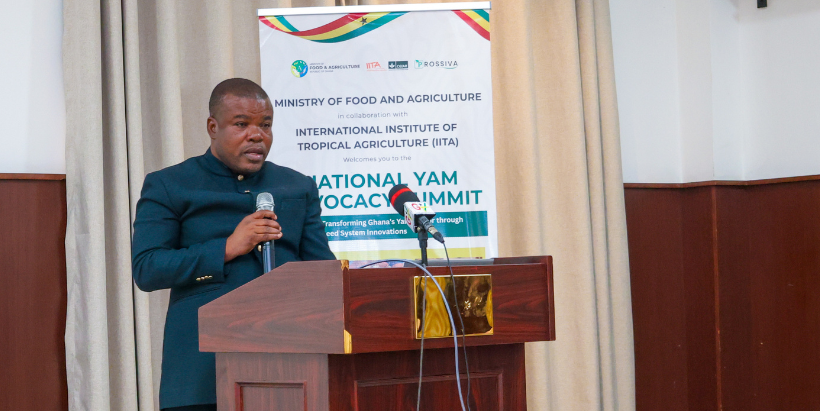
Hon. Bright Demordzi delivering his keynote speech.

Delivering the keynote address on behalf of the Minister, the National Coordinator of the Feed Ghana Program, Hon. Bright Demordzi, highlighted yams’ strategic importance to Ghana’s agricultural economy, noting that the country produces more than 11 million metric tonnes annually and recorded approximately US$48 million in yam exports in 2021. He added that successful national adoption of the LBC technique for yam multiplication would further strengthen the sector by boosting productivity, improving farmers’ incomes, and contributing to Ghana’s broader agricultural development agenda.

Against this backdrop, the summit showcased the LBC technique as a method with the potential to rapidly multiply high-quality planting materials while reducing certain risks associated with conventional seed production. Dr Beatrice Aighewi, Lead of the Yam Component of PROSSIVA, highlighted the potential of vine-based propagation to reduce the risk of soil-borne disease spread, support faster multiplication, enable year-round production, facilitate the rapid dissemination of improved yam varieties, and create opportunities to increase the value of yam production.

Dr Emmanuel Amponsah Adjei (CSIR-SARI yam breeder) speaking during one of the panel sessions.

During her presentation on PROSSIVA, Project Lead Dr Delphine Amah highlighted the project’s three focus crops and their respective innovations, including Semi-Autotrophic Hydroponics (SAH) for cassava and macropropagation for plantain seed production. She also spotlighted SeedTracker for traceability and market linkages. The presentation generated interest beyond yam, with state representatives and other participants seeking information on the availability and application of PROSSIVA’s cassava and banana technologies. This response underscored the relevance and practical potential of the project’s innovative approaches to addressing persistent challenges in the production of vegetatively propagated crops.

Through two focused panel discussions, stakeholders examined how to move quality seed yam innovations from research to widespread adoption and stimulate demand through markets, investment, and enterprise. The discussions highlighted that scaling up improved seed technologies must go hand in hand with stronger market linkages, private-sector investment, and viable business opportunities across the yam value chain. Stakeholders noted that the high cost of planting material remains a major constraint for farmers but emphasized that wider adoption of improved multiplication technologies could substantially reduce these costs while expanding access to quality seed yams.
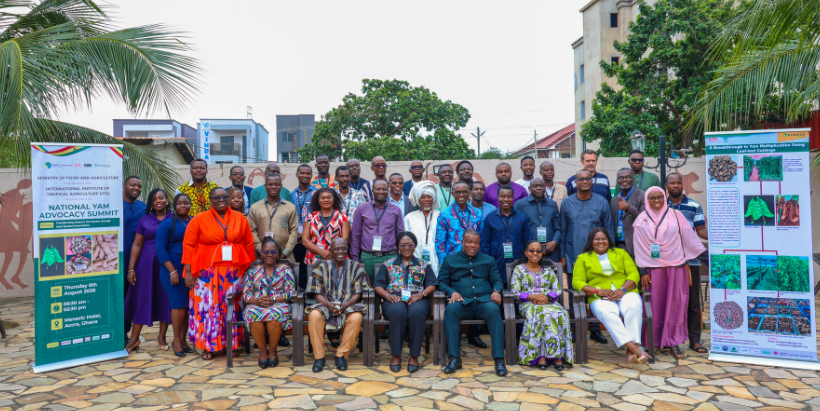
Participants at the Ghana National Yam Advocacy Summit.

The strong interest from participants was evident in their inquiries about the availability and practical applications of PROSSIVA’s yam, cassava, and banana technologies, underscoring the relevance and potential of the project’s innovative approaches to addressing persistent challenges in vegetatively propagated crops. The Programme emerged as a timely opportunity to scale these innovations, linking improved seed technologies and productivity gains to the country’s broader food security and agricultural transformation agenda.

The National Yam Advocacy Summit marks the start of a broader collaborative effort towards scaling innovative seed technologies in Ghana. Building on the momentum from the Summit, CGIAR-NARS research institutions, the private sector, and other value-chain actors will work together to strengthen capacity, expand demonstrations, and create the market and institutional linkages needed to scale seed system innovations.


Retour en haut
Olaosebikan, Olamide

Olamide Deborah Nwanze est une chercheuse principale spécialisée dans la recherche sur l'approche "genre" afin d'éclairer les politiques de sélection participative et inclusive, de développement de variétés et de systèmes semenciers concernant les cultures de racines, tubercules et bananes (RTB) au siège de l'Institut International d'Agriculture Tropicale, à Ibadan, au Nigeria. Elle est candidate au doctorat à l'Université d'Ibadan et titulaire d'un master et d'un diplôme d'ingénieur agronome en vulgarisation agricole et développement rural. Olamide est membre du programme African Women in Agricultural Research and Development – Gender Responsive Agricultural Systems Policy (SAISIE DE RÉCOMPENSEet les Chercheuses Sensibles au Genre Équipées pour la Transformation Agricole (SUPER. Elle cherche à appliquer ses apprentissages en matière d’approche genre, recherche sensible au genre, et expertise en développement et examen de politiques pour faciliter l’accès et l’adoption par les femmes, les jeunes, les enfants et les groupes sociaux vulnérables aux innovations agricoles qui garantissent la sécurité alimentaire, nutritionnelle, des revenus et des moyens de subsistance en Afrique. Ses rôles actuels comprennent le mentorat de chercheurs stagiaires, le développement de guides et manuels de formation, la mise en œuvre et l'adaptation de cadres et d'outils genre, l'engagement des acteurs de la chaîne de valeur en tant que partenaires de la science citoyenne, l'examen et la refonte des politiques, la gestion et l'analyse des données. Ses recherches actuelles portent sur les méthodes mixtes ainsi que sur les approches participatives et interdisciplinaires pour saisir et mettre en évidence les dynamiques de genre, les besoins, les préférences et les défis rencontrés par les parties prenantes au sein de la chaîne de valeur des moyens de subsistance agricoles afin de prioriser des stratégies axées sur le genre dans les programmes de sélection, la conception et la mise en œuvre des politiques.

À l'IITA, elle contribue à la mise en œuvre du CGIAR Initiative d'Élevage Accéléré et Innovation génétique Programmes ; recherche participative et genre au sein des Prochaine Génération ManiocHarvestPlusRTBAliments, et Tricot-ClimMob 1000Fermes Projets ; et la communication des connaissances sur le genre via le Série de webinaires G-LENS, vidéo documentaire, notes de politiquepublications, et blogs.


Publications récentes

de Sousa, K., van Etten, J., Manners, R. Bello, A., Teeken, B., Olaosebikan, O., et al. 2024. L'approche tricot : un cadre agile pour les essais décentralisés à la ferme soutenus par la science citoyenne. Une rétrospective. Agron. Sustain. Dev. 44, 8. https://doi.org/10.1007/s13593-023-00937-1

Madu, T., Onwuka, S., Nwafor, S., Onyemauwa, N., Ejechi, M., Ofoeze, M., Ukeje, B., Eluagu, C., Olaosebikan, O., Okoye, B., 2024. Les études sur les consommateurs inclusifs en matière de genre améliorent l'amélioration du manioc au Nigeria dans : Frontiers in Sociology, volume 9, numéro : 1224504, doi : 10.3389/fsoc.2024.1224504

Olaosebikan, O. ; Bello, A. ; Utoblo, O. ; Okoye, B. ; Olutegbe, N. ; Garner, E. ; Teeken, B. ; Bryan, E. ; Forsythe, L. ; Cole, S. ; Madu, T. 2023. Facteurs de stress et résilience au sein de la chaîne de valeur du manioc au Nigeria : Caractéristiques préférées des variétés de manioc et stratégies de réponse des hommes et des femmes pour informer l'amélioration variétale. Sustainability 15, 7837. https://doi.org/10.3390/su15107837

Okoye, B., Ofoeze, M., Ejechi, M., Onwuka, S., Nwafor, S., Onyemauwa, N., Ukeje, B., Eluagu, C., Obidiegwu, J.*, Olaosebikan, O., Madu, T.* 2023. Priorisation des traits préférés dans la chaîne de valeur de l'igname au Nigeria : une analyse de la situation en matière de genre in: Frontiers in Sociology, volume 8, numéro : 1232626, pages 1 – 9, ISSN 2297-7775, 2023. https://www.frontiersin.org/articles/10.3389/fsoc.2023.1232626/full

Olaosebikan, O., Bello, A. A., de Sousa, K., Ndjouenkeu, R., Adesokan, M., Alamu, E. O., Agbona, A., van Etten, J., Kegah, F. N.*, Dufour, D., Bouniol, A., Teeken, B. 2023. Acceptabilité par les consommateurs des produits alimentaires à base de gari-eba de manioc dans des contextes culturels et environnementaux variés en utilisant l'approche triade de comparaison des technologies (tricot) dans : Journal of the Science of Food and Agriculture,

Teeken, B., Olaosebikan, O., Bello, A. A., Madu, T.*, Cole, S. M. 2023. Évaluation qualitative de la positionnalité et des préférences des dyades en relation avec les activités liées au manioc : travailler avec des scientifiques citoyens du procès tricot https://hdl.handle.net/10568/138326 Type : Manuel

Bouniol, A., Ceballos, H., Bello, A. A., Teeken, B., Olaosebikan, O., Owoade, D., Agbona, A., Fotso Kuate, A., Madu, T.*, Okoye, B.*, Ofoeze, M.*, Nwafor, S.*, Onyemauwa, N.*, Adinsi, L.*, Forsythe, L., Dufour, D. 2023. Impact variétal sur le travail des femmes, la charge de travail et la pénibilité associée dans le traitement des plantes à racines, tubercules et bananes : focus sur le manioc en Afrique subsaharienne dans : Journal of the Science of Food and Agriculture, pages 1 – 25, ISSN 0022-5142,

Bello, A. A., Agbona, A., Olaosebikan, O., Edughaen, G., Dufour, D., Bouniol, A., Iluebbey, P., Ndjouenkeu, R.*, Rabbi, I. Y., Teeken, B. 2023. Effets génétiques et environnementaux sur la productivité de la transformation et le rendement des produits alimentaires : la pénibilité du travail des femmes dans : Journal of the Science of Food and Agriculture, pages 1 – 32, ISSN 0022-5142, 5

Cavicchioli, M., Zimbiti, T., Teeken, B., Nwanze, D.O., Liani, M., Parkes, E. & Bello, A. 2023. Rapport sur la formation en sélection génétique sensible au genre à l'IITA. Genetic Resources Center, IITA-HQ, Ibadan, 21-23 septembre 2022. Ibadan, Nigéria : IITA, (34 p.).https://hdl.handle.net/10568/131368

Agbona, A. Peteti P., Teeken B., Olaosebikan O. Bello, A. A., Parkes, E., Rabbi, I. Y., Mueller, L., Egesi, C., Kulakow, P. 2022. Gestion des données dans les programmes d'amélioration des cultures RTB africaines multidisciplinaires. In : Williamson, H.F., Leonelli, S. (eds) Towards Responsible Plant Data Linkage: Data Challenges for Agricultural Research and Development. Springer, Cham. https://doi.org/10.1007/978-3-031-13276-6_5

Lora Forsythe, Pricilla Marimo, Sarah Mayanja, Olamide D. Olaosebikan, Esme Stuart, Bela Teeken, Benjamin Okoye, Tessy Madu, (2021). Analyse transversale du genre dans RTBfoods Étape 2 Cartographie des genres sur les produits RTB. Comprendre les moteurs des préférences en matière de traits et le développement de profils de produits RTB multi-utilisateurs, WP1. Londres, Royaume-Uni : Rapport scientifique de terrain RTBfoods, 30 p.

Teeken, B., Garner, E., Agbona, A., Balogun, I., Olaosebikan, O., Bello, A., Madu, T., Okoye, B., Egesi, C., Kulakow, P. et Tufan, H.A. 2021. Au-delà des “ traits des femmes ” : explorer comment le genre, les différences sociales et les caractéristiques des ménages influencent les préférences pour les traits. Frontiers Systèmes alimentaires durables 5:740926. https://doi.org/10.3389/fsufs.2021.740926

Teeken, B., Agbona, A., Bello, A., Olaosebikan, O., Alamu, E., Adesokan, M., Awoyale, W., Madu, T., Okoye, B., Chijioke, U., Owoade, D., Okoro, M., Bouniol, A., Dufour, D., Hershey, C., Rabbi, I., Maziya‐Dixon, B., Egesi, C., Tufan, H. et Kulakow, P. (020. Comprendre les préférences variétales du manioc par le classement par paires du gari-eba et du fufu préparés par des agriculteurs-transformateurs locaux. Int J Food Sci Technol. https://doi.org/10.1111/ijfs.14862

Bela Teeken, Olamide Olaosebikan, Ireti Balogun, Benjamin Okoye, Tessy Madu, Steven Cole, Abolore Bello, Elizabeth Parkes. (2020). Pilotage des outils de profil client et produit G+ pour l'amélioration sensible au genre du manioc au Nigeria. Nigeria : Institut international d'agriculture tropicale (IIAT). https://hdl.handle.net/20.500.11766/13000