
NOUVELLES DE L'IITA

Ugandan Minister of Agric. to launch project to boost banana production in East and Central Africa
mai 20, 2015

The project seeks to develop new disease and pest resistant hybrid varieties of Matooke et Mchare― two popular cooking banana types grown by farmers in East Africa.
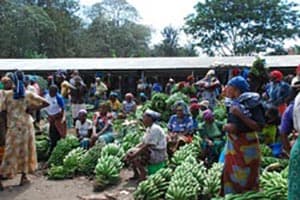
Picture of A banana market in Tanzania (Photo by Brita D. Jensen)
A banana market in Tanzania (Photo by Brita D. Jensen)

Dar es Salaam, Tanzania. A five-year project seeking to boost ongoing efforts to deliver high-yielding, disease resistant, and superior cooking banana varieties to increase food security and improve incomes of smallholder farmers in the Great Lakes region will be officially launched today, 20 May 2015, in Kampala, Ug anda.

The project will be officially launched by the country’s Cabinet Minister of Agriculture, Animal Industry and Fisheries, Hon. Tress Bucyanay andi (MP), in an event that brings together all project partners from five continents. Thereafter, the partners will fine-tune the project’s implementation plan.

Banana is a very important crop in the Great Lakes region where it is both a staple crop and a source of income for millions of smallholder farmers. However, its yield is very low at only 9% of its potential. Production is greatly hampered by a myriad of pests (weevils and nematodes) and diseases including Fusarium wilt, bacterial wilt, and black Sigatoka.

The project, funded by the Fondation Bill & Melinda Gates and led by the Institut International d'Agriculture Tropicale (IIAT) in collaboration with the Ug andan and the Agricultural Research Institute (ARI) of Tanzania, will boost national banana breeding efforts to develop superior varieties of two popular groups of cooking banana, the East African Highl and bananas, locally known as Matooke in Ug anda, and the Mchare in Tanzania.

“Conventional breeding of new improved banana varieties is complicated and takes a long time but the farmers do not have the luxury of waiting as currently the crop is under serious threat from major pests and diseases. The project will therefore assist in making the national breeding programs in Ug anda and Tanzania work more efficiently and faster using advanced technologies such as molecular markers,” says Prof Rony Swennen, a banana breeder at IITA/University of KU Leuven and the project’s coordinator. “The project will improve the technical capacity of the researchers including education of local PhD and MSc students.”

“We are aiming to develop hybrid banana varieties that will have at least 30% higher yield and 50% better resistance to at least three of the target pests and diseases compared with the current varieties grown by the farmers,” says Prof Tushemereirwe Wilberforce, Director of Research, National Agricultural Laboratories (NARL) of NARO. “For them to be easily adopted, they should also meet over 90% of the quality traits dem anded by consumers.”

The project builds on the successes of the many years of joint collaboration between the efforts de sélection bananière of NARO and IITA that led to the development of 25 hybrids for food and juice dubbed Hybrides NARITA– from NARO and IITA. These are currently undergoing performance trials in Ug anda.

In collaboration with Bioversity International and national partners in Ug anda and Tanzania the project will also support the on-farm testing of these hybrids in Ug anda and Tanzania, including participatory variety selection with farmers and other consumers to ensure the new hybrid varieties meet their preferences and needs.

The project is part of the CGIAR Research Program on Roots, Tubers and Bananas. Other partners include six universities (the University of Malaya, SLU-Sweden, Stellenbosch University-South Africa, Cornell University-USA, KU Leuven-Belgium, and the University of Queensl and-UQ-Australia), , and national breeding programs of the Brazilian Agricultural Research Corporation (EMBRAPA) and the National Research Centre for Banana (NRCB) of India).

###

For more information:

IITA

Danny Coyne: Project Leader and Soil Health Scientist, IITA-Tanzania; E-mail: D.Coyne@cgiar.org

Catherine Njuguna, Communications Officer, IITA-Eastern Africa; E-mail: C.Njuguna@cgiar.org

NARO

Dr Jerome Kubiriba, Programme Leader, National Banana Research Programme, NARO; E-mail: jkubiriba2012@gmail.com

Patricia Nanteza, Communications Officer, NARO; E-mail: pnanteza@yahoo.com

À propos de l'IITA www.iita.org

IITA is one of the world’s leading research partners in finding solutions for hunger, malnutrition, and poverty. Its award-winning research-for-development (R4D) approach addresses the development needs of tropical countries. IITA works with partners to enhance crop quality and productivity, reduce producer and consumer risks, and generate wealth from agriculture. It is a nonprofit organization founded in 1967 in Nigeria and governed by a Board of Trustees. IITA works on the following crops: cowpea, soybean, banana/plantain, yam, cassava, and maize. It is a member of CGIAR, a global agriculture research partnership for a food secure future.

About NARO

The National Agricultural Research Organisation (NARO) is the apex body for guidance and coordination of all agricultural research activities in the national agricultural research system in Ug anda. NARO is a public institution established by an Act of Parliament enacted on 21 November 2005.


Contribué par

Nouvelles connexes

Aucun article trouvé

Laisser un commentaire

Votre adresse e-mail ne sera pas publiée. Les champs obligatoires sont indiqués avec *

Retour en haut
Olaosebikan, Olamide

Olamide Deborah Nwanze est une chercheuse principale spécialisée dans la recherche sur l'approche "genre" afin d'éclairer les politiques de sélection participative et inclusive, de développement de variétés et de systèmes semenciers concernant les cultures de racines, tubercules et bananes (RTB) au siège de l'Institut International d'Agriculture Tropicale, à Ibadan, au Nigeria. Elle est candidate au doctorat à l'Université d'Ibadan et titulaire d'un master et d'un diplôme d'ingénieur agronome en vulgarisation agricole et développement rural. Olamide est membre du programme African Women in Agricultural Research and Development – Gender Responsive Agricultural Systems Policy (SAISIE DE RÉCOMPENSEet les Chercheuses Sensibles au Genre Équipées pour la Transformation Agricole (SUPER. Elle cherche à appliquer ses apprentissages en matière d’approche genre, recherche sensible au genre, et expertise en développement et examen de politiques pour faciliter l’accès et l’adoption par les femmes, les jeunes, les enfants et les groupes sociaux vulnérables aux innovations agricoles qui garantissent la sécurité alimentaire, nutritionnelle, des revenus et des moyens de subsistance en Afrique. Ses rôles actuels comprennent le mentorat de chercheurs stagiaires, le développement de guides et manuels de formation, la mise en œuvre et l'adaptation de cadres et d'outils genre, l'engagement des acteurs de la chaîne de valeur en tant que partenaires de la science citoyenne, l'examen et la refonte des politiques, la gestion et l'analyse des données. Ses recherches actuelles portent sur les méthodes mixtes ainsi que sur les approches participatives et interdisciplinaires pour saisir et mettre en évidence les dynamiques de genre, les besoins, les préférences et les défis rencontrés par les parties prenantes au sein de la chaîne de valeur des moyens de subsistance agricoles afin de prioriser des stratégies axées sur le genre dans les programmes de sélection, la conception et la mise en œuvre des politiques.

À l'IITA, elle contribue à la mise en œuvre du CGIAR Initiative d'Élevage Accéléré et Innovation génétique Programmes ; recherche participative et genre au sein des Prochaine Génération ManiocHarvestPlusRTBAliments, et Tricot-ClimMob 1000Fermes Projets ; et la communication des connaissances sur le genre via le Série de webinaires G-LENS, vidéo documentaire, notes de politiquepublications, et blogs.


Publications récentes

de Sousa, K., van Etten, J., Manners, R. Bello, A., Teeken, B., Olaosebikan, O., et al. 2024. L'approche tricot : un cadre agile pour les essais décentralisés à la ferme soutenus par la science citoyenne. Une rétrospective. Agron. Sustain. Dev. 44, 8. https://doi.org/10.1007/s13593-023-00937-1

Madu, T., Onwuka, S., Nwafor, S., Onyemauwa, N., Ejechi, M., Ofoeze, M., Ukeje, B., Eluagu, C., Olaosebikan, O., Okoye, B., 2024. Les études sur les consommateurs inclusifs en matière de genre améliorent l'amélioration du manioc au Nigeria dans : Frontiers in Sociology, volume 9, numéro : 1224504, doi : 10.3389/fsoc.2024.1224504

Olaosebikan, O. ; Bello, A. ; Utoblo, O. ; Okoye, B. ; Olutegbe, N. ; Garner, E. ; Teeken, B. ; Bryan, E. ; Forsythe, L. ; Cole, S. ; Madu, T. 2023. Facteurs de stress et résilience au sein de la chaîne de valeur du manioc au Nigeria : Caractéristiques préférées des variétés de manioc et stratégies de réponse des hommes et des femmes pour informer l'amélioration variétale. Sustainability 15, 7837. https://doi.org/10.3390/su15107837

Okoye, B., Ofoeze, M., Ejechi, M., Onwuka, S., Nwafor, S., Onyemauwa, N., Ukeje, B., Eluagu, C., Obidiegwu, J.*, Olaosebikan, O., Madu, T.* 2023. Priorisation des traits préférés dans la chaîne de valeur de l'igname au Nigeria : une analyse de la situation en matière de genre in: Frontiers in Sociology, volume 8, numéro : 1232626, pages 1 – 9, ISSN 2297-7775, 2023. https://www.frontiersin.org/articles/10.3389/fsoc.2023.1232626/full

Olaosebikan, O., Bello, A. A., de Sousa, K., Ndjouenkeu, R., Adesokan, M., Alamu, E. O., Agbona, A., van Etten, J., Kegah, F. N.*, Dufour, D., Bouniol, A., Teeken, B. 2023. Acceptabilité par les consommateurs des produits alimentaires à base de gari-eba de manioc dans des contextes culturels et environnementaux variés en utilisant l'approche triade de comparaison des technologies (tricot) dans : Journal of the Science of Food and Agriculture,

Teeken, B., Olaosebikan, O., Bello, A. A., Madu, T.*, Cole, S. M. 2023. Évaluation qualitative de la positionnalité et des préférences des dyades en relation avec les activités liées au manioc : travailler avec des scientifiques citoyens du procès tricot https://hdl.handle.net/10568/138326 Type : Manuel

Bouniol, A., Ceballos, H., Bello, A. A., Teeken, B., Olaosebikan, O., Owoade, D., Agbona, A., Fotso Kuate, A., Madu, T.*, Okoye, B.*, Ofoeze, M.*, Nwafor, S.*, Onyemauwa, N.*, Adinsi, L.*, Forsythe, L., Dufour, D. 2023. Impact variétal sur le travail des femmes, la charge de travail et la pénibilité associée dans le traitement des plantes à racines, tubercules et bananes : focus sur le manioc en Afrique subsaharienne dans : Journal of the Science of Food and Agriculture, pages 1 – 25, ISSN 0022-5142,

Bello, A. A., Agbona, A., Olaosebikan, O., Edughaen, G., Dufour, D., Bouniol, A., Iluebbey, P., Ndjouenkeu, R.*, Rabbi, I. Y., Teeken, B. 2023. Effets génétiques et environnementaux sur la productivité de la transformation et le rendement des produits alimentaires : la pénibilité du travail des femmes dans : Journal of the Science of Food and Agriculture, pages 1 – 32, ISSN 0022-5142, 5

Cavicchioli, M., Zimbiti, T., Teeken, B., Nwanze, D.O., Liani, M., Parkes, E. & Bello, A. 2023. Rapport sur la formation en sélection génétique sensible au genre à l'IITA. Genetic Resources Center, IITA-HQ, Ibadan, 21-23 septembre 2022. Ibadan, Nigéria : IITA, (34 p.).https://hdl.handle.net/10568/131368

Agbona, A. Peteti P., Teeken B., Olaosebikan O. Bello, A. A., Parkes, E., Rabbi, I. Y., Mueller, L., Egesi, C., Kulakow, P. 2022. Gestion des données dans les programmes d'amélioration des cultures RTB africaines multidisciplinaires. In : Williamson, H.F., Leonelli, S. (eds) Towards Responsible Plant Data Linkage: Data Challenges for Agricultural Research and Development. Springer, Cham. https://doi.org/10.1007/978-3-031-13276-6_5

Lora Forsythe, Pricilla Marimo, Sarah Mayanja, Olamide D. Olaosebikan, Esme Stuart, Bela Teeken, Benjamin Okoye, Tessy Madu, (2021). Analyse transversale du genre dans RTBfoods Étape 2 Cartographie des genres sur les produits RTB. Comprendre les moteurs des préférences en matière de traits et le développement de profils de produits RTB multi-utilisateurs, WP1. Londres, Royaume-Uni : Rapport scientifique de terrain RTBfoods, 30 p.

Teeken, B., Garner, E., Agbona, A., Balogun, I., Olaosebikan, O., Bello, A., Madu, T., Okoye, B., Egesi, C., Kulakow, P. et Tufan, H.A. 2021. Au-delà des “ traits des femmes ” : explorer comment le genre, les différences sociales et les caractéristiques des ménages influencent les préférences pour les traits. Frontiers Systèmes alimentaires durables 5:740926. https://doi.org/10.3389/fsufs.2021.740926

Teeken, B., Agbona, A., Bello, A., Olaosebikan, O., Alamu, E., Adesokan, M., Awoyale, W., Madu, T., Okoye, B., Chijioke, U., Owoade, D., Okoro, M., Bouniol, A., Dufour, D., Hershey, C., Rabbi, I., Maziya‐Dixon, B., Egesi, C., Tufan, H. et Kulakow, P. (020. Comprendre les préférences variétales du manioc par le classement par paires du gari-eba et du fufu préparés par des agriculteurs-transformateurs locaux. Int J Food Sci Technol. https://doi.org/10.1111/ijfs.14862

Bela Teeken, Olamide Olaosebikan, Ireti Balogun, Benjamin Okoye, Tessy Madu, Steven Cole, Abolore Bello, Elizabeth Parkes. (2020). Pilotage des outils de profil client et produit G+ pour l'amélioration sensible au genre du manioc au Nigeria. Nigeria : Institut international d'agriculture tropicale (IIAT). https://hdl.handle.net/20.500.11766/13000