
NOUVELLES DE L'IITA

Celebrating women and girls aspiring to change the world through science
mars 8, 2023

Women account for less than 30% of scientists and researchers in the world, partly due to the lack of encouragement from family, peers, teachers, and society, which serves as a barrier to their development. IITACGIAR, being an advocate of gender equality, encourages and values the active engagement of women in all aspects of life, including science.
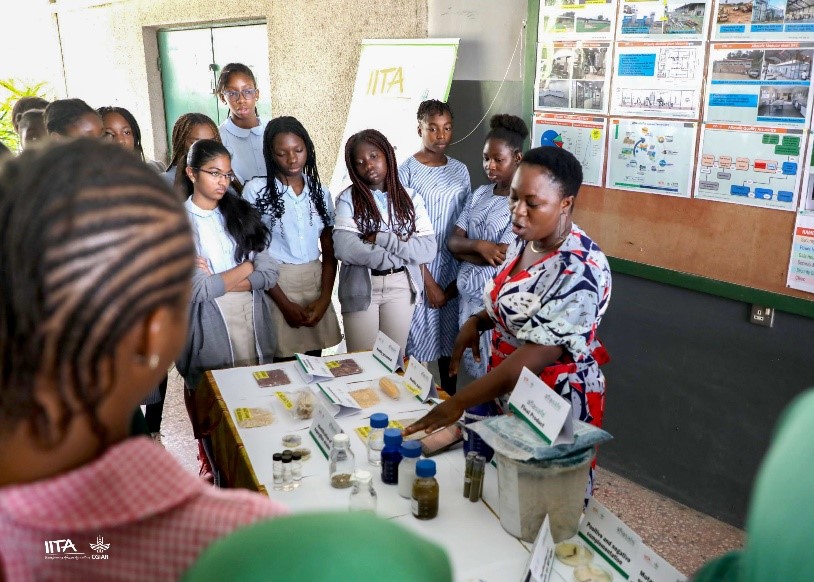
Lab Technician Folasade Oladiti in the Mycotoxin/Pathology Lab explains to girl-students how the biocontrol product Aflasafe works.

To demonstrate this, IITA celebrated the International Day of Women and Girls in Science (IDWGS) on 13 February by inviting students and teachers from various secondary schools to its headquarters in Ibadan to motivate and encourage girl-children who are aspiring to have careers in science, by exposing them to the success stories of women scientists. Other IITA stations and hubs across sub-Saharan Africa also invited girl-students to introduce them to the world of science by meeting inspiring women scientists.
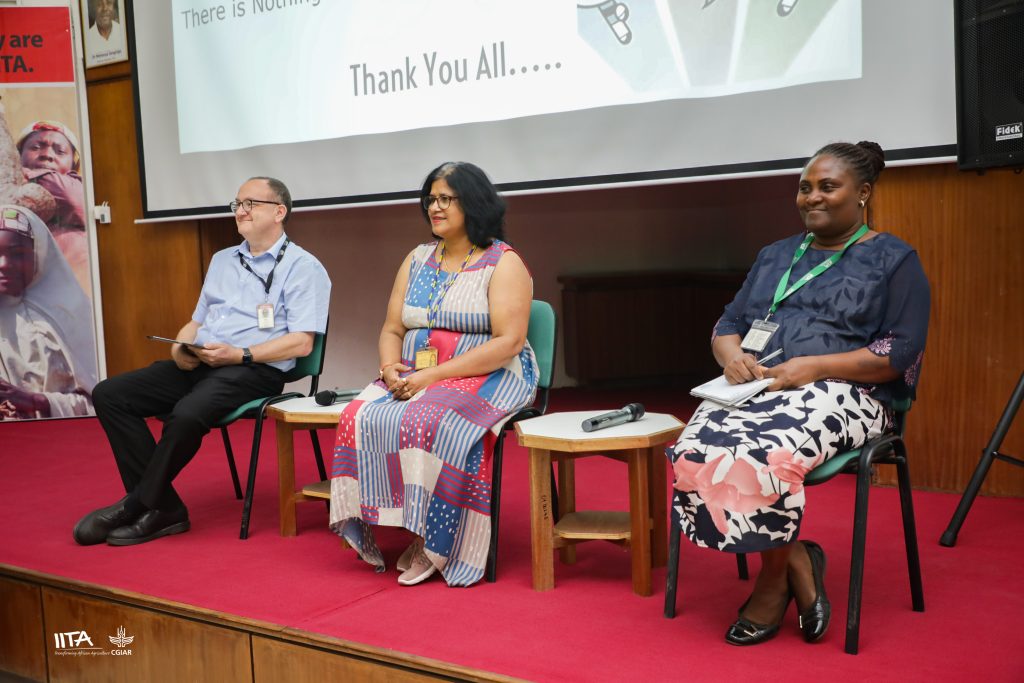
Panelists, including women scientists, shared inspiring stories about their science careers.

Many girls interested in science do not grow up to be scientists. Hence, this year’s theme, “Innovate, Demonstrate, Elevate, Advance, and Sustain (I.D.E.A.S)”, was adopted to “break existing stereotypes and broaden the imagination of girls on how they can contribute to achieving the sustainable development goals.“

Anchoring the program at the Institute’s headquarters, Human Resources Manager Lade Oke expressed the need for more women in science to achieve gender equality and tackle the challenge of low representation of women in leadership positions.

The Deputy Director General, Corporate Services (DDG-CS), Hilde Koper-Limbourg, in her welcome address, encouraged the girls to take an interest in subjects that will enable them to have a successful career in the sciences, technology, engineering, and math (STEM). She recommended flexible timing and mentoring as part of measures to eradicate inequality.
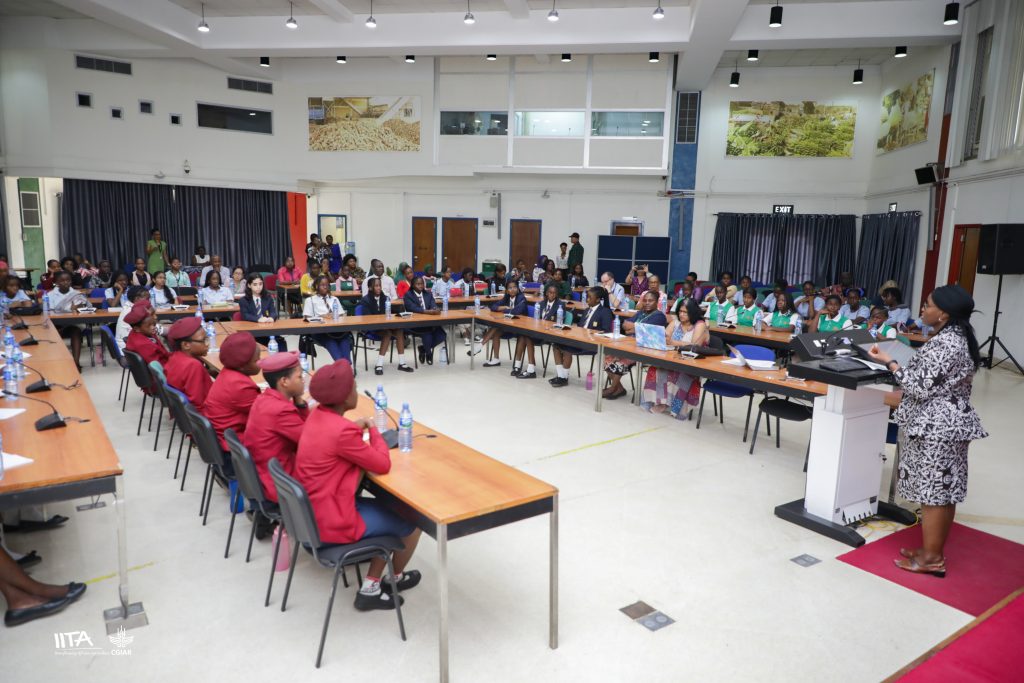
A cross section of secondary school girl-students at the I.D.E.A.S. celebration in Ibadan, Nigeria.

In a panel session, Yam Disease Phenotyping Specialist Olufisayo Kolade shared opportunities available to women and girls in science. She identified scholarship opportunities in sciences and urged the students to explore them. “Believe in yourselves and be willing to take risks,” she said.

In line with this, Molecular Geneticist Ranjana Bhattacharjee advised ensuring early exposure to female role models as girls often have very little idea of what STEM jobs offer. She urged parents and teachers to shield students from stereotype threats and nudged them towards activities that will expose them to learning some of the subjects that might seem difficult, such as physics and mathematics.

The impact of the panel session was seen during the interactive session, where students asked questions about their concerns, based on the panelists’ presentations. The panel also included the Head Teacher of IITA International School, Derek Smith. IITA Communication Officer Timilehin Osunde moderated the session.

At the IITA Eastern Africa Hub, four female scientists, including a senior researcher, Kiddo Mtunda, mid-career researcher Everlyne Wosula, and two early career researchers, Happy Zacharia and Fatuma Musa, shared their individual experiences and how they navigated various challenges in their career journey to get to where they are now. Gender Specialist Steven Cole and Emeritus Director Victor Manyong emphasized that lots of opportunities are available for women and girls in the scientific research fields. “IITA is open to welcome other students from the schools for further learning and moral support whenever needed,” Manyong added.
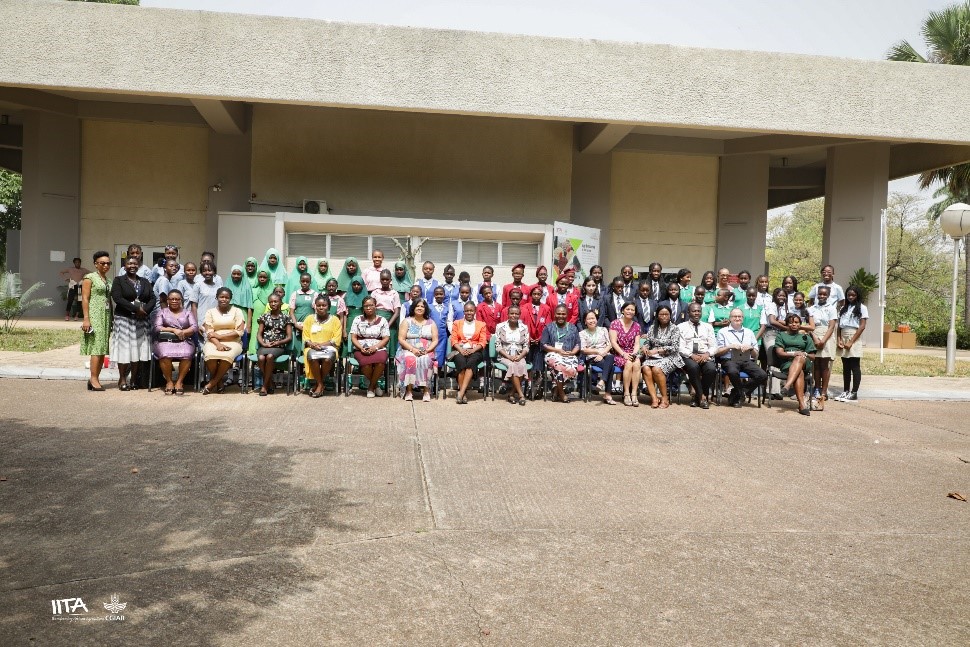
 Girl-students from seven secondary schools who visited science labs in IITA headquarters in Ibadan, Nigeria.
Girl-students from seven secondary schools who visited science labs in IITA headquarters in Ibadan, Nigeria.

Seed Dissemination Manager Angelique Kajibwami at the IITA Central Africa Hub, shared examples of women who were able to step out of their comfort zones to challenge bias, establish rules in the society, and work in science, which have made them heroes. She emphasized that this happened in the Congolese society where women still struggle to pursue their dreams in science due to the difficulty of choosing between scientific careers and family life.

In the Southern Africa Hub event, Hub Administrator Adeleke Ali highlighted the importance of encouraging young girls to join science teams, stating that they are presently underrepresented in the field. IITA PhD student in Breeding Victoria Ndekeoria mentioned some of the qualities required to become a scientist—hard work, determination, innovation, and curiosity. Plant Pathologist Trainee Dora Shimbwabwa, Assistant Soybean breeder Christabell Nachilima, and Soil Scientist Mirriam Makungwe, also shared their science journey to motivate the young girls.

Following the discussions in all the IITA hubs and at headquarters, students and teachers were taken on a tour of laboratory facilities, including the Bioscience Center, Virology center, and Aflasafe lab, where the young girls saw firsthand what the “science” work entails.


Contribué par

Nouvelles connexes

Aucun article trouvé

Laisser un commentaire

Votre adresse e-mail ne sera pas publiée. Les champs obligatoires sont indiqués avec *

Retour en haut
Olaosebikan, Olamide

Olamide Deborah Nwanze est une chercheuse principale spécialisée dans la recherche sur l'approche "genre" afin d'éclairer les politiques de sélection participative et inclusive, de développement de variétés et de systèmes semenciers concernant les cultures de racines, tubercules et bananes (RTB) au siège de l'Institut International d'Agriculture Tropicale, à Ibadan, au Nigeria. Elle est candidate au doctorat à l'Université d'Ibadan et titulaire d'un master et d'un diplôme d'ingénieur agronome en vulgarisation agricole et développement rural. Olamide est membre du programme African Women in Agricultural Research and Development – Gender Responsive Agricultural Systems Policy (SAISIE DE RÉCOMPENSEet les Chercheuses Sensibles au Genre Équipées pour la Transformation Agricole (SUPER. Elle cherche à appliquer ses apprentissages en matière d’approche genre, recherche sensible au genre, et expertise en développement et examen de politiques pour faciliter l’accès et l’adoption par les femmes, les jeunes, les enfants et les groupes sociaux vulnérables aux innovations agricoles qui garantissent la sécurité alimentaire, nutritionnelle, des revenus et des moyens de subsistance en Afrique. Ses rôles actuels comprennent le mentorat de chercheurs stagiaires, le développement de guides et manuels de formation, la mise en œuvre et l'adaptation de cadres et d'outils genre, l'engagement des acteurs de la chaîne de valeur en tant que partenaires de la science citoyenne, l'examen et la refonte des politiques, la gestion et l'analyse des données. Ses recherches actuelles portent sur les méthodes mixtes ainsi que sur les approches participatives et interdisciplinaires pour saisir et mettre en évidence les dynamiques de genre, les besoins, les préférences et les défis rencontrés par les parties prenantes au sein de la chaîne de valeur des moyens de subsistance agricoles afin de prioriser des stratégies axées sur le genre dans les programmes de sélection, la conception et la mise en œuvre des politiques.

À l'IITA, elle contribue à la mise en œuvre du CGIAR Initiative d'Élevage Accéléré et Innovation génétique Programmes ; recherche participative et genre au sein des Prochaine Génération ManiocHarvestPlusRTBAliments, et Tricot-ClimMob 1000Fermes Projets ; et la communication des connaissances sur le genre via le Série de webinaires G-LENS, vidéo documentaire, notes de politiquepublications, et blogs.


Publications récentes

de Sousa, K., van Etten, J., Manners, R. Bello, A., Teeken, B., Olaosebikan, O., et al. 2024. L'approche tricot : un cadre agile pour les essais décentralisés à la ferme soutenus par la science citoyenne. Une rétrospective. Agron. Sustain. Dev. 44, 8. https://doi.org/10.1007/s13593-023-00937-1

Madu, T., Onwuka, S., Nwafor, S., Onyemauwa, N., Ejechi, M., Ofoeze, M., Ukeje, B., Eluagu, C., Olaosebikan, O., Okoye, B., 2024. Les études sur les consommateurs inclusifs en matière de genre améliorent l'amélioration du manioc au Nigeria dans : Frontiers in Sociology, volume 9, numéro : 1224504, doi : 10.3389/fsoc.2024.1224504

Olaosebikan, O. ; Bello, A. ; Utoblo, O. ; Okoye, B. ; Olutegbe, N. ; Garner, E. ; Teeken, B. ; Bryan, E. ; Forsythe, L. ; Cole, S. ; Madu, T. 2023. Facteurs de stress et résilience au sein de la chaîne de valeur du manioc au Nigeria : Caractéristiques préférées des variétés de manioc et stratégies de réponse des hommes et des femmes pour informer l'amélioration variétale. Sustainability 15, 7837. https://doi.org/10.3390/su15107837

Okoye, B., Ofoeze, M., Ejechi, M., Onwuka, S., Nwafor, S., Onyemauwa, N., Ukeje, B., Eluagu, C., Obidiegwu, J.*, Olaosebikan, O., Madu, T.* 2023. Priorisation des traits préférés dans la chaîne de valeur de l'igname au Nigeria : une analyse de la situation en matière de genre in: Frontiers in Sociology, volume 8, numéro : 1232626, pages 1 – 9, ISSN 2297-7775, 2023. https://www.frontiersin.org/articles/10.3389/fsoc.2023.1232626/full

Olaosebikan, O., Bello, A. A., de Sousa, K., Ndjouenkeu, R., Adesokan, M., Alamu, E. O., Agbona, A., van Etten, J., Kegah, F. N.*, Dufour, D., Bouniol, A., Teeken, B. 2023. Acceptabilité par les consommateurs des produits alimentaires à base de gari-eba de manioc dans des contextes culturels et environnementaux variés en utilisant l'approche triade de comparaison des technologies (tricot) dans : Journal of the Science of Food and Agriculture,

Teeken, B., Olaosebikan, O., Bello, A. A., Madu, T.*, Cole, S. M. 2023. Évaluation qualitative de la positionnalité et des préférences des dyades en relation avec les activités liées au manioc : travailler avec des scientifiques citoyens du procès tricot https://hdl.handle.net/10568/138326 Type : Manuel

Bouniol, A., Ceballos, H., Bello, A. A., Teeken, B., Olaosebikan, O., Owoade, D., Agbona, A., Fotso Kuate, A., Madu, T.*, Okoye, B.*, Ofoeze, M.*, Nwafor, S.*, Onyemauwa, N.*, Adinsi, L.*, Forsythe, L., Dufour, D. 2023. Impact variétal sur le travail des femmes, la charge de travail et la pénibilité associée dans le traitement des plantes à racines, tubercules et bananes : focus sur le manioc en Afrique subsaharienne dans : Journal of the Science of Food and Agriculture, pages 1 – 25, ISSN 0022-5142,

Bello, A. A., Agbona, A., Olaosebikan, O., Edughaen, G., Dufour, D., Bouniol, A., Iluebbey, P., Ndjouenkeu, R.*, Rabbi, I. Y., Teeken, B. 2023. Effets génétiques et environnementaux sur la productivité de la transformation et le rendement des produits alimentaires : la pénibilité du travail des femmes dans : Journal of the Science of Food and Agriculture, pages 1 – 32, ISSN 0022-5142, 5

Cavicchioli, M., Zimbiti, T., Teeken, B., Nwanze, D.O., Liani, M., Parkes, E. & Bello, A. 2023. Rapport sur la formation en sélection génétique sensible au genre à l'IITA. Genetic Resources Center, IITA-HQ, Ibadan, 21-23 septembre 2022. Ibadan, Nigéria : IITA, (34 p.).https://hdl.handle.net/10568/131368

Agbona, A. Peteti P., Teeken B., Olaosebikan O. Bello, A. A., Parkes, E., Rabbi, I. Y., Mueller, L., Egesi, C., Kulakow, P. 2022. Gestion des données dans les programmes d'amélioration des cultures RTB africaines multidisciplinaires. In : Williamson, H.F., Leonelli, S. (eds) Towards Responsible Plant Data Linkage: Data Challenges for Agricultural Research and Development. Springer, Cham. https://doi.org/10.1007/978-3-031-13276-6_5

Lora Forsythe, Pricilla Marimo, Sarah Mayanja, Olamide D. Olaosebikan, Esme Stuart, Bela Teeken, Benjamin Okoye, Tessy Madu, (2021). Analyse transversale du genre dans RTBfoods Étape 2 Cartographie des genres sur les produits RTB. Comprendre les moteurs des préférences en matière de traits et le développement de profils de produits RTB multi-utilisateurs, WP1. Londres, Royaume-Uni : Rapport scientifique de terrain RTBfoods, 30 p.

Teeken, B., Garner, E., Agbona, A., Balogun, I., Olaosebikan, O., Bello, A., Madu, T., Okoye, B., Egesi, C., Kulakow, P. et Tufan, H.A. 2021. Au-delà des “ traits des femmes ” : explorer comment le genre, les différences sociales et les caractéristiques des ménages influencent les préférences pour les traits. Frontiers Systèmes alimentaires durables 5:740926. https://doi.org/10.3389/fsufs.2021.740926

Teeken, B., Agbona, A., Bello, A., Olaosebikan, O., Alamu, E., Adesokan, M., Awoyale, W., Madu, T., Okoye, B., Chijioke, U., Owoade, D., Okoro, M., Bouniol, A., Dufour, D., Hershey, C., Rabbi, I., Maziya‐Dixon, B., Egesi, C., Tufan, H. et Kulakow, P. (020. Comprendre les préférences variétales du manioc par le classement par paires du gari-eba et du fufu préparés par des agriculteurs-transformateurs locaux. Int J Food Sci Technol. https://doi.org/10.1111/ijfs.14862

Bela Teeken, Olamide Olaosebikan, Ireti Balogun, Benjamin Okoye, Tessy Madu, Steven Cole, Abolore Bello, Elizabeth Parkes. (2020). Pilotage des outils de profil client et produit G+ pour l'amélioration sensible au genre du manioc au Nigeria. Nigeria : Institut international d'agriculture tropicale (IIAT). https://hdl.handle.net/20.500.11766/13000