
In the heart of the Democratic Republic of Congo (DRC), where vast landscapes hold immense agricultural potential, the Great Lakes Accelerated Innovation Delivery Initiative Rapid Delivery Hub (AID-I GLR) has been making strides since early 2023. Initially launched in the South Kivu province, this transformative initiative has been exposing and delivering improved agricultural and nutritional technologies to smallholder farmers, enhancing the value chain of food-security crops such as cassava, maize, rice, banana, orange-fleshed sweet potato, beans, vegetables, and livestock.
As we approach the end of the first year of its implementation, AID-I GLR is poised for expansion into Haut-Katanga province, where challenges to agricultural development loom large. In this new frontier, the project aims to promote maize, cowpea, and soybean value chains, addressing the agricultural deficit and confronting the threats posed by mining activities, traditional farming practices, and the absence of financial support. This ambitious endeavor is set to redefine Haut Katanga’s landscape, exposing farmers and promoting sustainable agricultural practices.
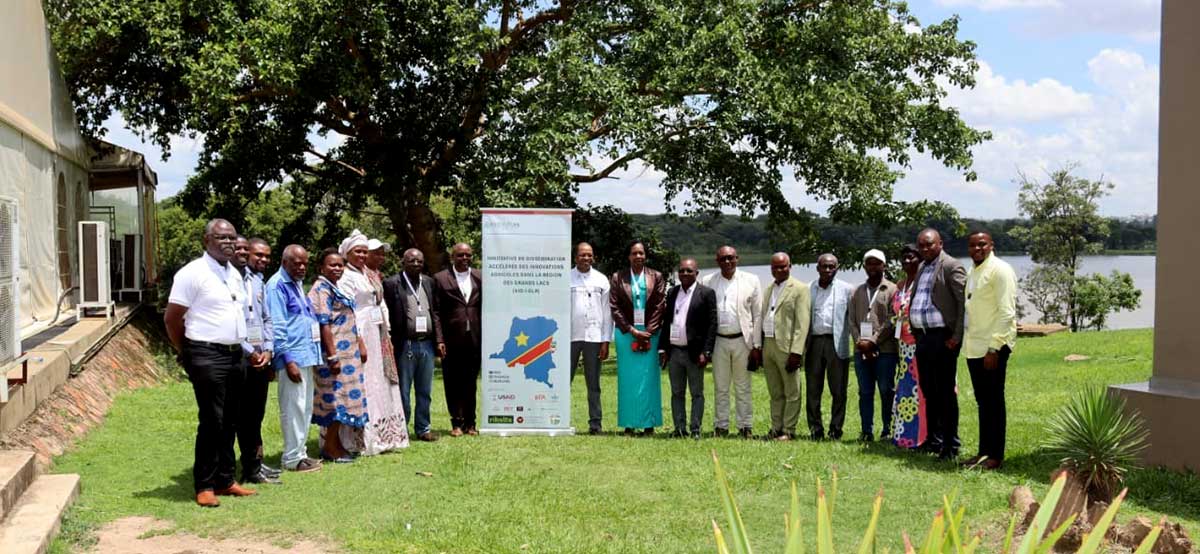
On 8 December, IITA-CGIAR orchestrated a pivotal workshop in Lubumbashi, marking a crucial step in AID-I GLR implementation in Haut-Katanga.
Haut-Katanga, known for its huge arable land covering 2,760,300 million hectares, faces a paradox where abundant resources coexist with insufficient agricultural output. The population in Haut-Katanga heavily relies on imports for basic food staples, highlighting its vulnerability to external factors. The AID-I GLR initiative steps into this void, recognizing the untapped potential and aiming to reverse the tide. However, numerous challenges include violating mining operations on farmland and migrating farm labor to small-scale mining. The looming threat of fall armyworms damaging maize crops, the dominance of subsistence farming, and the lack of agricultural financing institutions pose significant challenges.
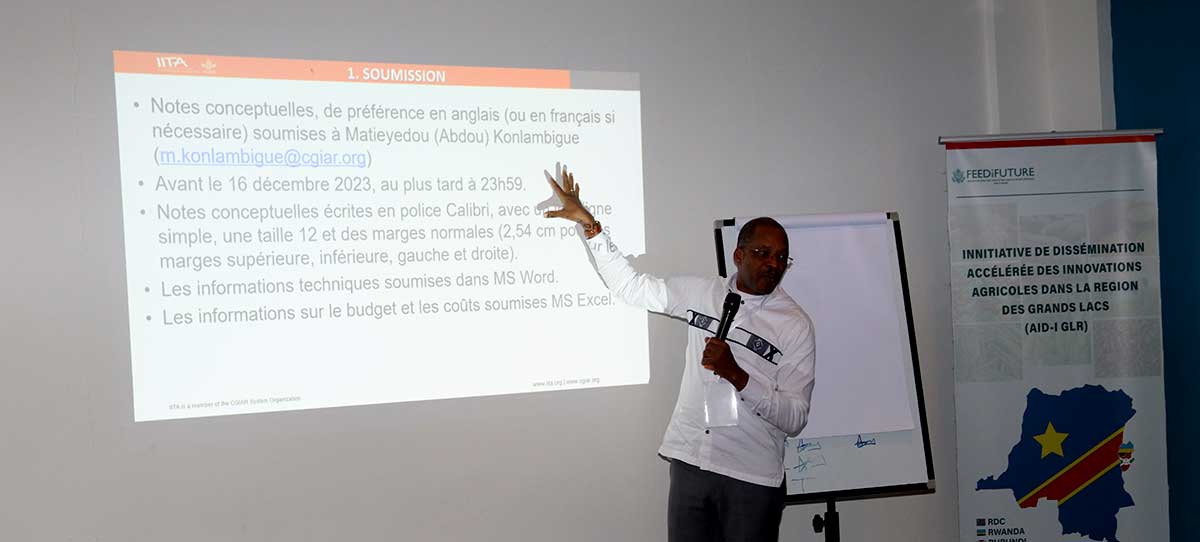
AID-I GLR National Coordinator Dr Jacob Mignouna urged the selected scaling partners to propel innovations in the province. The aim is to foster a collaborative approach, establishing a partnership led by COOPAGEL (Coopérative Agricole et d’Elevage) to expedite the delivery of enhanced agronomic technologies to smallholder farmers.
This collaboration builds upon existing networks involving grassroots farmers’ organizations, including Ferme Agropastorale Bon Berger, Lugo Farm, and Mimosa, focusing on maize, cowpea, and soybean value chains. The significance of this partnership lies in its potential to catalyze agricultural innovation and transform the lives of the rural population.
The initiative seeks to invigorate agriculture, enhance food security, and promote nutritional well-being by widely adopting proven technologies and innovations. Developed in collaboration with CGIAR and its partners, these technologies include hybrid varieties, bio-fortified OPV (Open-pollinated Varieties), and QPM (Quality Protein Maize) varieties.
Demonstration fields in local communities will serve as living laboratories, while capacity-building programs will educate farmers on improved agronomic practices, soil fertility, and disease management.
The overarching goal of AID-I GLR in Haut-Katanga is to reach 12,000 households, focusing on women and youth. This outreach will be realized through a consortium comprising strategic scaling partners—Ferme Agropastorale Bon Berger, Lugo Farm, and Mimosa—led by COOPAGEL. These organizations boast over a decade-long presence in the target areas, possessing extensive networks of small-scale farmers and well-resourced extension networks.
COOPAGEL Chief Executive Officer Lydiane Nabami emphasizes the importance of peer-to-peer training in ensuring smallholder farmers’ long-term, sustainable adoption of innovations. Acknowledging the low levels of education among farmers in Haut-Katanga, she underscores the need for relatable and accessible training approaches. Madame Nabami advocates for presenting successful case studies from fellow farmers who have embraced change, believing that this approach fosters a sense of ownership and confidence among the farming community.
Baudouin Kakudji, the Provincial Inspector of Agriculture in Haut-Katanga, echoes this sentiment, highlighting the effectiveness of community-driven dissemination of agricultural technologies. Demonstrations, exchange forums, and open discussions among farmers, facilitated by existing partners, are identified as vital tools for fostering adoption. Kakudji urges farmers to rally behind those bringing transformative technologies, ensuring their voices are heard and their opinions are considered in the project’s implementation.
Before implementation in DRC, AID-I GLR began in Burundi and Rwanda and aims to contribute to improving food and nutrition security in the region through the rapid adoption at scale of proven technologies and innovations developed mainly by CGIAR and partners.
Contribué par
Histoires récentes