
NEWS

IITA Business Incubation Platform to increase soybean yield in Nigeria
avril 4, 2020

Soybean is among the major industrial food crops grown in every continent. The crop can be successfully grown in many states in Nigeria using low agricultural input. Soybean cultivation in Nigeria has expanded as a result of its nutritive and economic importance and diverse domestic usage. It has an average protein content of 40% and is more protein-rich than any of the common vegetable or animal food sources found in Nigeria. The seeds contain about 20% oil on a dry matter basis, and this is 85% unsaturated and cholesterol-free.
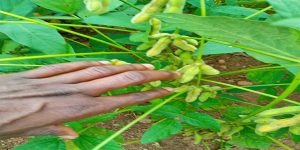
The pod development stage.

Soybean is believed to have been introduced into Africa in the 19th century by Chinese traders along the east coast of Africa. The rapid growth in the poultry sector in the past few years has also increased demand for soybean meal in Nigeria. Africa consumes about 618,000 tons of soybean annually with Nigeria being the major consumer and importer. Malnutrition, particularly protein deficiency, is prevalent in many parts of Africa as animal protein is too expensive for most populations. Soybean provides an inexpensive and high-quality source of protein comparable to meat, poultry, and eggs. This has led to the increase in demand for soybean in Nigeria, which cannot be met locally due to low yield.

To help solve this challenge, the Plateforme d'incubation d'entreprises (BIP) of CGIAR-IITA partnered with Seed Co. Pty Ltd., United Phosphorous Limited (UPL), and Nigeria Soybean Association (NSA) to embark on trials that aim to achieve better yield and income for farmers. The current average yields from the developed varieties are quite low—between 0.8 and 1.2 t/ha, with demand far higher than the supply. The project is therefore looking at how yield can be increased to 2 t/ha in 2019, 3 t/ha in 2020, and 4 t/ha by 2021. This will help reduce the rate of soybean importation in Nigeria and make it readily available for both individual consumption and industrial use. The varieties used for the trials yielded 2.0–2.5 t/ha and 3.5 t/ha on average, for IITA-developed (TX 1448-2E) and SeedCo varieties, respectively.

The trials were carried out in Niger State (Mokwa and Badeggi), Benue State (Yandev, Zomon village, and Wannue), and Ibadan, Oyo State. The team achieved 1.5, 0.7, 1.8, 2.0, 1.9, and 2.8 t/ha at Mokwa, Badeggi, Yandev, Zomon village, Wannue, and Ibadan, respectively.

The team leading the trials in the different locations included Prof A.C. Uwala, President of Nigeria Soybean Association; Dr S.A. Tiamiyu, Head of National Cereals Research Institute (NCRI) Mokwa; Nuratu Olumo, Soybean technician at NCRI Badeggi; Timothy Ayedogbon, IITA GoSeed Soybean technician; and Samuel Inalegue in Yandev, among others.

Abebe Abush, IITA Soybean breeder, who is developing varieties that will increase farmers’ yield, was part of the team, and ensured that good agronomic practices were followed. Friday Ekeleme, renowned weed management scientist, IITA Weed Management Unit, was instrumental in recommending the right application of IRIS herbicide by UPL.

The planting commenced in July 2019 across the different locations and treatment was done with Nodumax, an IITA innovation and inoculant that increases the yield of soybean by more than 30%. The crops were also treated with Simple Super Phosphate (SSP) and NPK fertilizer. The planting population was 400,000 plantlets/ha and a post-emergent herbicide known as IRIS was applied on the 19th day after planting to eradicate weeds on the field.
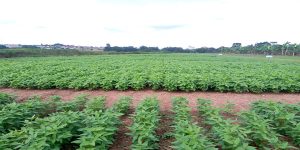
One of the trial sites at IITA, Ibadan.

The team carried out separate demonstration trials at IITA, some with Nodumax treatment and others without. They discovered that those treated with Nodumax had far better yields than those without.

They also studied factors affecting yield disparity across different locations and found that environmental variations contributed to this disparity. In Ibadan, the highest average yield of 2.8 t/ha was achieved due to adequate water availability via irrigation despite low rainfall for three weeks after planting. This shows that availability of water can contribute significantly to the growth performance of soybean. Quality seeds, right fertilizer application, proper weed management, and application of an inoculant (Nodumax) are key ingredients that can contribute to achieving better results. Some of the stages such as planting, germination, pod development, yellow coloration stage, brownish coloration stage, harvesting, and threshing need to be monitored properly and activities in each of these stages managed effectively for good output.

The IITA-BIP team led by Frederick Schreurs believes that at least 4 t/ha can be achieved by 2021. The BIP team is open to collaboration on projects that involve commercial soybean production and can leverage on outgrowers’ model to increase farmers’ yield and income. BIP also has quality breeder and foundations seeds, which seed companies can obtain from IITA-GoSeed. BIP contacts: Victor Saleh (victorsaleh@iitagoseed.com and +2348038936889) or Frederick Schreurs (f.schreurs@cgiar.org and +234 803 978 4212).


Contribué par

Histoires récentes

Aucun article trouvé

Laisser un commentaire

Votre adresse e-mail ne sera pas publiée. Les champs obligatoires sont indiqués avec *

Retour en haut
Olaosebikan, Olamide

Olamide Deborah Nwanze est une chercheuse principale spécialisée dans la recherche sur l'approche "genre" afin d'éclairer les politiques de sélection participative et inclusive, de développement de variétés et de systèmes semenciers concernant les cultures de racines, tubercules et bananes (RTB) au siège de l'Institut International d'Agriculture Tropicale, à Ibadan, au Nigeria. Elle est candidate au doctorat à l'Université d'Ibadan et titulaire d'un master et d'un diplôme d'ingénieur agronome en vulgarisation agricole et développement rural. Olamide est membre du programme African Women in Agricultural Research and Development – Gender Responsive Agricultural Systems Policy (SAISIE DE RÉCOMPENSEet les Chercheuses Sensibles au Genre Équipées pour la Transformation Agricole (SUPER. Elle cherche à appliquer ses apprentissages en matière d’approche genre, recherche sensible au genre, et expertise en développement et examen de politiques pour faciliter l’accès et l’adoption par les femmes, les jeunes, les enfants et les groupes sociaux vulnérables aux innovations agricoles qui garantissent la sécurité alimentaire, nutritionnelle, des revenus et des moyens de subsistance en Afrique. Ses rôles actuels comprennent le mentorat de chercheurs stagiaires, le développement de guides et manuels de formation, la mise en œuvre et l'adaptation de cadres et d'outils genre, l'engagement des acteurs de la chaîne de valeur en tant que partenaires de la science citoyenne, l'examen et la refonte des politiques, la gestion et l'analyse des données. Ses recherches actuelles portent sur les méthodes mixtes ainsi que sur les approches participatives et interdisciplinaires pour saisir et mettre en évidence les dynamiques de genre, les besoins, les préférences et les défis rencontrés par les parties prenantes au sein de la chaîne de valeur des moyens de subsistance agricoles afin de prioriser des stratégies axées sur le genre dans les programmes de sélection, la conception et la mise en œuvre des politiques.

À l'IITA, elle contribue à la mise en œuvre du CGIAR Initiative d'Élevage Accéléré et Innovation génétique Programmes ; recherche participative et genre au sein des Prochaine Génération ManiocHarvestPlusRTBAliments, et Tricot-ClimMob 1000Fermes Projets ; et la communication des connaissances sur le genre via le Série de webinaires G-LENS, vidéo documentaire, notes de politiquepublications, et blogs.


Publications récentes

de Sousa, K., van Etten, J., Manners, R. Bello, A., Teeken, B., Olaosebikan, O., et al. 2024. L'approche tricot : un cadre agile pour les essais décentralisés à la ferme soutenus par la science citoyenne. Une rétrospective. Agron. Sustain. Dev. 44, 8. https://doi.org/10.1007/s13593-023-00937-1

Madu, T., Onwuka, S., Nwafor, S., Onyemauwa, N., Ejechi, M., Ofoeze, M., Ukeje, B., Eluagu, C., Olaosebikan, O., Okoye, B., 2024. Les études sur les consommateurs inclusifs en matière de genre améliorent l'amélioration du manioc au Nigeria dans : Frontiers in Sociology, volume 9, numéro : 1224504, doi : 10.3389/fsoc.2024.1224504

Olaosebikan, O. ; Bello, A. ; Utoblo, O. ; Okoye, B. ; Olutegbe, N. ; Garner, E. ; Teeken, B. ; Bryan, E. ; Forsythe, L. ; Cole, S. ; Madu, T. 2023. Facteurs de stress et résilience au sein de la chaîne de valeur du manioc au Nigeria : Caractéristiques préférées des variétés de manioc et stratégies de réponse des hommes et des femmes pour informer l'amélioration variétale. Sustainability 15, 7837. https://doi.org/10.3390/su15107837

Okoye, B., Ofoeze, M., Ejechi, M., Onwuka, S., Nwafor, S., Onyemauwa, N., Ukeje, B., Eluagu, C., Obidiegwu, J.*, Olaosebikan, O., Madu, T.* 2023. Priorisation des traits préférés dans la chaîne de valeur de l'igname au Nigeria : une analyse de la situation en matière de genre in: Frontiers in Sociology, volume 8, numéro : 1232626, pages 1 – 9, ISSN 2297-7775, 2023. https://www.frontiersin.org/articles/10.3389/fsoc.2023.1232626/full

Olaosebikan, O., Bello, A. A., de Sousa, K., Ndjouenkeu, R., Adesokan, M., Alamu, E. O., Agbona, A., van Etten, J., Kegah, F. N.*, Dufour, D., Bouniol, A., Teeken, B. 2023. Acceptabilité par les consommateurs des produits alimentaires à base de gari-eba de manioc dans des contextes culturels et environnementaux variés en utilisant l'approche triade de comparaison des technologies (tricot) dans : Journal of the Science of Food and Agriculture,

Teeken, B., Olaosebikan, O., Bello, A. A., Madu, T.*, Cole, S. M. 2023. Évaluation qualitative de la positionnalité et des préférences des dyades en relation avec les activités liées au manioc : travailler avec des scientifiques citoyens du procès tricot https://hdl.handle.net/10568/138326 Type : Manuel

Bouniol, A., Ceballos, H., Bello, A. A., Teeken, B., Olaosebikan, O., Owoade, D., Agbona, A., Fotso Kuate, A., Madu, T.*, Okoye, B.*, Ofoeze, M.*, Nwafor, S.*, Onyemauwa, N.*, Adinsi, L.*, Forsythe, L., Dufour, D. 2023. Impact variétal sur le travail des femmes, la charge de travail et la pénibilité associée dans le traitement des plantes à racines, tubercules et bananes : focus sur le manioc en Afrique subsaharienne dans : Journal of the Science of Food and Agriculture, pages 1 – 25, ISSN 0022-5142,

Bello, A. A., Agbona, A., Olaosebikan, O., Edughaen, G., Dufour, D., Bouniol, A., Iluebbey, P., Ndjouenkeu, R.*, Rabbi, I. Y., Teeken, B. 2023. Effets génétiques et environnementaux sur la productivité de la transformation et le rendement des produits alimentaires : la pénibilité du travail des femmes dans : Journal of the Science of Food and Agriculture, pages 1 – 32, ISSN 0022-5142, 5

Cavicchioli, M., Zimbiti, T., Teeken, B., Nwanze, D.O., Liani, M., Parkes, E. & Bello, A. 2023. Rapport sur la formation en sélection génétique sensible au genre à l'IITA. Genetic Resources Center, IITA-HQ, Ibadan, 21-23 septembre 2022. Ibadan, Nigéria : IITA, (34 p.).https://hdl.handle.net/10568/131368

Agbona, A. Peteti P., Teeken B., Olaosebikan O. Bello, A. A., Parkes, E., Rabbi, I. Y., Mueller, L., Egesi, C., Kulakow, P. 2022. Gestion des données dans les programmes d'amélioration des cultures RTB africaines multidisciplinaires. In : Williamson, H.F., Leonelli, S. (eds) Towards Responsible Plant Data Linkage: Data Challenges for Agricultural Research and Development. Springer, Cham. https://doi.org/10.1007/978-3-031-13276-6_5

Lora Forsythe, Pricilla Marimo, Sarah Mayanja, Olamide D. Olaosebikan, Esme Stuart, Bela Teeken, Benjamin Okoye, Tessy Madu, (2021). Analyse transversale du genre dans RTBfoods Étape 2 Cartographie des genres sur les produits RTB. Comprendre les moteurs des préférences en matière de traits et le développement de profils de produits RTB multi-utilisateurs, WP1. Londres, Royaume-Uni : Rapport scientifique de terrain RTBfoods, 30 p.

Teeken, B., Garner, E., Agbona, A., Balogun, I., Olaosebikan, O., Bello, A., Madu, T., Okoye, B., Egesi, C., Kulakow, P. et Tufan, H.A. 2021. Au-delà des “ traits des femmes ” : explorer comment le genre, les différences sociales et les caractéristiques des ménages influencent les préférences pour les traits. Frontiers Systèmes alimentaires durables 5:740926. https://doi.org/10.3389/fsufs.2021.740926

Teeken, B., Agbona, A., Bello, A., Olaosebikan, O., Alamu, E., Adesokan, M., Awoyale, W., Madu, T., Okoye, B., Chijioke, U., Owoade, D., Okoro, M., Bouniol, A., Dufour, D., Hershey, C., Rabbi, I., Maziya‐Dixon, B., Egesi, C., Tufan, H. et Kulakow, P. (020. Comprendre les préférences variétales du manioc par le classement par paires du gari-eba et du fufu préparés par des agriculteurs-transformateurs locaux. Int J Food Sci Technol. https://doi.org/10.1111/ijfs.14862

Bela Teeken, Olamide Olaosebikan, Ireti Balogun, Benjamin Okoye, Tessy Madu, Steven Cole, Abolore Bello, Elizabeth Parkes. (2020). Pilotage des outils de profil client et produit G+ pour l'amélioration sensible au genre du manioc au Nigeria. Nigeria : Institut international d'agriculture tropicale (IIAT). https://hdl.handle.net/20.500.11766/13000