
NEWS

IITA Business Incubation Platform to increase soybean yield in Nigeria
April 4, 2020

Soybean is among the major industrial food crops grown in every continent. The crop can be successfully grown in many states in Nigeria using low agricultural input. Soybean cultivation in Nigeria has expanded as a result of its nutritive and economic importance and diverse domestic usage. It has an average protein content of 40% and is more protein-rich than any of the common vegetable or animal food sources found in Nigeria. The seeds contain about 20% oil on a dry matter basis, and this is 85% unsaturated and cholesterol-free.
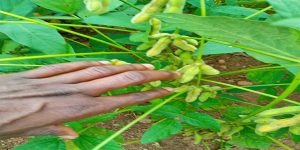
The pod development stage.

Soybean is believed to have been introduced into Africa in the 19th century by Chinese traders along the east coast of Africa. The rapid growth in the poultry sector in the past few years has also increased demand for soybean meal in Nigeria. Africa consumes about 618,000 tons of soybean annually with Nigeria being the major consumer and importer. Malnutrition, particularly protein deficiency, is prevalent in many parts of Africa as animal protein is too expensive for most populations. Soybean provides an inexpensive and high-quality source of protein comparable to meat, poultry, and eggs. This has led to the increase in demand for soybean in Nigeria, which cannot be met locally due to low yield.

To help solve this challenge, the Business Incubation Platform (BIP) of CGIAR-IITA partnered with Seed Co. Pty Ltd., United Phosphorous Limited (UPL), and Nigeria Soybean Association (NSA) to embark on trials that aim to achieve better yield and income for farmers. The current average yields from the developed varieties are quite low—between 0.8 and 1.2 t/ha, with demand far higher than the supply. The project is therefore looking at how yield can be increased to 2 t/ha in 2019, 3 t/ha in 2020, and 4 t/ha by 2021. This will help reduce the rate of soybean importation in Nigeria and make it readily available for both individual consumption and industrial use. The varieties used for the trials yielded 2.0–2.5 t/ha and 3.5 t/ha on average, for IITA-developed (TX 1448-2E) and SeedCo varieties, respectively.

The trials were carried out in Niger State (Mokwa and Badeggi), Benue State (Yandev, Zomon village, and Wannue), and Ibadan, Oyo State. The team achieved 1.5, 0.7, 1.8, 2.0, 1.9, and 2.8 t/ha at Mokwa, Badeggi, Yandev, Zomon village, Wannue, and Ibadan, respectively.

The team leading the trials in the different locations included Prof A.C. Uwala, President of Nigeria Soybean Association; Dr S.A. Tiamiyu, Head of National Cereals Research Institute (NCRI) Mokwa; Nuratu Olumo, Soybean technician at NCRI Badeggi; Timothy Ayedogbon, IITA GoSeed Soybean technician; and Samuel Inalegue in Yandev, among others.

Abebe Abush, IITA Soybean breeder, who is developing varieties that will increase farmers’ yield, was part of the team, and ensured that good agronomic practices were followed. Friday Ekeleme, renowned weed management scientist, IITA Weed Management Unit, was instrumental in recommending the right application of IRIS herbicide by UPL.

The planting commenced in July 2019 across the different locations and treatment was done with Nodumax, an IITA innovation and inoculant that increases the yield of soybean by more than 30%. The crops were also treated with Simple Super Phosphate (SSP) and NPK fertilizer. The planting population was 400,000 plantlets/ha and a post-emergent herbicide known as IRIS was applied on the 19th day after planting to eradicate weeds on the field.
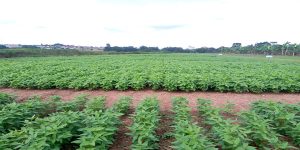
One of the trial sites at IITA, Ibadan.

The team carried out separate demonstration trials at IITA, some with Nodumax treatment and others without. They discovered that those treated with Nodumax had far better yields than those without.

They also studied factors affecting yield disparity across different locations and found that environmental variations contributed to this disparity. In Ibadan, the highest average yield of 2.8 t/ha was achieved due to adequate water availability via irrigation despite low rainfall for three weeks after planting. This shows that availability of water can contribute significantly to the growth performance of soybean. Quality seeds, right fertilizer application, proper weed management, and application of an inoculant (Nodumax) are key ingredients that can contribute to achieving better results. Some of the stages such as planting, germination, pod development, yellow coloration stage, brownish coloration stage, harvesting, and threshing need to be monitored properly and activities in each of these stages managed effectively for good output.

The IITA-BIP team led by Frederick Schreurs believes that at least 4 t/ha can be achieved by 2021. The BIP team is open to collaboration on projects that involve commercial soybean production and can leverage on outgrowers’ model to increase farmers’ yield and income. BIP also has quality breeder and foundations seeds, which seed companies can obtain from IITA-GoSeed. BIP contacts: Victor Saleh (victorsaleh@iitagoseed.com and +2348038936889) or Frederick Schreurs (f.schreurs@cgiar.org and +234 803 978 4212).


Contributed by

Recent stories

No items found

Leave a Reply

Your email address will not be published. Required fields are marked *

Scroll to Top
Olaosebikan, Olamide

Olamide Deborah Nwanze is a Senior Research Associate specializing in gender mainstreaming research to inform participatory and inclusive breeding, variety development, and seed systems policies regarding root, tuber, and banana (RTB) crops in the International Institute of Tropical Agriculture Headquarters, Ibadan, Nigeria. She is a PhD candidate at the University of Ibadan and holds an MSc and B. Agric in Agricultural Extension and Rural Development. Olamide is a fellow of the African Women in Agricultural Research and Development – Gender Responsive Agricultural Systems Policy (AWARD-GRASP) and the Gender Responsive Researchers Equipped for Agricultural Transformation (GREAT). She seeks to apply her gender-mainstreaming learnings, gender-responsive research, and policy development, and review expertise to facilitate women, youth, children, and vulnerable social group’s access to and adoption of agricultural Innovations that guarantee food, nutrition, income, and livelihood security in Africa. Her current roles include mentoring research fellows, development of guides and training manuals, implementation and adaptation of gender frameworks and tools, value chain actors’ engagement as citizen science partners, policy review and redesign, data management, and analysis. Her current research explores mixed methods and participatory and interdisciplinary approaches to capture and highlight gender dynamics, needs, preferences, and challenges stakeholders face within the agricultural livelihood value chain to prioritize gender-inclusive strategies in breeding programs, policy design, and implementation.

At IITA, she contributes to the implementation of the CGIAR Accelerated Breeding Initiative and Genetic Innovation Programs; participatory and gender research within the NextGen CassavaHarvestPlusRTBFoods, and Tricot-ClimMob 1000Farms Projects; and gender knowledge communication via the G-LENS webinar series, video documentary, policy briefspublications, and blogs.


Recent publications

de Sousa, K., van Etten, J., Manners, R. Bello, A., Teeken, B., Olaosebikan, O., et al. 2024. The tricot approach: an agile framework for decentralized on-farm testing supported by citizen science. A retrospective. Agron. Sustain. Dev. 44, 8. https://doi.org/10.1007/s13593-023-00937-1

Madu, T., Onwuka, S., Nwafor, S., Onyemauwa, N., Ejechi, M., Ofoeze, M., Ukeje, B., Eluagu, C., Olaosebikan, O., Okoye, B., 2024. Gender-Inclusive Consumer Studies Improve Cassava Breeding in Nigeria in: Frontiers in Sociology, volume 9, number: 1224504, doi: 10.3389/fsoc.2024.1224504

Olaosebikan, O.; Bello, A.; Utoblo, O.; Okoye, B.; Olutegbe, N.; Garner, E.; Teeken, B.; Bryan, E.; Forsythe, L.; Cole, S.; Madu, T. 2023.  Stressors and Resilience within the Cassava Value Chain in Nigeria: Preferred Cassava Variety Traits and Response Strategies of Men and Women to Inform Breeding. Sustainability 15, 7837. https://doi.org/10.3390/su15107837

Okoye, B., Ofoeze, M., Ejechi, M., Onwuka, S., Nwafor, S., Onyemauwa, N., Ukeje, B., Eluagu, C., Obidiegwu, J.*, Olaosebikan, O., Madu, T.* 2023. Prioritizing preferred traits in the yam value chain in Nigeria: a gender situation analysis in: Frontiers in Sociology, volume 8, number: 1232626, pages 1 – 9, ISSN 2297-7775, 2023. https://www.frontiersin.org/articles/10.3389/fsoc.2023.1232626/full

Olaosebikan, O., Bello, A. A., de Sousa, K., Ndjouenkeu, R., Adesokan, M., Alamu, E. O., Agbona, A., van Etten, J., Kegah, F. N.*, Dufour, D., Bouniol, A., Teeken, B. 2023. Consumer acceptability of cassava gari-eba food products across cultural and environmental settings using the triadic comparison of technologies approach (tricot) in: Journal of the Science of Food and Agriculture,

Teeken, B., Olaosebikan, O., Bello, A. A., Madu, T.*, Cole, S. M. 2023. Qualitative assessment on the positionality and preferences of dyads in relation to cassava-related activities: working with tricot trial citizen scientists https://hdl.handle.net/10568/138326 Type: Manual

Bouniol, A., Ceballos, H., Bello, A. A., Teeken, B., Olaosebikan, O., Owoade, D., Agbona, A., Fotso Kuate, A., Madu, T.*, Okoye, B.*, Ofoeze, M.*, Nwafor, S.*, Onyemauwa, N.*, Adinsi, L.*, Forsythe, L., Dufour, D. 2023. Varietal impact on women’s labour, workload and related drudgery in processing root, tuber and banana crops: focus on cassava in sub-Saharan Africa in: Journal of the Science of Food and Agriculture, pages 1 – 25, ISSN 0022-5142,

Bello, A. A., Agbona, A., Olaosebikan, O., Edughaen, G., Dufour, D., Bouniol, A., Iluebbey, P., Ndjouenkeu, R.*, Rabbi, I. Y., Teeken, B. 2023. Genetic and environmental effects on processing productivity and food product yield: drudgery of women’s work in: Journal of the Science of Food and Agriculture, pages 1 – 32, ISSN 0022-5142, 5

Cavicchioli, M., Zimbiti, T., Teeken, B., Nwanze, D.O., Liani, M., Parkes, E. & Bello, A. 2023. IITA-Gender Responsive Breeding Training Report. Genetic Resources Center, IITA-HQ, Ibadan, 21-23 September, 2022. Ibadan, Nigeria: IITA, (34 p.).https://hdl.handle.net/10568/131368

Agbona, A. Peteti P., Teeken B., Olaosebikan O. Bello, A. A., Parkes, E., Rabbi, I. Y., Mueller, L., Egesi, C., Kulakow, P. 2022. Data Management in Multi-disciplinary African RTB Crop Breeding Programs. In: Williamson, H.F., Leonelli, S. (eds) Towards Responsible Plant Data Linkage: Data Challenges for Agricultural Research and Development. Springer, Cham. https://doi.org/10.1007/978-3-031-13276-6_5

Lora Forsythe, Pricilla Marimo, Sarah Mayanja, Olamide D. Olaosebikan, Esme Stuart, Bela Teeken, Benjamin Okoye, Tessy Madu, (2021). Cross-product Gender Analysis of RTBfoods Step 2 Gendered Food Mapping on RTB Products. Understanding the Drivers of Trait Preferences and the Development of Multi-user RTB Product Profiles, WP1. London, UK: RTBfoods Field Scientific Report, 30 p.

Teeken, B., Garner, E., Agbona, A., Balogun, I., Olaosebikan, O., Bello, A., Madu, T., Okoye, B., Egesi, C., Kulakow, P. and Tufan, H.A. 2021. Beyond “Women’s Traits”: Exploring How Gender, Social Difference, and Household Characteristics Influence Trait Preferences. Frontiers Sustainable Food Systems 5:740926. https://doi.org/10.3389/fsufs.2021.740926

Teeken, B., Agbona, A., Bello, A., Olaosebikan, O., Alamu, E., Adesokan, M., Awoyale, W., Madu, T., Okoye, B., Chijioke, U., Owoade, D., Okoro, M., Bouniol, A., Dufour, D., Hershey, C., Rabbi, I., Maziya‐Dixon, B., Egesi, C., Tufan, H. and Kulakow, P. (020. Understanding cassava varietal preferences through pairwise ranking of gari‐eba and fufu prepared by local farmer–processors. Int J Food Sci Technol. https://doi.org/10.1111/ijfs.14862

Bela Teeken, Olamide Olaosebikan, Ireti Balogun, Benjamin Okoye, Tessy Madu, Steven Cole, Abolore Bello, Elizabeth Parkes. (2020). Piloting the G+ customer and product profile tools for gender-responsive cassava breeding in Nigeria. Nigeria: International Institute of Tropical Agriculture (IITA). https://hdl.handle.net/20.500.11766/13000