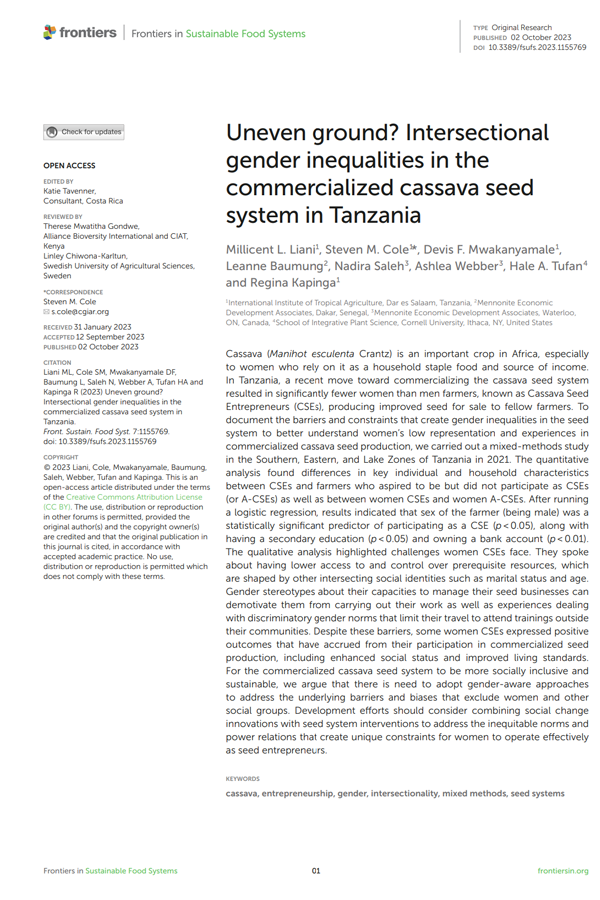
IITA and partners have amassed a relatively large and recent body of work on gender and climate change (e.g., Wright et al., 2014; Ampaire et al., 2017; 2019; Brown and Sonwa, 2018), gender and value chains (Gondwe et al., 2017; Fischer et al., 2017; Masamha et al., 2017; 2018; Okonya et al., 2019; Fischer et al., 2020; Cole et al., 2021), gender and seed systems (Liani et al., 2023; Cole et al., 2021), gender and plant health (Nkengla-Asi L. et al., 2019; 2021; Ajambo et al., 2018), gender and agronomy (Saito et al., 2021; Tufa et al., 2022; Puskur et al., 2023; Lambrecht et al., 2023a; Lambrecht et al., 2023b), inclusive sustainable agricultural intensification (Zulu et al., 2020; Fischer et al., 2020) and mechanization (Fischer et al., 2018), as well as on gender and agricultural extension (Lambrecht et al., 2016), access to and control of land (Yami and Snyder, 2016), biofortification (Olaosebikan et al., 2019), post-harvest losses (Alamu et al., 2019), and on women’s empowerment (Elias et al., 2021; Quisumbing et al., 2023; Cole et al., 2023) and gendered social norms in agri-food systems (Seymour et al., 2023; Achandi et al., 2023; Mudege et al., 2023).
IITA has also designed and carried out sex-disaggregated adoption and impact studies (e.g., Ainembabazi et al., 2018; Wossen et al., 2018; Bentley et al. 2016; Wossen et al. 2017; Dontsop et al., 2020) and a number of youth-focused studies (Yami et al., 2019; Ng’atigwa et al., 2020; Ogunmodede et al., 2020; Yeboah et al., 2020; Crossouard et al., 2021; Olaosebikan et al., 2021).
IITA has recently helped develop and/or pilot several tools to better understand intra-household decision making (Petesch and Bullock, 2018; Farnworth et al., 2022; Cole et al., 2021; Mwakanyamale et al., 2023), to integrate gender transformative approaches in social protection (Cole et al., 2023) and engage men in maize systems (Farnworth et al., 2020), to measure gender transformative change (FAO, IFAD, WFP & CGIAR GENDER Impact Platform, 2023), and for contextualizing women’s and men’s trait preferences (Cavicchioli et al., 2023). IITA gender researchers have also assisted in the development of different training manuals to strengthen capacities within the agricultural research for development ecosystem (Fischer et al., 2019; Fischer, 2019; Teeken et al., 2023).
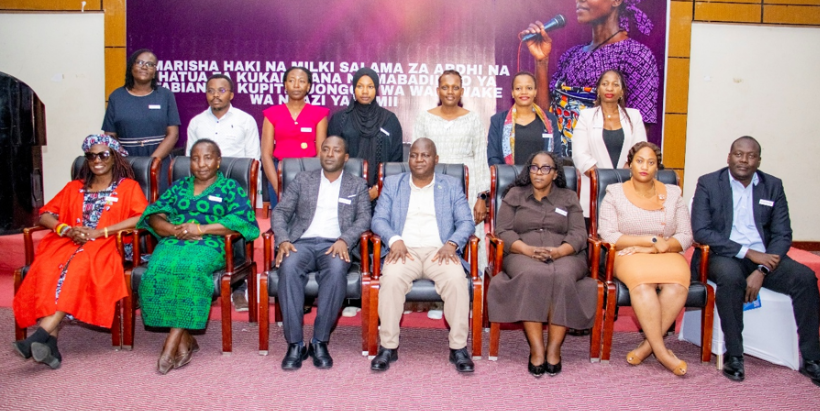
IITA has an active Gender Science Network, comprising gender researchers, economists, and biophysical scientists who are interested in creating an innovative and diverse network of scientists to strengthen the quality and visibility of gender research at IITA through dialogue, cooperation, and influencing the delivery agenda of the institute.
IITA gender researchers make significant contributions to the CGIAR GENDER Impact Platform, including representing IITA as a Gender Research Coordinator on the Platform and as a member of the Platform’s Management Committee.
The current gender researchers at IITA are involved in several One CGIAR Initiatives, for example, the Gender Equality, Market Intelligence, Accelerated Breeding, Mixed Farming Systems, Excellence in Agronomy, and Aquatic Foods Initiatives and on a wide range of bilateral projects that IITA leads or partners on to help deliver gender-responsive and -transformative research for development outcomes.