NEWS

CIALCA on track to improve profitable agriculture in the Great Lakes Region
janvier 1, 2020
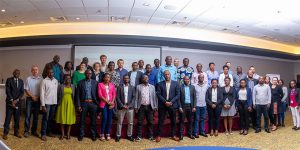
Improving food and nutrition security and developing climate-resilient and profitable agriculture were discussed at the mid-term review meeting of the Consortium for Improving Agriculture-based Livelihoods in Central Africa (CIALCA). The three-day meeting was held in Kigali, Rwanda between 29 October and 1 November. CIALCA operates in Rwanda, Burundi, and Eastern Democratic Republic of Congo and is co-led by IITA, Bioversity International, and the Joint Agriculture Organization of the United Nations and International Atomic Energy Agency (FAO/IAEA).

Question and answer session.

Over 40 participants from CIALCA’s leading organizations, and partner and development organizations graced CIALCA mid-term review meeting and commended its continued impact in transforming agriculture and challenged CIALCA to leverage on its 14-year presence and take agriculture to an extra mile. Dr Charles Murekezi, Director General of Agriculture Development in the Rwandan Ministry of Agriculture and Animal Resources, observed the relevance of CIALCA in Rwanda and the Great Lakes Region. “I applaud CIALCA for their ability to move with time and the way this consortium evolves from hard science towards science for action. CIALCA’s mandate falls in the vision of the Ministry of Agriculture and Animal Resources, not only in Rwanda but also in the whole region,” said Dr Murekezi, also a CIALCA Alumni, who officiated the opening of the meeting. Of note was CIALCA’s work co-investing with scaling partners to ramp up delivery of innovation. Since 2018, CIALCA has partnered with One Acre Fund to help them better understand their clients, particularly the drivers of adoption for their interventions and whether specific types of farmers are more or less likely to adopt certain practices and technologies. To do this, CIALCA and One Acre Fund have developed farm typologies of Rwandan farmers to understand better and reduce the complexity of heterogeneity present in farming households.

Group photograph.

This process has seen a series of typologies developed which have mapped farming households along two axes (wealth and adoption of inputs). These typologies are now being validated to ensure their existence and help One Acre Fund to target interventions towards potential clients who are more likely to adopt their technologies and to deliver appropriate and tailored interventions that are sensitive to farm heterogeneity across Rwanda. Another noteworthy highlight was the development of site-specific fertilizer recommendations for cassava in the Great Lakes Region. In November 2018, CIALCA established 121 field trials in Burundi, Democratic Republic of Congo, and Rwanda to understand more how cassava responds to different combinations of Nitrogen, Phosphorous, Potassium, and other micronutrient-based fertilizers. CIALCA is optimistic about the results with Deus Kayibanda, CIALCA Research Assistant in Rwanda, mentioning that, “Observable results before harvesting are very impressive and promising.” This research will support the Governments and agriculture institutions of Rwanda, Burundi, and Eastern Democratic Republic of Congo to come up with fertilizer recommendations for cassava farming tailored to location, weather predictions, soil type, the farmer’s production objectives. “There is a big difference between the cassava fields that are fertilized and the cassava fields that are not fertilized. The fertilized cassava crop looks much better and there is no doubt that we will harvest better roots,” Matabaro David, one of the farmers whose land is used for cassava nutrient omission trials in Ruhango district, witnessed to participants of the CIALCA mid-term review who visited his fields. Another highlight was the work of CIALCA spin-off project, ICT4BXW, which focuses on the use of ICT tools in the fight against Banana Xanthomonas Wilt (BXW) in Rwanda. “Farmer promoters are easily diagnosing Banana Xanthomonas Wilt in the main banana regions and directly transferring information to sector agronomist and RAB. Before BXW-App was introduced, we had to travel to those sites, but now we do it using the phones,” explained Nkunduwimye Jean Marie Vianney who works for RAB Ruhango station, which serves Ruhango, Muhanga and Kamonyi districts in the southern province of Rwanda. CIALCA has continued to invest in developing the capacity of future business, science, and policy leaders as part of its efforts to strengthen agricultural research and development capacity in the Great Lakes Region. Since the start of CIALCA, more than 150 PhD, Msc, and Bachelor students have completed their studies/research, and currently, eight students are pursuing their PhD and Msc studies under the CIALCA umbrella. As part of its future outlook, CIALCA is committed to continuing leveraging research for development in the Great Lakes Region. Dr Bernard Vanlauwe, IITA Central Africa Hub Regional Director who officially closed the mid-term review meeting, reiterated the impact brought by CIALCA to the Great Lakes Region and called for the continuous rejuvenation of the consortium. “CIALCA is Research for Development, that will not change, but we need to constantly adapt to up-to-date agriculture needs and opportunities. CIALCA has been there over a decade but we never get old”, Vanlauwe said in his closing remarks. Dr Kathelyne Craenen, Attaché Development Cooperation at the Belgian Embassy who represented the Belgian Development Cooperation (DGD), CIALCA’s core donor, mentioned that: “I have been involved in CIALCA since its very first start in 2005. CIALCA is one of the flagships of DGD in terms of how development cooperation can lead to real innovation, capacity development and impact.”

Contribué par

Histoires récentes

Aucun article trouvé

Laisser un commentaire

Votre adresse e-mail ne sera pas publiée. Les champs obligatoires sont indiqués avec *

Retour en haut
Olaosebikan, Olamide

Olamide Deborah Nwanze est une chercheuse principale spécialisée dans la recherche sur l'approche "genre" afin d'éclairer les politiques de sélection participative et inclusive, de développement de variétés et de systèmes semenciers concernant les cultures de racines, tubercules et bananes (RTB) au siège de l'Institut International d'Agriculture Tropicale, à Ibadan, au Nigeria. Elle est candidate au doctorat à l'Université d'Ibadan et titulaire d'un master et d'un diplôme d'ingénieur agronome en vulgarisation agricole et développement rural. Olamide est membre du programme African Women in Agricultural Research and Development – Gender Responsive Agricultural Systems Policy (SAISIE DE RÉCOMPENSEet les Chercheuses Sensibles au Genre Équipées pour la Transformation Agricole (SUPER. Elle cherche à appliquer ses apprentissages en matière d’approche genre, recherche sensible au genre, et expertise en développement et examen de politiques pour faciliter l’accès et l’adoption par les femmes, les jeunes, les enfants et les groupes sociaux vulnérables aux innovations agricoles qui garantissent la sécurité alimentaire, nutritionnelle, des revenus et des moyens de subsistance en Afrique. Ses rôles actuels comprennent le mentorat de chercheurs stagiaires, le développement de guides et manuels de formation, la mise en œuvre et l'adaptation de cadres et d'outils genre, l'engagement des acteurs de la chaîne de valeur en tant que partenaires de la science citoyenne, l'examen et la refonte des politiques, la gestion et l'analyse des données. Ses recherches actuelles portent sur les méthodes mixtes ainsi que sur les approches participatives et interdisciplinaires pour saisir et mettre en évidence les dynamiques de genre, les besoins, les préférences et les défis rencontrés par les parties prenantes au sein de la chaîne de valeur des moyens de subsistance agricoles afin de prioriser des stratégies axées sur le genre dans les programmes de sélection, la conception et la mise en œuvre des politiques.

À l'IITA, elle contribue à la mise en œuvre du CGIAR Initiative d'Élevage Accéléré et Innovation génétique Programmes ; recherche participative et genre au sein des Prochaine Génération ManiocHarvestPlusRTBAliments, et Tricot-ClimMob 1000Fermes Projets ; et la communication des connaissances sur le genre via le Série de webinaires G-LENS, vidéo documentaire, notes de politiquepublications, et blogs.


Publications récentes

de Sousa, K., van Etten, J., Manners, R. Bello, A., Teeken, B., Olaosebikan, O., et al. 2024. L'approche tricot : un cadre agile pour les essais décentralisés à la ferme soutenus par la science citoyenne. Une rétrospective. Agron. Sustain. Dev. 44, 8. https://doi.org/10.1007/s13593-023-00937-1

Madu, T., Onwuka, S., Nwafor, S., Onyemauwa, N., Ejechi, M., Ofoeze, M., Ukeje, B., Eluagu, C., Olaosebikan, O., Okoye, B., 2024. Les études sur les consommateurs inclusifs en matière de genre améliorent l'amélioration du manioc au Nigeria dans : Frontiers in Sociology, volume 9, numéro : 1224504, doi : 10.3389/fsoc.2024.1224504

Olaosebikan, O. ; Bello, A. ; Utoblo, O. ; Okoye, B. ; Olutegbe, N. ; Garner, E. ; Teeken, B. ; Bryan, E. ; Forsythe, L. ; Cole, S. ; Madu, T. 2023. Facteurs de stress et résilience au sein de la chaîne de valeur du manioc au Nigeria : Caractéristiques préférées des variétés de manioc et stratégies de réponse des hommes et des femmes pour informer l'amélioration variétale. Sustainability 15, 7837. https://doi.org/10.3390/su15107837

Okoye, B., Ofoeze, M., Ejechi, M., Onwuka, S., Nwafor, S., Onyemauwa, N., Ukeje, B., Eluagu, C., Obidiegwu, J.*, Olaosebikan, O., Madu, T.* 2023. Priorisation des traits préférés dans la chaîne de valeur de l'igname au Nigeria : une analyse de la situation en matière de genre in: Frontiers in Sociology, volume 8, numéro : 1232626, pages 1 – 9, ISSN 2297-7775, 2023. https://www.frontiersin.org/articles/10.3389/fsoc.2023.1232626/full

Olaosebikan, O., Bello, A. A., de Sousa, K., Ndjouenkeu, R., Adesokan, M., Alamu, E. O., Agbona, A., van Etten, J., Kegah, F. N.*, Dufour, D., Bouniol, A., Teeken, B. 2023. Acceptabilité par les consommateurs des produits alimentaires à base de gari-eba de manioc dans des contextes culturels et environnementaux variés en utilisant l'approche triade de comparaison des technologies (tricot) dans : Journal of the Science of Food and Agriculture,

Teeken, B., Olaosebikan, O., Bello, A. A., Madu, T.*, Cole, S. M. 2023. Évaluation qualitative de la positionnalité et des préférences des dyades en relation avec les activités liées au manioc : travailler avec des scientifiques citoyens du procès tricot https://hdl.handle.net/10568/138326 Type : Manuel

Bouniol, A., Ceballos, H., Bello, A. A., Teeken, B., Olaosebikan, O., Owoade, D., Agbona, A., Fotso Kuate, A., Madu, T.*, Okoye, B.*, Ofoeze, M.*, Nwafor, S.*, Onyemauwa, N.*, Adinsi, L.*, Forsythe, L., Dufour, D. 2023. Impact variétal sur le travail des femmes, la charge de travail et la pénibilité associée dans le traitement des plantes à racines, tubercules et bananes : focus sur le manioc en Afrique subsaharienne dans : Journal of the Science of Food and Agriculture, pages 1 – 25, ISSN 0022-5142,

Bello, A. A., Agbona, A., Olaosebikan, O., Edughaen, G., Dufour, D., Bouniol, A., Iluebbey, P., Ndjouenkeu, R.*, Rabbi, I. Y., Teeken, B. 2023. Effets génétiques et environnementaux sur la productivité de la transformation et le rendement des produits alimentaires : la pénibilité du travail des femmes dans : Journal of the Science of Food and Agriculture, pages 1 – 32, ISSN 0022-5142, 5

Cavicchioli, M., Zimbiti, T., Teeken, B., Nwanze, D.O., Liani, M., Parkes, E. & Bello, A. 2023. Rapport sur la formation en sélection génétique sensible au genre à l'IITA. Genetic Resources Center, IITA-HQ, Ibadan, 21-23 septembre 2022. Ibadan, Nigéria : IITA, (34 p.).https://hdl.handle.net/10568/131368

Agbona, A. Peteti P., Teeken B., Olaosebikan O. Bello, A. A., Parkes, E., Rabbi, I. Y., Mueller, L., Egesi, C., Kulakow, P. 2022. Gestion des données dans les programmes d'amélioration des cultures RTB africaines multidisciplinaires. In : Williamson, H.F., Leonelli, S. (eds) Towards Responsible Plant Data Linkage: Data Challenges for Agricultural Research and Development. Springer, Cham. https://doi.org/10.1007/978-3-031-13276-6_5

Lora Forsythe, Pricilla Marimo, Sarah Mayanja, Olamide D. Olaosebikan, Esme Stuart, Bela Teeken, Benjamin Okoye, Tessy Madu, (2021). Analyse transversale du genre dans RTBfoods Étape 2 Cartographie des genres sur les produits RTB. Comprendre les moteurs des préférences en matière de traits et le développement de profils de produits RTB multi-utilisateurs, WP1. Londres, Royaume-Uni : Rapport scientifique de terrain RTBfoods, 30 p.

Teeken, B., Garner, E., Agbona, A., Balogun, I., Olaosebikan, O., Bello, A., Madu, T., Okoye, B., Egesi, C., Kulakow, P. et Tufan, H.A. 2021. Au-delà des “ traits des femmes ” : explorer comment le genre, les différences sociales et les caractéristiques des ménages influencent les préférences pour les traits. Frontiers Systèmes alimentaires durables 5:740926. https://doi.org/10.3389/fsufs.2021.740926

Teeken, B., Agbona, A., Bello, A., Olaosebikan, O., Alamu, E., Adesokan, M., Awoyale, W., Madu, T., Okoye, B., Chijioke, U., Owoade, D., Okoro, M., Bouniol, A., Dufour, D., Hershey, C., Rabbi, I., Maziya‐Dixon, B., Egesi, C., Tufan, H. et Kulakow, P. (020. Comprendre les préférences variétales du manioc par le classement par paires du gari-eba et du fufu préparés par des agriculteurs-transformateurs locaux. Int J Food Sci Technol. https://doi.org/10.1111/ijfs.14862

Bela Teeken, Olamide Olaosebikan, Ireti Balogun, Benjamin Okoye, Tessy Madu, Steven Cole, Abolore Bello, Elizabeth Parkes. (2020). Pilotage des outils de profil client et produit G+ pour l'amélioration sensible au genre du manioc au Nigeria. Nigeria : Institut international d'agriculture tropicale (IIAT). https://hdl.handle.net/20.500.11766/13000