
Un projet mené par l'IITA sur l'amélioration des bananiers dépasse ses principaux objectifs alors qu'il entre dans sa troisième année
13 mai 2017
Une équipe d'experts internationaux en bananes a développé 48 hybrides de Matooke, une banane à cuire populaire dans les hauts plateaux de l'Afrique de l'Est, qui font actuellement l'objet d'évaluations sur le terrain en Ouganda afin de sélectionner celles qui ont les rendements les plus élevés et de confirmer leur résistance à quatre grands ravageurs et maladies.
Les hybrides constituent l'une des principales réalisations d'une initiative quinquennale menée en partenariat multiple visant à fournir de meilleures variétés de bananes à cuire aux petits agriculteurs en Ouganda et en Tanzanie. C'est l'une des réalisations rapportées par l'équipe lors de sa troisième réunion annuelle de planification et d'évaluation, du 24 au 26 avril à Kampala, en Ouganda, accueillie par l'Organisation nationale de recherche agricole (NARO) — un partenaire clé dans le projet. L'équipe a déclaré que c'était bien supérieur à son objectif pour l'année 3 et que, si ce rythme était maintenu, le projet surpasserait ses objectifs.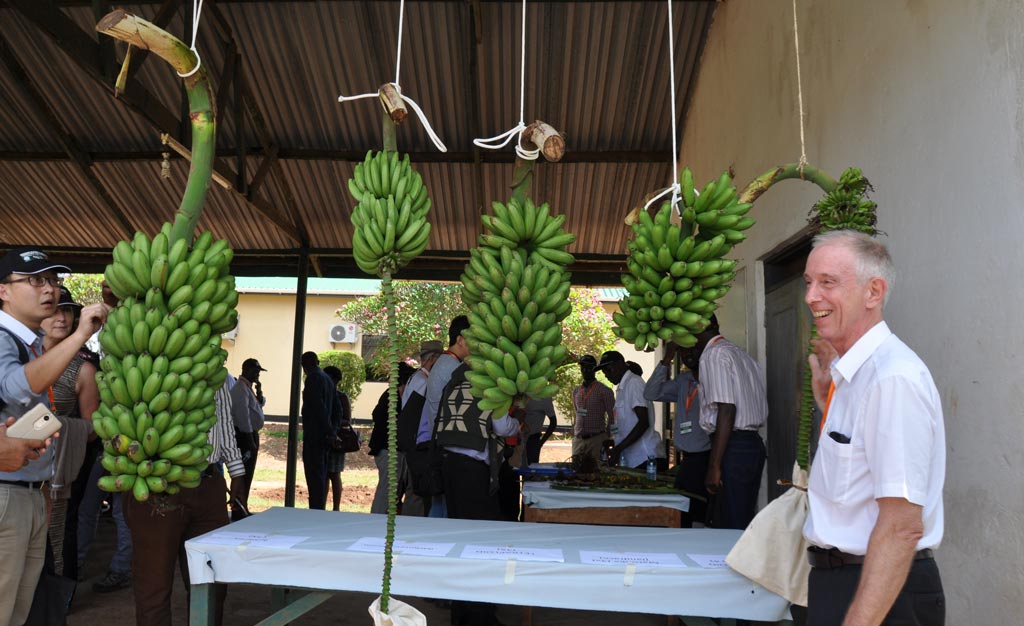
Rony Swennen expliquant le processus d'amélioration hybride qui a mené au NARITA.
Des bananes hybrides saluées comme un pas dans la bonne direction !
La réunion a été officiellement ouverte par Ambrose Agona, directeur général de la NARO, qui a salué le projet comme étant bien conçu dans son approche visant à accroître la productivité de la banane. “ La plupart des gains réalisés dans la production agricole dans de nombreux pays d'Afrique l'ont été grâce à l'expansion des terres agricoles. Cependant, nous devons intensifier la production pour augmenter les rendements des principales cultures. Par conséquent, l'objectif du projet de développer des hybrides de bananiers à haut rendement va dans la bonne direction ”, a-t-il déclaré. S'exprimant également lors de la réunion, Victor Manyong, directeur de l'IITA pour l'Afrique de l'Est, a souligné que la banane n'était pas seulement une culture vivrière majeure pour les petits exploitants, mais aussi un produit de base important. Par conséquent, tout effort visant à accroître la production de cette culture se traduirait également par une amélioration de leurs moyens de subsistance.Créer un programme efficace d'amélioration des bananes
L'objectif du projet est de mettre au point des variétés hybrides de bananes présentant une augmentation de 30% du rendement et de 50% de la résistance à au moins trois des principaux ravageurs et maladies, par rapport aux variétés actuellement cultivées par les agriculteurs dans les mêmes conditions de production. “ Nous soutenons les systèmes nationaux de sélection afin de les rendre plus efficaces et plus dynamiques. Au bout de cinq ans, nous souhaitons proposer une banane hybride de Matooke et Mchare qui sont non seulement à haut rendement et résistantes aux maladies, mais qui répondent également aux besoins et aux préférences de l'utilisateur final ”, déclare Rony Swennen, sélectionneur de bananiers à l'IITA et chef d'équipe du projet. “ Nous avons pris de l'avance sur notre objectif principal puisque nous en avons déjà développé 48 Matooke hybrides qui se dirigent vers des essais de rendement préliminaires et nous en avons beaucoup d'autres en préparation, a-t-il ajouté. Le projet se concentre sur les deux types de bananes à cuire des hauts plateaux d'Afrique de l'Est les plus populaires, Matooke en Ouganda et Mchare en Tanzanie, et les deux principales maladies qui s'attaquent à la culture―Fusariose et Cercosporiose noire (la maladie de Sigatoka), et de deux ravageurs majeurs : les nématodes parasites (vers microscopiques) et les charançons. “ En plus des 48 hybrides, nous menons six autres essais à partir desquels nous prévoyons de sélectionner plus de 600 hybrides pour des essais préliminaires en champ. Nous avons également obtenu d'excellents résultats dans la production de graines destinées aux croisement pour soutenir les travaux de sélection “, ajoute Jerome Kubiriba de la NARO, qui est également le chef d'équipe des efforts de sélection du projet. Les bananiers sont stériles et produisent très peu de graines, ce qui rend la sélection très difficile. Les chercheurs doivent les forcer à développer des graines pour effectuer des croisement et développer des variétés. ” Cependant, ces variétés ont encore un long chemin à parcourir avant d'arriver entre les mains des agriculteurs. Il faut généralement jusqu'à 20 ans pour développer de nouvelles variétés de bananiers, mais grâce à ce projet, en collaboration avec des sélectionneurs du monde entier, nous explorons de nouvelles méthodes pour réduire ce délai. » La NARO dirige les efforts de sélection du bananier du projet, qui constituent la composante la plus importante et la plus vaste.Outils pour accélérer l'amélioration des bananiers
Le projet a également intégré différents experts pour soutenir et travailler aux côtés de l'équipe de sélection afin d'accélérer et de simplifier le processus long et complexe de l'amélioration des bananiers. Ils ont également réalisé de grands progrès dans la réalisation de leurs objectifs. Dépistage rapide des maladies contre les agents pathogènes et les nuisibles “ Nous avons recueilli beaucoup d'informations sur les agents pathogènes et les ravageurs les plus importants de la culture qui nous intéresse, à savoir la fusariose, la cercosporiose noire, ainsi que les nématodes et les charançons. Nous avons également mis au point des méthodes de criblage rapide qui peuvent réduire de moitié ou du quart le temps nécessaire aux sélectionneurs pour tester la résistance de leurs variétés. ” “ Ces outils contribueront également à accélérer les efforts de sélection du bananier à l'échelle mondiale ”, déclare Albertus Viljoen de l'Université de Stellenbosch, qui dirige ces travaux. Développement d'outils moléculaires pour accélérer le dépistage de la résistance Les biologistes moléculaires du projet développent des outils biotechnologiques pour aider les obtenteurs lors du criblage précoce. Ceux-ci comprennent des marqueurs moléculaires qui aident les obtenteurs à détecter, dès le début du processus de sélection, la présence des gènes associés aux caractéristiques souhaitées, telles que la résistance aux ravageurs et aux maladies, et seuls les plantules dotées de ces gènes passent aux essais en champ. “ Nous cartographions des marqueurs génétiques pour nous aider à identifier les gènes qui contrôlent la résistance aux ravageurs et aux maladies chez les plantes. Nous avons également développé des modèles pour prédire le rendement et d'autres caractéristiques sur la base de marqueurs génotypiques que nous évaluerons dans les années à venir ”, déclare Brigitte Uwimana, un sélectionneur moléculaire à IITA-Ouganda. Musabase – soutien à la collecte, au stockage et au partage de données La collecte et l'analyse des données représentent une part importante des efforts de sélection ; pour faciliter cette tâche, le projet a soutenu le développement d'outils numériques, notamment une base de données et une application mobile de collecte de données. “ Si vous voulez utiliser des techniques de sélection modernes, vous devez collecter beaucoup de données génotypiques (génétiques) et phénotypiques (physiques). Pour ce faire, vous avez besoin d'une bonne base de données pour stocker et partager efficacement toutes ces données. Musabase est une base de données spécialement conçue pour les obtenteurs de bananiers. Elle contribuera également à créer des synergies entre les équipes ”, explique Lukas Mueller, du Boyce Thompson Institute, qui dirige les travaux de bio-informatique. Une application mobile adaptée aux besoins des obtenteurs sur le terrain a également été développée pour permettre la collecte de données en temps réel. L'application est en cours de test avec l'équipe d'Arusha avant d'être déployée auprès du reste de l'équipe. ’ La base de données et l'application mobile garantissent que les données sont collectées, analysées et stockées sans quitter l'écosystème numérique. Nous avons également formé de nombreux chercheurs et techniciens à la collecte de données et à l'utilisation de la base de données “, a déclaré M. Mueller. Essais sur le terrain d'hybrides issus d'une collaboration antérieure entre l'IITA et la NARO La collaboration passée entre l'IITA et le NARO a conduit au développement de 27 variétés précoces Matooke des hybrides baptisés “ NARITA ’. Deux d’entre eux ont été officiellement mis sur le marché par le NARO en 2010 en Ouganda et sont désormais cultivés dans au moins 151 TP3T d’exploitations bananières ougandaises. Le projet soutient l’évaluation de 20 de ces hybrides NARITA en Ouganda et en Tanzanie afin de déterminer leur adéquation aux conditions locales et leur acceptation par les agriculteurs. ” Nous évaluons les variétés NARITA sur cinq sites d’essai dans les deux pays afin de recommander la mise sur le marché officielle de celles qui présentent les meilleurs rendements et la plus grande résistance aux maladies, et qui répondent aux besoins des agriculteurs “, explique Inge Van den Bergh, de Bioversity International, responsable de cet objectif. ’ Nous avons également mené une enquête de référence pour comprendre les caractéristiques que les agriculteurs recherchent dans les bananes. Nous avons interrogé plus de 1 000 ménages et organisé plus de 100 groupes de discussion ; nous sommes en train d’analyser les données. Celles-ci seront partagées avec les sélectionneurs afin de les aider à sélectionner des bananiers qui répondent aux besoins des agriculteurs et des autres utilisateurs finaux. ’ Les outils et les méthodologies développés dans le cadre du projet contribueront également à la sélection des bananiers à travers le monde.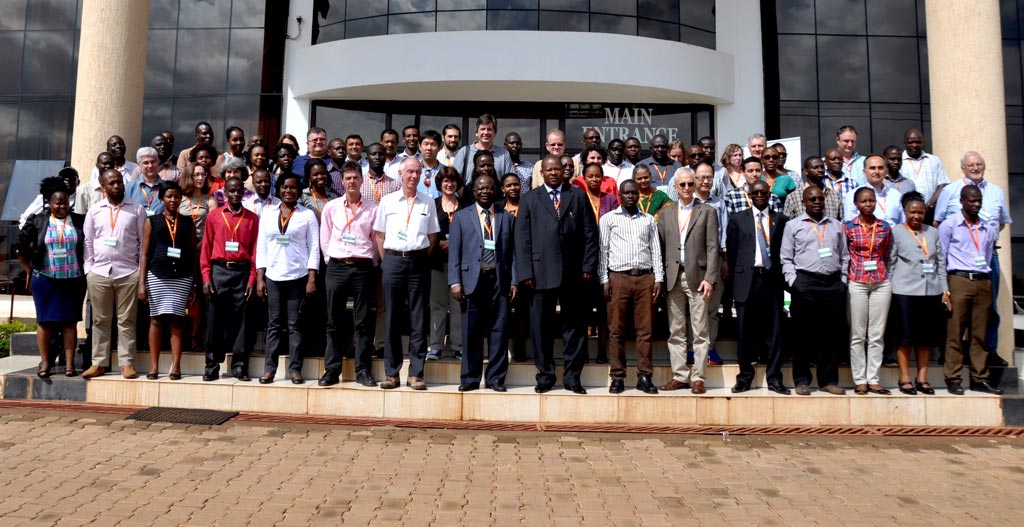
Photo de groupe des participants
Contribué par
Histoires récentes
Aucun article trouvé