
On the second day of President Julius Maada Bio’s visit to the IITA-CGIAR, an esteemed assembly of policymakers, industry leaders, researchers, and development partners gathered, all committed to shaping the future of agriculture in Africa. Under the theme “The Power of Improved Technologies and Public-Private Partnerships to Accelerate the Feed Salone Strategy,” discussions centered on solutions to drive food security and economic growth across the continent.
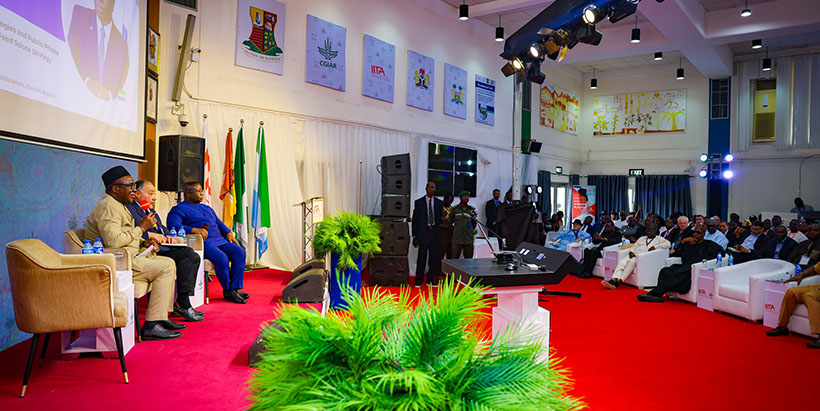
Welcoming dignitaries to the event, IITA’s Director General and CGIAR Regional Director for Continental Africa, Dr Siméon Ehui, highlighted the importance of collaboration in achieving sustainable agricultural development. Among the high-level guests were the Governors of Plateau, Borno, and Oyo States; Honorable Ministers from Sierra Leone; and key partners from the World Bank, African Development Bank (AfDB), and other development organizations.
Ehui led a pivotal strategic dialogue session with President Bio and Hafez Ghanem, Fellow at the Brookings Institution and former World Bank Vice President. The conversation spotlighted the major challenges hindering global agricultural transformation, particularly in Africa, and explored actionable strategies for successfully implementing the Feed Salone initiative.
“We stand at a critical junction in global food systems, tasked with reimagining agriculture to be more sustainable, resilient, and inclusive,” said Ehui. He underscored the necessity of partnerships, innovation, and investment as core pillars for driving agricultural progress, emphasizing that Africa should aim for self-sufficiency and contribute to feeding the world.
Hafez Ghanem provided a global perspective on agriculture’s challenges, citing the ongoing geopolitical shifts, climate change, and the impact of external funding withdrawals, such as USAID’s exit from some African countries. “Of the 750 million people experiencing hunger today, 300 million are in Africa,” he noted. He stressed that Africa’s agricultural potential remains vast, but governments must allocate more resources to the sector. Despite commitments to invest 10% of national budgets in agriculture, many African nations fall short of this target.
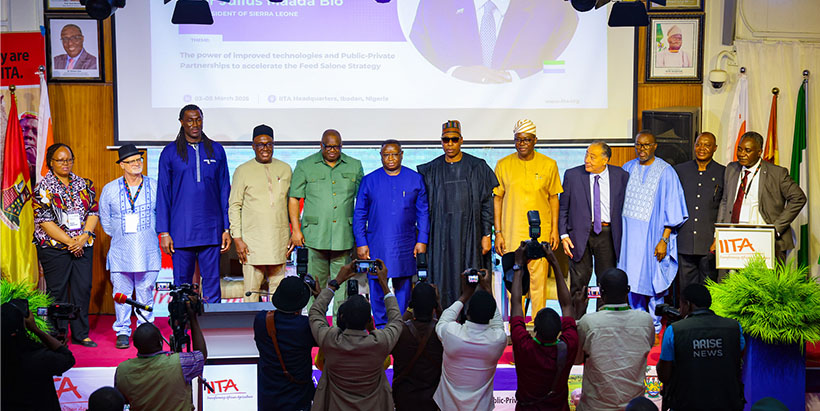
President Bio reinforced this sentiment, linking food security to broader economic stability, employment, and public health. “The investments required for agriculture are huge, but we cannot afford to neglect them,” he said, calling for regional cooperation and increased private-sector involvement. He emphasized the need for African nations to tailor agricultural investments based on their comparative advantages to maximize impact.
A session moderated by IITA Deputy Director General, Partnerships for Delivery, Dr Kenton Dashiell, featured insights from the Governors of Borno, Plateau, and Oyo States. They shared their states’ agricultural development strategies, underscoring the role of infrastructure and investment in transforming the sector.
The governor of Borno highlighted his administration’s efforts to boost productivity through mechanization, subsidized fuel for farmers, and investments in rain-fed irrigation systems, which were facilitated in collaboration with IITA. Meanwhile, the Governors of Plateau and Oyo emphasized the importance of developing infrastructure and leveraging private-sector expertise to drive agricultural progress, ensuring sustainable growth beyond government-led initiatives.
The agricultural financing model session, led by Sierra Leone’s Minister of Finance, Sheku Ahmed Fantamadi Bangura, tackled the challenge of mobilizing resources for agricultural investment. He proposed a blended financing approach combining public funding with international investments to de-risk agriculture and attract large-scale investments. “The government is committed, and we call on multinationals and partners to help scale up and invest in local communities,” he stated.
The final session of the day, led by Aline Mugisho, Executive Manager of IITA’s I-Youth program, focused on the crucial role of youth in advancing agriculture and agribusiness in Sierra Leone. She presented compelling statistics from IITA’s Youth in Agribusiness (IYA) initiative, demonstrating how young people across Africa have embraced agriculture when provided with the right skills, mentorship, and opportunities.
“Youth engagement is central to achieving food security and sustainable agricultural growth in Africa,” Mugisho emphasized. She highlighted that Sierra Leone had been identified as a priority country under the AfDB’s Transition Support Facility (TSF), focusing on building youth capacity for agribusiness.
To further support youth involvement in agriculture, she proposed visiting Sierra Leone to develop a roadmap for advocacy and skill development. She stressed the importance of ongoing mentorship and strategic private-sector partnerships to make agribusiness more attractive to young people.
The discussions on the second day of President Bio’s visit to IITA reinforced the critical role of partnerships, innovation, and investment in transforming agriculture across Africa. By aligning scientific advancements, private-sector engagement, and youth participation, African nations can accelerate food security initiatives like Feed Salone and build a resilient agricultural sector that contributes to global food systems. IITA remains committed to supporting these efforts, ensuring that research-driven solutions lead to sustainable agricultural growth across the continent.
Proposé par Folake Oduntan
Contribué par
Histoires récentes