
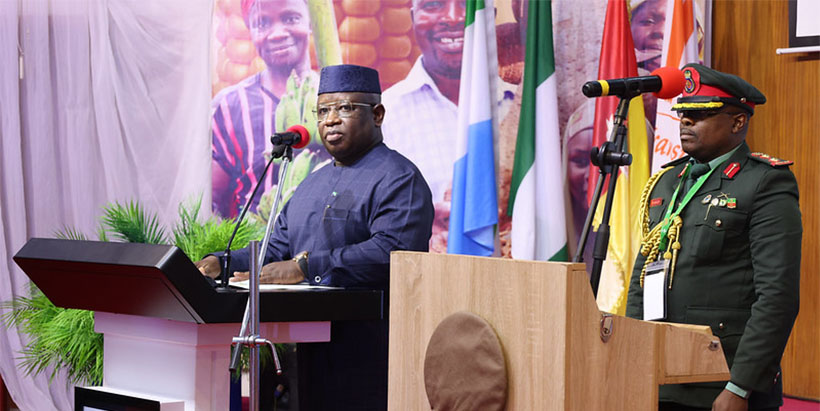
IITA continues to play an important role in alleviating poverty and ensuring food security for millions of farm families in sub-Saharan Africa. As part of its commitment to fostering research-driven agricultural innovations and strengthening public-private partnerships, IITA hosted His Excellency President Julius Maada Bio of Sierra Leone at its headquarters in Ibadan, Nigeria, from 3 to 6 March. This visit marked a significant milestone in accelerating the ‘Feed Salone Program,’ an initiative to transform Sierra Leone’s agricultural sector.
This engagement between IITA and the Sierra Leonean government highlights a shared commitment to advancing food security through innovation, research, and strategic investment. The visit assembled key stakeholders from Nigeria and across West Africa to align strategies and explore areas of collaboration that will drive agricultural transformation in the region.
Welcoming President Bio and his delegation, the IITA Director General, Dr Siméon Ehui, underscored the institute’s unwavering dedication to championing research-driven innovations for nearly six decades.
“This is not just a visit; it is a reaffirmation of our collective vision for food security and economic development in Africa. We recognize that technology is a key driver of agricultural transformation, and Sierra Leone stands at the heart of this transformation. While science is fundamental, partnerships will ultimately accelerate the change we seek,” Ehui said.
The Permanent Secretary of Nigeria’s Ministry of Agriculture and Food Security, Dr Marcus Ogunbiyi, shared insights into Nigeria’s ongoing agricultural transformation, emphasizing the country’s advancements in mechanization and agribusiness. Nigeria’s $1.2 billion initiative in technical training, technology transfer, and joint investments provides a model for collaboration with Sierra Leone, particularly in food storage, fertilizer distribution, and youth empowerment programs.
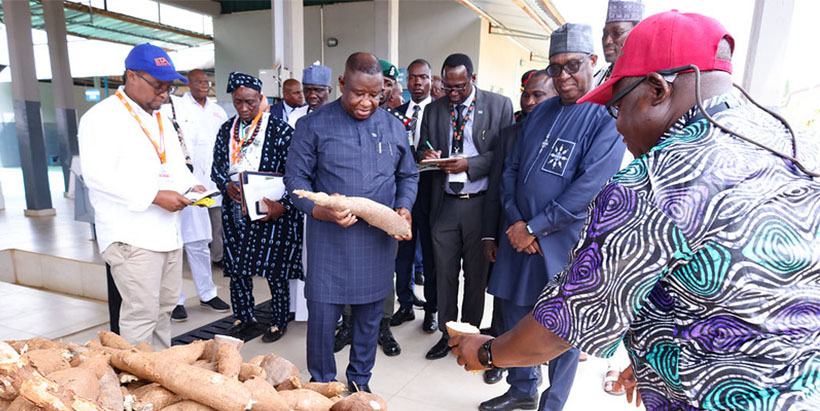
Governor of Oyo State, Seyi Makinde, showcased the state’s unique strategies for agricultural development through private partnerships, leveraging climatic and logistical advantages. He highlighted Oyo’s well-established agricultural institutions, including the University of Ibadan, NIHORT, FRIN, IAR&T, and CRIN, as pivotal players in fostering agricultural research and innovation. Governor Makinde also emphasized the ‘Start Them Early Program’ (STEP), designed to cultivate interest in agriculture among secondary school students, reinforcing Oyo State’s role as a hub for agricultural excellence.
IITA Deputy Director General, Research for Delivery (R4D), Bernard Vanlauwe, shared CGIAR’s cutting-edge research innovations that are revolutionizing agriculture, including high-quality cassava flour, Semi-Autotrophic Hydroponics (SAH) – rapid cassava reproduction – digital soil mapping for soil fertility management, and the Seed Tracker for improved seed distribution. These innovations offer promising opportunities for Sierra Leone to enhance its agricultural productivity and resilience.
In his keynote address, President Bio reaffirmed Sierra Leone’s commitment to transforming its agricultural sector by leveraging research, innovation, and technology.
“Food is not just about what we grow; it is linked to economic stability, health, and national security. To truly transform African agriculture, we must harness research and innovation. Our collaboration with IITA has already yielded remarkable progress in enhancing seed systems, strengthening agronomical practices, improving food safety, and creating youth employment opportunities,” he stated.
Emphasizing youth and women’s empowerment, he noted that 70% of Sierra Leone’s agricultural workforce comprises women. He underscored the importance of expanding mentorship programs, technical training, and collaboration with IITA’s fertilizer hub to increase yields and build a sustainable food system.
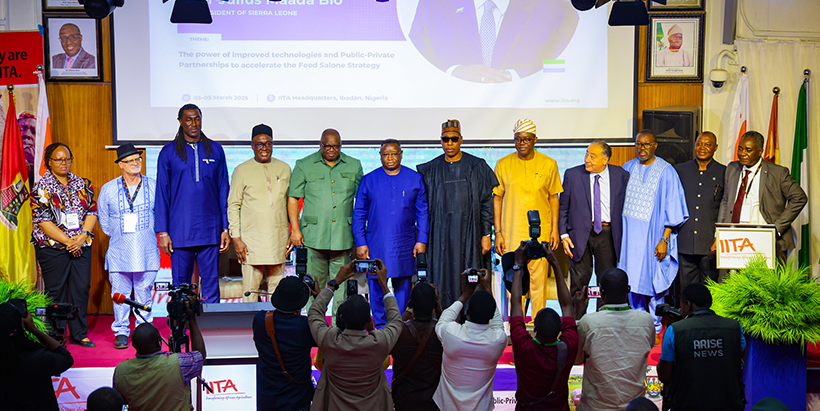
Sierra Leone’s Minister of Agriculture and Food Security, Dr Henry Musa Kpaka, outlined the Feed Salone Strategy, which aims to reduce reliance on food imports, enhance export earnings, create jobs, and build a resilient food system. The initiative focuses on mechanization, improved seed and input systems, aggregation, processing, marketing linkages, agricultural finance, Ag-Tech, climate-smart agriculture, and youth and women empowerment.
In addition, Khalid Bomba, former CEO of Ethiopia’s Agricultural Transformation Agency (ATA) and current CEO of Development Sovereignty Group, discussed Ethiopia’s agricultural transformation model and its potential adaptability to Sierra Leone’s Feed Salone Program.
President Bio’s visit to IITA signifies a renewed commitment to advancing agricultural transformation in Sierra Leone and the broader West African region. By harnessing improved technologies, fostering strategic partnerships, and empowering youth and women, the Feed Salone Strategy will drive sustainable agricultural development and economic growth.
As stakeholders continue to collaborate, the drive generated by this engagement is expected to lead to impactful solutions that will strengthen food security and resilience in Sierra Leone and beyond. The partnership between IITA and Sierra Leone is a testament to the power of research, innovation, and cooperation in shaping the future of African agriculture.
Contribué par Ochuwa Favour Daramola
Contribué par
Histoires récentes