
NOUVELLES DE L'IITA

IITA Forest Center welcomes the community to the first Tree Heritage Park Open Day
16 janvier 2026

IITA Forest Center welcomes the community to the first Tree Heritage Park Open Day
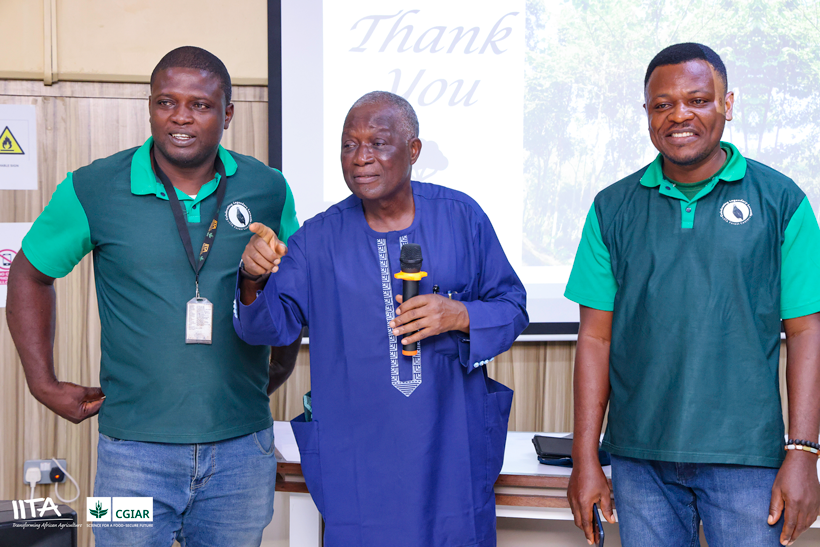
IITA Forest Center Patron, Dr David Ladipo, with IITA Forest Center Field Supervisors telling the story of the Tree Heritage Park.

Centre forestier de l'IITA hosted its inaugural Tree Heritage Park (THP) Open Day recently, bringing together students, researchers, conservationists, and nature lovers for a day dedicated to celebrating Nigeria’s native tree species and strengthening public commitment to environmental stewardship.

The Open Day supports the Center’s continuous mandate to conserve Nigeria’s threatened tree species and upholds the ArbNet Level II accreditation the Park received in January 2022—Nigeria’s first internationally accredited arboretum, the 11th in Africa, and the 500th worldwide.

Located within the 350-hectare IITA Forest Reserve, the five-hectare THP, fondly called the “Noah’s Ark,” hosts more than 100 indigenous species. These include culturally important and endangered trees such as Iroko (Milicia excelsa), African Baobab (Adansonia digitata), African Locust Bean (Parkia biglobosa), et Araba (Ceiba pentandra), where the shy, yellow-billed kite often nests. Many other species in the park were recalled from landscapes affected by urban expansion, illegal logging, storms, and the growing pressures of climate change.
IITA Forest Center Patron, Dr David Ladipo, with IITA Forest Center Field Supervisors telling the story of the Tree Heritage Park.
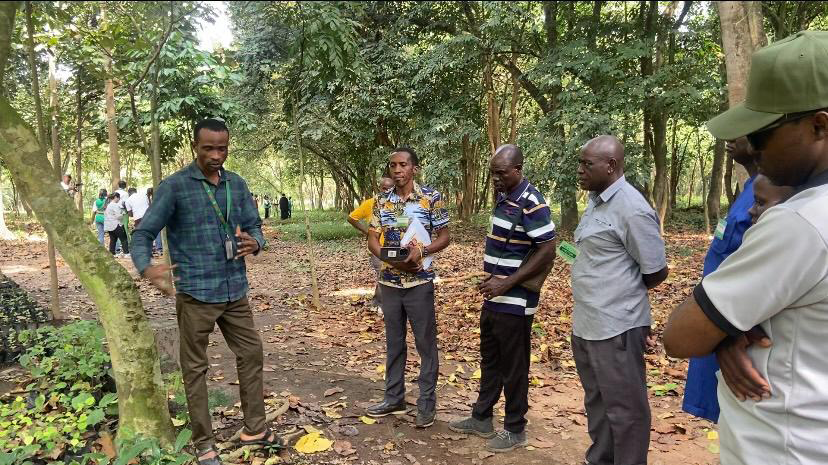
Students, researchers, and conservationists in different training sessions during the guided tour at the Tree Heritage Park.

Dr David Ladipo, IITA Forest Center patron, who has contributed to conservation work in the Reserve since the 1990s, introduced the participants to the Park’s evolution through a documentary and a presentation. He emphasized the THP’s significance, noting, “This living gene bank is more than a collection of trees; it is a rescue mission. Many of these species would have disappeared without the decades of deliberate conservation efforts here.”

Following the classroom session, participants embarked on a guided tour of the Park. Led by IITA Forest Center staff, the tour highlighted the ecological, cultural, and scientific value of the species conserved in this living genebank, as well as the foundational work of conservation champions such as Phil Hall, Prof Shiwuwa Manu, Dr David Ladipo, Dr John Peacock, Deni Bown, and, more recently, Dr Adewale Awoyemi, the IITA Forest Center Manager.

Speaking on behalf of the Forest Center Manager, Ademola Ajayi underscored the urgency of protecting Nigeria’s native biodiversity. “Our trees are linked to our food. Our food is linked to our health. Many native trees support the growth of indigenous vegetables, fruits, and leaves,” he said. “Destroying our natural forests affects our economy, our food systems, our health, and our cultural heritage. What began as the conversion of an old arboretum into a Tree Heritage Park has now grown into a rallying point for conservation, tourism, and adventure in Ibadan—creating new opportunities for awareness and income generation.”

Professor of Pediatric Hematology and Guest Speaker, Prof. Adekunle Adekile, a passionate naturalist and photographer, encouraged participants to take personal responsibility for environmental protection. “This Park shows how passion-backed science can transform conservation. When communities, students, and experts come together, we create a future where nature and people thrive together,” he said, adding that greater public awareness is vital to addressing myths and deepening appreciation for biodiversity.

Younger participants shared enthusiasm. Adesina Abdul Rahman from Amao College said, “I enjoyed the tour around the THP. I now understand the value of trees and how to plant them. With this knowledge, I plan to become an advocate for conservation among my schoolmates.”

Aderonke Oyewumi from Ibadan International School added, “Today I learnt that every small effort makes a difference. We can protect our environment by joining conservation clubs, recycling plastics, and planting more trees.”

The event also emphasized the Forest Center’s broader impact, including raising seedlings for the restoration of nearly 1,000 hectares of degraded landscapes in Olokemeji, supporting reforestation projects across Nigeria, and nurturing more than 63 Schools Conservation Clubs that groom young environmental stewards.

As visitors departed, many expressed renewed optimism for the future of Nigeria’s forests. The IITA Forest Center remains committed to documenting endangered species, collecting seeds and wildlings, and producing training resources to guide ecological restoration nationwide ensuring that Africa’s native trees continue to stand as symbols of identity, resilience, and pride.

Contributed by Folake Oduntan


Contribué par

Nouvelles connexes

Aucun article trouvé

Laisser un commentaire

Votre adresse e-mail ne sera pas publiée. Les champs obligatoires sont indiqués avec *

Retour en haut
Olaosebikan, Olamide

Olamide Deborah Nwanze est une chercheuse principale spécialisée dans la recherche sur l'approche "genre" afin d'éclairer les politiques de sélection participative et inclusive, de développement de variétés et de systèmes semenciers concernant les cultures de racines, tubercules et bananes (RTB) au siège de l'Institut International d'Agriculture Tropicale, à Ibadan, au Nigeria. Elle est candidate au doctorat à l'Université d'Ibadan et titulaire d'un master et d'un diplôme d'ingénieur agronome en vulgarisation agricole et développement rural. Olamide est membre du programme African Women in Agricultural Research and Development – Gender Responsive Agricultural Systems Policy (SAISIE DE RÉCOMPENSEet les Chercheuses Sensibles au Genre Équipées pour la Transformation Agricole (SUPER. Elle cherche à appliquer ses apprentissages en matière d’approche genre, recherche sensible au genre, et expertise en développement et examen de politiques pour faciliter l’accès et l’adoption par les femmes, les jeunes, les enfants et les groupes sociaux vulnérables aux innovations agricoles qui garantissent la sécurité alimentaire, nutritionnelle, des revenus et des moyens de subsistance en Afrique. Ses rôles actuels comprennent le mentorat de chercheurs stagiaires, le développement de guides et manuels de formation, la mise en œuvre et l'adaptation de cadres et d'outils genre, l'engagement des acteurs de la chaîne de valeur en tant que partenaires de la science citoyenne, l'examen et la refonte des politiques, la gestion et l'analyse des données. Ses recherches actuelles portent sur les méthodes mixtes ainsi que sur les approches participatives et interdisciplinaires pour saisir et mettre en évidence les dynamiques de genre, les besoins, les préférences et les défis rencontrés par les parties prenantes au sein de la chaîne de valeur des moyens de subsistance agricoles afin de prioriser des stratégies axées sur le genre dans les programmes de sélection, la conception et la mise en œuvre des politiques.

À l'IITA, elle contribue à la mise en œuvre du CGIAR Initiative d'Élevage Accéléré et Innovation génétique Programmes ; recherche participative et genre au sein des Prochaine Génération ManiocHarvestPlusRTBAliments, et Tricot-ClimMob 1000Fermes Projets ; et la communication des connaissances sur le genre via le Série de webinaires G-LENS, vidéo documentaire, notes de politiquepublications, et blogs.


Publications récentes

de Sousa, K., van Etten, J., Manners, R. Bello, A., Teeken, B., Olaosebikan, O., et al. 2024. L'approche tricot : un cadre agile pour les essais décentralisés à la ferme soutenus par la science citoyenne. Une rétrospective. Agron. Sustain. Dev. 44, 8. https://doi.org/10.1007/s13593-023-00937-1

Madu, T., Onwuka, S., Nwafor, S., Onyemauwa, N., Ejechi, M., Ofoeze, M., Ukeje, B., Eluagu, C., Olaosebikan, O., Okoye, B., 2024. Les études sur les consommateurs inclusifs en matière de genre améliorent l'amélioration du manioc au Nigeria dans : Frontiers in Sociology, volume 9, numéro : 1224504, doi : 10.3389/fsoc.2024.1224504

Olaosebikan, O. ; Bello, A. ; Utoblo, O. ; Okoye, B. ; Olutegbe, N. ; Garner, E. ; Teeken, B. ; Bryan, E. ; Forsythe, L. ; Cole, S. ; Madu, T. 2023. Facteurs de stress et résilience au sein de la chaîne de valeur du manioc au Nigeria : Caractéristiques préférées des variétés de manioc et stratégies de réponse des hommes et des femmes pour informer l'amélioration variétale. Sustainability 15, 7837. https://doi.org/10.3390/su15107837

Okoye, B., Ofoeze, M., Ejechi, M., Onwuka, S., Nwafor, S., Onyemauwa, N., Ukeje, B., Eluagu, C., Obidiegwu, J.*, Olaosebikan, O., Madu, T.* 2023. Priorisation des traits préférés dans la chaîne de valeur de l'igname au Nigeria : une analyse de la situation en matière de genre in: Frontiers in Sociology, volume 8, numéro : 1232626, pages 1 – 9, ISSN 2297-7775, 2023. https://www.frontiersin.org/articles/10.3389/fsoc.2023.1232626/full

Olaosebikan, O., Bello, A. A., de Sousa, K., Ndjouenkeu, R., Adesokan, M., Alamu, E. O., Agbona, A., van Etten, J., Kegah, F. N.*, Dufour, D., Bouniol, A., Teeken, B. 2023. Acceptabilité par les consommateurs des produits alimentaires à base de gari-eba de manioc dans des contextes culturels et environnementaux variés en utilisant l'approche triade de comparaison des technologies (tricot) dans : Journal of the Science of Food and Agriculture,

Teeken, B., Olaosebikan, O., Bello, A. A., Madu, T.*, Cole, S. M. 2023. Évaluation qualitative de la positionnalité et des préférences des dyades en relation avec les activités liées au manioc : travailler avec des scientifiques citoyens du procès tricot https://hdl.handle.net/10568/138326 Type : Manuel

Bouniol, A., Ceballos, H., Bello, A. A., Teeken, B., Olaosebikan, O., Owoade, D., Agbona, A., Fotso Kuate, A., Madu, T.*, Okoye, B.*, Ofoeze, M.*, Nwafor, S.*, Onyemauwa, N.*, Adinsi, L.*, Forsythe, L., Dufour, D. 2023. Impact variétal sur le travail des femmes, la charge de travail et la pénibilité associée dans le traitement des plantes à racines, tubercules et bananes : focus sur le manioc en Afrique subsaharienne dans : Journal of the Science of Food and Agriculture, pages 1 – 25, ISSN 0022-5142,

Bello, A. A., Agbona, A., Olaosebikan, O., Edughaen, G., Dufour, D., Bouniol, A., Iluebbey, P., Ndjouenkeu, R.*, Rabbi, I. Y., Teeken, B. 2023. Effets génétiques et environnementaux sur la productivité de la transformation et le rendement des produits alimentaires : la pénibilité du travail des femmes dans : Journal of the Science of Food and Agriculture, pages 1 – 32, ISSN 0022-5142, 5

Cavicchioli, M., Zimbiti, T., Teeken, B., Nwanze, D.O., Liani, M., Parkes, E. & Bello, A. 2023. Rapport sur la formation en sélection génétique sensible au genre à l'IITA. Genetic Resources Center, IITA-HQ, Ibadan, 21-23 septembre 2022. Ibadan, Nigéria : IITA, (34 p.).https://hdl.handle.net/10568/131368

Agbona, A. Peteti P., Teeken B., Olaosebikan O. Bello, A. A., Parkes, E., Rabbi, I. Y., Mueller, L., Egesi, C., Kulakow, P. 2022. Gestion des données dans les programmes d'amélioration des cultures RTB africaines multidisciplinaires. In : Williamson, H.F., Leonelli, S. (eds) Towards Responsible Plant Data Linkage: Data Challenges for Agricultural Research and Development. Springer, Cham. https://doi.org/10.1007/978-3-031-13276-6_5

Lora Forsythe, Pricilla Marimo, Sarah Mayanja, Olamide D. Olaosebikan, Esme Stuart, Bela Teeken, Benjamin Okoye, Tessy Madu, (2021). Analyse transversale du genre dans RTBfoods Étape 2 Cartographie des genres sur les produits RTB. Comprendre les moteurs des préférences en matière de traits et le développement de profils de produits RTB multi-utilisateurs, WP1. Londres, Royaume-Uni : Rapport scientifique de terrain RTBfoods, 30 p.

Teeken, B., Garner, E., Agbona, A., Balogun, I., Olaosebikan, O., Bello, A., Madu, T., Okoye, B., Egesi, C., Kulakow, P. et Tufan, H.A. 2021. Au-delà des “ traits des femmes ” : explorer comment le genre, les différences sociales et les caractéristiques des ménages influencent les préférences pour les traits. Frontiers Systèmes alimentaires durables 5:740926. https://doi.org/10.3389/fsufs.2021.740926

Teeken, B., Agbona, A., Bello, A., Olaosebikan, O., Alamu, E., Adesokan, M., Awoyale, W., Madu, T., Okoye, B., Chijioke, U., Owoade, D., Okoro, M., Bouniol, A., Dufour, D., Hershey, C., Rabbi, I., Maziya‐Dixon, B., Egesi, C., Tufan, H. et Kulakow, P. (020. Comprendre les préférences variétales du manioc par le classement par paires du gari-eba et du fufu préparés par des agriculteurs-transformateurs locaux. Int J Food Sci Technol. https://doi.org/10.1111/ijfs.14862

Bela Teeken, Olamide Olaosebikan, Ireti Balogun, Benjamin Okoye, Tessy Madu, Steven Cole, Abolore Bello, Elizabeth Parkes. (2020). Pilotage des outils de profil client et produit G+ pour l'amélioration sensible au genre du manioc au Nigeria. Nigeria : Institut international d'agriculture tropicale (IIAT). https://hdl.handle.net/20.500.11766/13000