
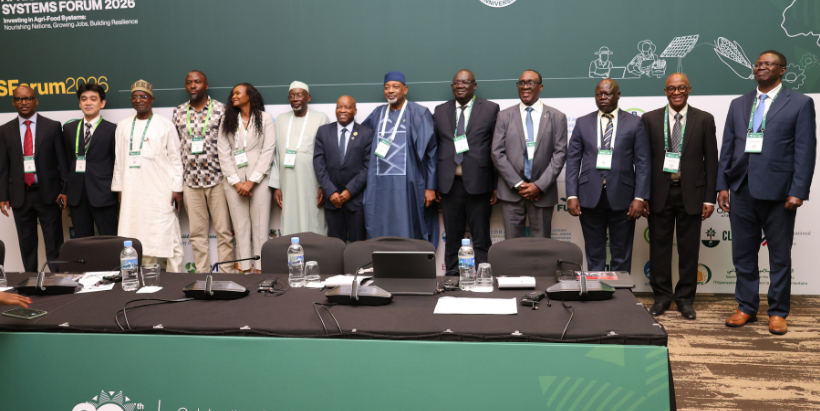
This year, IITA brought its science, partnerships and vision for Africa’s agricultural transformation to the Africa Food Systems Forum (AFSF) 2026 in Kigali, Rwanda, where governments, researchers, development finance institutions, private-sector leaders and other partners gathered to advance solutions for more productive, resilient and inclusive food systems on the continent.
Across high-level dialogues, breakthrough sessions and bilateral engagements, IITA Director General and CGIAR Regional Director for Africa, Dr Simeon Ehui, advanced a consistent message: Africa has no shortage of agricultural innovation. The urgent task is to connect that innovation with the investment, policies, partnerships and delivery systems needed to put proven solutions into the hands of millions of farmers.
The message was particularly clear during the high-level side event: “From Emergency Responses to Food Systems Resilience: Lessons Learnt from the African Emergency Food Production Facility (AEFPF) for Africa’s Next Generation of Agricultural Investments.” Reflecting on more than five decades of CGIAR engagement in Africa, Dr Ehui highlighted how IITA’s proven agricultural technologies, and strategic partnerships, have provided support for food systems’ resilience when integrated into national and regional agricultural programs.
Underscoring the strategic importance of strengthening Africa’s preparedness for future shocks to food systems, Dr Ehui highlighted how collaboration with African governments and national research systems has helped develop improved varieties of crops like maize, cassava, cowpea and other staple crops, strengthening productivity and resilience to drought, heat, pests and diseases.
He emphasized that the next phase of agricultural transformation must focus increasingly on scale and impact. “Africa does not lack agricultural innovation,” was the underlying message. What is needed is a more deliberate connection between CGIAR science and national priorities, African research institutions, private-sector delivery systems, and large-scale public and development finance.
The results of such an approach are already visible. Through the African Development Bank-supported Technologies for African Agricultural Transformation (TAAT) program, CGIAR innovations have reached more than 25 million farmers across Africa. In Nigeria, heat-tolerant wheat technologies supported through TAAT contributed to an expansion of the wheat production area from about 70,000 hectares in 2022/23 to more than 277,000 hectares in 2024/25.
IITA-developed innovations are also demonstrating how research can address challenges beyond production. Aflasafe, developed by IITA and partners, is helping tackle aflatoxin contamination, with field applications reducing contamination by more than 80 percent and helping strengthen food safety and market opportunities.
For Dr Ehui, scaling agricultural innovation cannot begin only when a crisis arrives. It must be built into agricultural investment long before the emergency. He argued that Africa must create the same sense of urgency around preparedness that it demonstrates during emergencies.
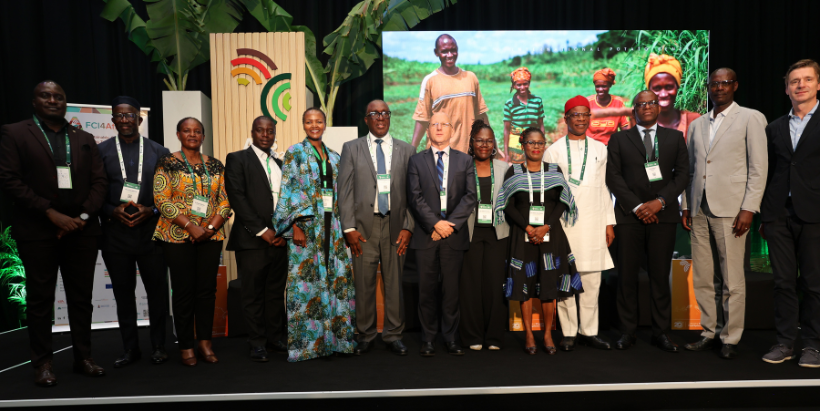
He pointed to drought-tolerant maize as a practical illustration of what preparedness looks like. IITA scientists, African national research institutions, seed companies and farmers had worked for years to develop maize varieties suited to drought-prone environments. When rainfall failed in parts of Tanzania in 2015, farmers who already had access to these varieties were better positioned to withstand the shock.
For Dr Ehui, that is what resilience means: making sure farmers have the right solutions before the crisis arrives, rather than waiting to provide assistance after the harvest has failed. Yet preparedness is only part of the equation. Even the most effective technology cannot deliver impact if farmers cannot access it.
This featured prominently in discussions on the future of Africa’s food systems. Dr Ehui stressed that agricultural investments must look beyond the question of whether a technology works to ask what it will take to reach millions of farmers with that technology.
Cassava provides one example. When cassava mosaic disease threatened production across parts of East and Central Africa, years of investment in breeding, disease surveillance, clean planting material and resistant varieties provided the foundation for recovery. But science alone could not solve the problem. Planting material had to be multiplied and distributed, seed systems had to function, national institutions had to participate, and farmers had to adopt the improved varieties.
The lesson is broader than any individual crop; this is because innovation becomes impact only when the systems around it work. Farmers need functioning seed and fertilizer systems, irrigation, healthy soils, storage, processing, finance, aggregation, transport and reliable markets.
The same systems perspective informed IITA’s engagement around roots, tubers and bananas (RTBs) at this year’s Forum.
Together with the International Potato Center (CIP) Director General Simon Heck, Dr Ehui opened the AFSF Breakthrough Session: “Unlocking Africa’s RTB Potential,” organized by CIP in collaboration with IITA under the PROSSIVA program led by IITA scientists – Drs Delphine Amah, Beatrice Aighewi, and James Legg. The session also featured a panel moderated by Dr Joyce Maru, CIP Regional Director for Africa with Africa Food Prize (AFP) 2025 winner and IITA GoSeed CEO, Dr Mercy Diebiru-Ojo, and NRCRI Executive Director, Professor Chiedozie Egesi.
The session highlighted the enormous but largely untapped economic potential of cassava, banana, potato, sweet potato and yam. While Africa is a global leader in the production of several RTB crops, much of the value generated through processing, commercialization, industrial applications and trade is still captured elsewhere.
Dr Ehui challenged participants to change the way these crops are perceived. “RTBs are not ‘poor people’s crops’ waiting to be replaced. They are underdeveloped industries waiting to be transformed.”
Realizing that potential will require investment well beyond the farm gate. Rural roads, aggregation systems, pre-processing and storage facilities, efficient market infrastructure and stronger links between farmers and processors are essential if Africa is to move from raw production to value addition and competitive industries.
IITA and its partners are already shortening breeding cycles for crops such as banana and yam, while advances in gene editing, genomics and artificial intelligence are opening new possibilities for crop improvement. But these scientific advances must be matched by modern seed and planting-material systems capable of delivering quality materials to farmers at scale.
For Dr Ehui, this is where agricultural transformation becomes an investment proposition rather than simply a research agenda.
Africa must increasingly develop intentional industrial strategies for RTBs, recognizing their potential to create businesses and jobs, strengthen food and nutrition security, expand exports and drive economic growth. Regional integration and the effective implementation of the African Continental Free Trade Area (AfCFTA) will also be important in creating the larger markets needed for RTB industries to thrive.
The emphasis on investment, systems and partnerships was also reflected in IITA’s engagements with national governments during the Forum.
Together, these engagements reflected another important element of IITA’s approach: agricultural transformation must be country-led, grounded in national priorities and delivered through strong partnerships.
Across Kigali, the different conversations ultimately converged around one idea: science matters, but science alone is not enough.
Africa needs to connect scientific innovation with finance, policy, enterprise, infrastructure and delivery. It needs to invest in preparedness before crises occur, take proven technologies beyond research stations, and build food systems that can withstand climate and other shocks while creating economic opportunity.
For IITA, this means deepening collaboration with governments, national research organizations, farmers, private-sector partners, development finance institutions and fellow CGIAR centers to ensure that agricultural science translates into solutions that people can use and industries can build upon.
The ambition is to build productive, resilient and competitive African food systems that improve nutrition, create jobs, and strengthen livelihoods.
As AFSF 2026 concluded in Kigali, IITA’s message was clear: Africa has the science, talent and entrepreneurial energy to transform its food systems. The next challenge is to connect these assets and invest in the systems that can take them to scale.
Contribué par
Timilehin Osunde
Histoires récentes