Agricultural innovation is not defined by the number of varieties released, but by the tangible benefits they deliver to farmers, processors, and consumers.
For root, tuber, and banana (RTB) crops, this means going beyond incremental improvements to develop varieties that deliver at least 25% higher productivity than the leading cultivars currently grown in their target markets.
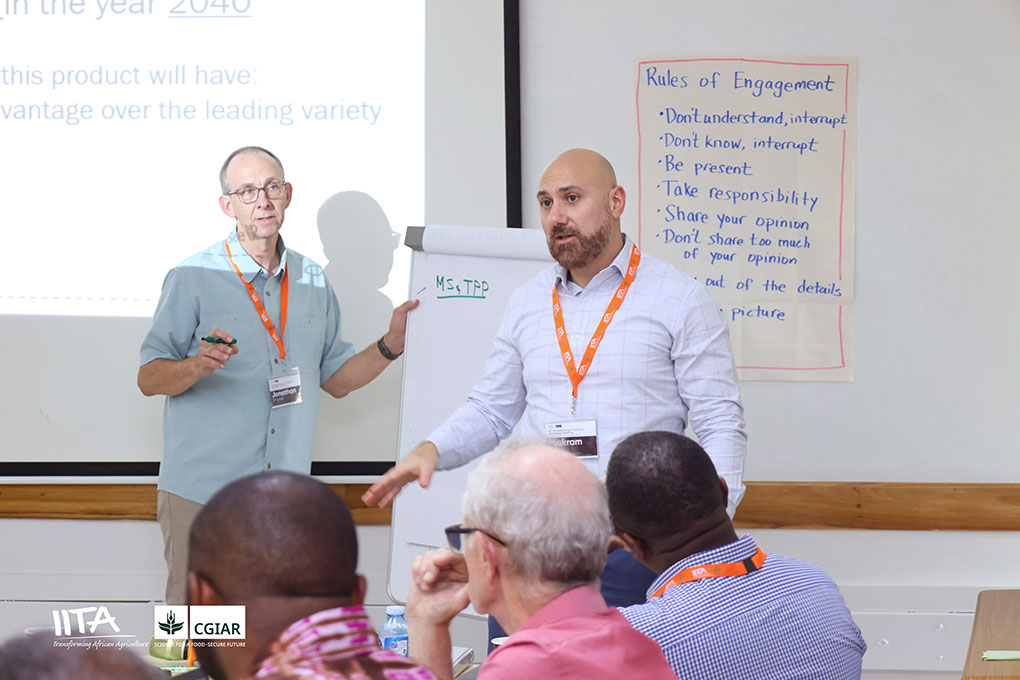
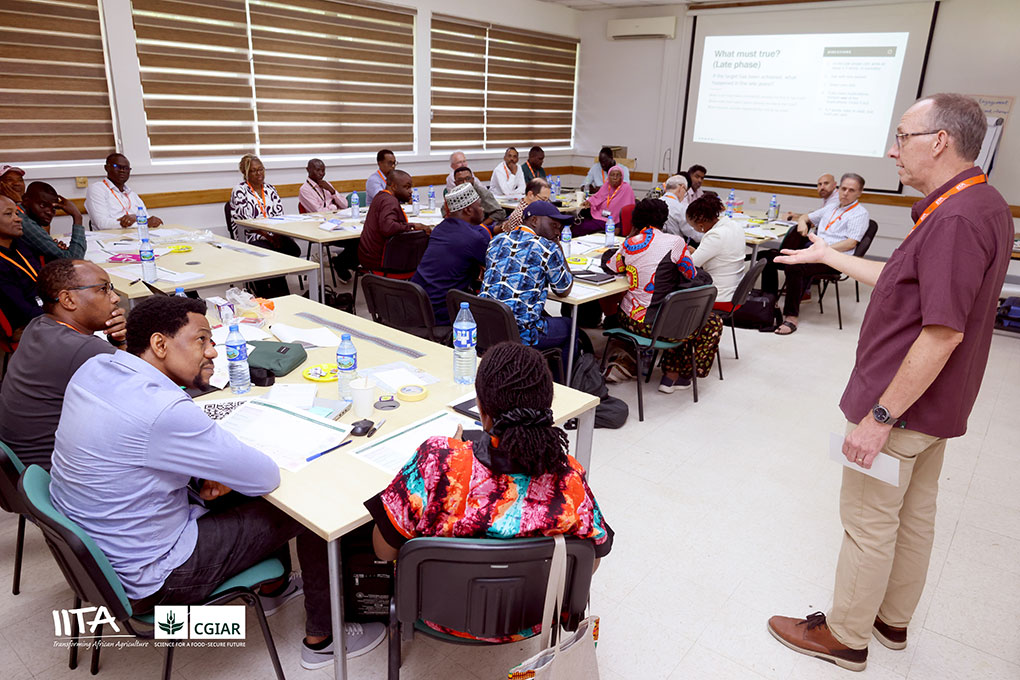
At IITA headquarters in Ibadan, breeders, seed system specialists, product-development experts, and consultants convened from 20–22 October to turn that ambition into a clear, actionable process. Their task was to map the decisions, partnerships, resources, and delivery systems required to develop and scale RTB breakthrough products, with a target of releasing them by 2035 and achieving 30 percent adoption in farmers’ fields by 2040.
The approach, implemented under the CGIAR’s Breeding for Tomorrow Science program, marks a shift in how breeding teams define success. Dr Makram Geha, the Director of the CGIAR Breeding for Tomorrow Program, stated in an interview that rather than concentrating primarily on developing improved varieties, the teams are working backward from the products farmers and markets will need to identify the research milestones and delivery arrangements required to make those products available and widely adopted.
The distinction matters as a variety may offer an improvement over what came before, but a breakthrough product must deliver a substantial, measurable difference in productivity while meeting the quality, processing and market requirements that determine whether farmers and other value-chain actors will adopt it.
Starting with the product, not the breeding pipeline
The roadmap approach asks teams to define the desired product first: its performance in farmers’ fields, its qualities for processing and consumption, and the adoption it must achieve. From there, they work backward to identify the breeding activities, seed multiplication, partnerships, and market engagement needed to meet the targets.
Dr Rabbin Ismaël, Head of IITA’s Cassava Breeding program, noted that this involves bringing breeding, seed systems, market intelligence, and scaling partners together around a common goal. The cassava roadmap sets an ambition to achieve a 30 percent increase in dry-root yield and 30 percent adoption by 2040. Reaching those targets, will require varieties that combine higher productivity with disease resistance and the root qualities that farmers, processors, and consumers demand, he stressed.
Dr Rabbi stated the roadmap would help his team establish time-bound milestones and clarify the steps required before and after release. The cassava team has set 2034 as its target for breakthrough product release, ahead of the broader program ambition of releases by 2035 and adoption at scale by 2040.
To accelerate progress, the team is considering ways to advance promising materials already in the breeding pipeline while developing new genetic combinations. Improved selection methods, greater use of data, and early multiplication of planting materials will be important for getting suitable products into farmers’ hands more quickly.
However, higher yields alone will not guarantee success. He noted that farmers need access to quality planting materials, while processors need roots that meet their requirements and can be handled efficiently. Production costs, market demand and the availability of seed must therefore be considered alongside the variety’s performance.
Defining what a breakthrough looks like across crops
The same product-led thinking is shaping work on yam, as Dr Asrat Amele, IITA’s yam crop lead, disclosed that his team is working from the end product it wants to deliver over the next 10 to 14 years and identifying the research and development activities needed to achieve them.
The team’s targets include varieties with at least 25 percent higher yields, dry matter content above 30 percent, and the ability to retain quality for up to four months in storage. The team is also seeking varieties that produce multiple tubers of more uniform size, shape, and weight, rather than one dominant tuber. Such characteristics, he stressed, will improve the usefulness and marketability of the harvest, while easier seed multiplication would help increase the supply of planting materials.
Research into yam genetics is also creating opportunities to shorten the time needed to deliver improved products. Genomic resources and molecular markers associated with agronomic and tuber-quality traits could help shorten breeding cycles and support more precise selection. However, the potential reduction in breeding time depends on the research outcomes and their successful application in breeding programs.
Dr Paterne Agre, another yam breeder and winner of the 2026 Japan International Award for Young Agricultural Researchers, highlighted the team’s ambition to develop two breakthrough products for white yam and one for water yam. He explained that the work also considers traits that could reduce production costs.
However, developing the desired traits is only part of the process. Market actors must be involved in testing and promoting varieties so that farmers and buyers understand their value and demand can grow before release. Dr Agre emphasized that an ideal yam product must combine high and stable yields with qualities consumers prefer. He noted that more than 2,000 farmers are already growing improved yam varieties across about 15 Nigerian states, with developing interests from other African countries.
He added that delivering the next generation of products will depend not only on scientific advances, but also on stable funding, suitable infrastructure, and partnerships across the value chain. Additionally, clear communication about what is being developed, when it will be available, and how it can be accessed will be essential for widespread adoption.
Making the products matter beyond the field
Beyond defining product performance, the roadmaps provide an opportunity to connect breeding priorities with the needs of the consumers and industries that depend on RTB crops.
In her opinion, Dr Elizabeth Parkes, a cassava breeder based at IITA’s Southern Africa Hub, Lusaka, Zambia, said the roadmap offers a way to bring different disciplines together around a defined result. Working across Malawi and Mozambique, she sees the process as an opportunity to agree on product attributes, clarify responsibilities and build the commitment needed to reach the targets.
The benefits, she mentioned, could extend well beyond crop yields. It would deliver varieties that are more productive and have high market quality, which could improve farmers’ returns, strengthen cassava-based industries, and make agriculture more attractive to young people.
Parkes also highlighted the importance of cassava to women, stressing their major roles in its production and processing. For many households, she said, cassava can serve as a “bank in the ground.” Varieties that deliver higher yields and dependable quality could therefore help strengthen household food supplies, incomes and spending on needs such as health and education.
These wider outcomes reinforce the need to redesign products around the people who will grow, process, sell and consume them. A variety that performs well in trials but fails to meet farmers’ needs, processors’ specifications or consumers’ preferences is unlikely to achieve the level of adoption the program seeks.
From a roadmap to delivery at scale
The RTB Meeting on creating a roadmap for a breakthrough delivery product emphasized the stages required to move a product from research to widespread use. That coordination was central to the roadmap’s purpose. Instead of treating variety development and adoption as separate tasks, the teams are identifying the milestones, responsibilities, and checkpoints needed to move from product design through release and delivery at scale.
The approach also recognizes that breeding does not end with a release. Crop diseases, changing environmental conditions, and evolving market requirements mean that product performance must continue to be monitored, and breeding pipelines renewed.
For the RTB teams, the test of the roadmap will ultimately be whether it delivers products that make a measurable difference in farmers’ fields and along the value chain. Meeting the 2035 release ambition and 2040 adoption goal will require more than scientific progress: it will depend on coordinated action, reliable seed systems, market engagement, and sustained investment. Ultimately, the success of the next generation of RTB varieties will not be defined simply by their release, but by their ability to deliver lasting value to the farmers, processors, and consumers they are developed to serve.
Contribué par
Anu Oyeleye and Tolulope Akinola