
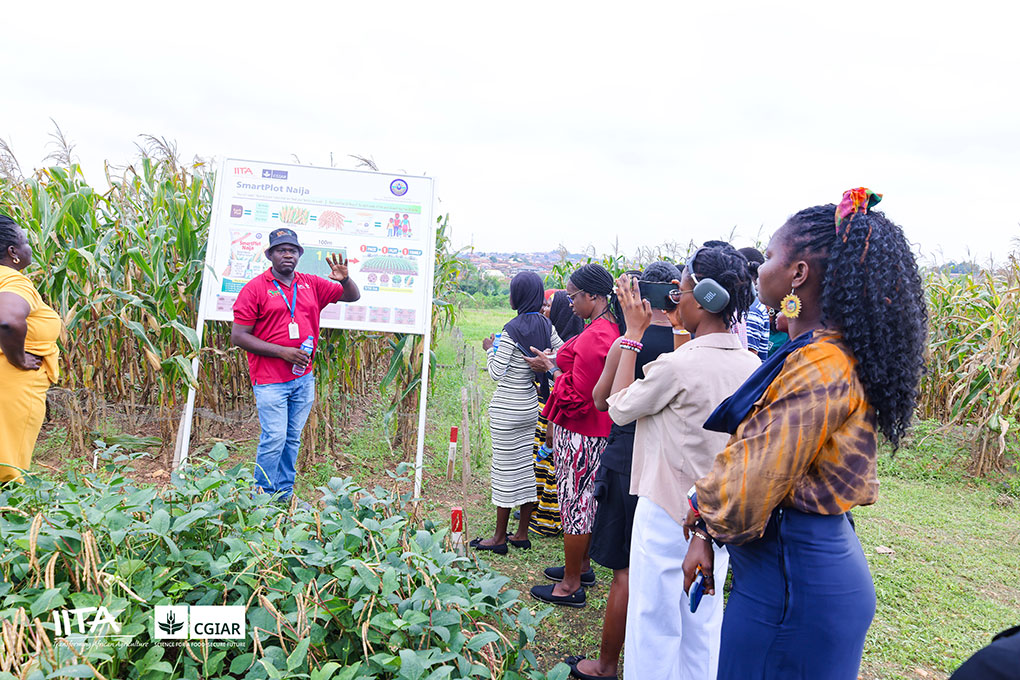
What if farmers could produce more food for their families from a small piece of land by managing it better? This is the idea behind SmartPlot Naija, a farming concept designed to show smallholder farmers and communities around IITA how to produce enough food for a family of six using their land, farm inputs, and labor.
Smallholder farmers often cultivate their entire 1–2 ha of available land yet still fail to produce sufficient food for their families. To address this challenge, many believe that expanding cultivated area or mechanization is the solution. However, neither option is always viable. Expanding production requires additional inputs and labor, and agronomic practices often become poorer, further reducing productivity. At the same time, mechanization remains financially inaccessible for most smallholder farmers.
Dean Muungani, Head of the Product Pipeline Development Unit (PPDU) and Product Manager for Grain Crops at IITA, explained that the concept was originally initiated by a commercial farmer, Berin Stockhill in Zimbabwe, and was developed by the Foundations for Farming.
At its core, the initiative seeks to answer a fundamental question: “How much land is required to feed a family of six per year?”
The model is based on the assumption that a family needs one 20 kg bucket of maize each week to meet its staple food requirements, combining this target with the principles of conservation agriculture: minimum soil disturbance, crop rotation, and permanent soil cover. This approach informed the development of the Pfumvudza Intwasa model, a name that means new season. IITA subsequently adapted the concept for Nigeria, renaming it SmartPlot Naija to give it local relevance.
Contribué par
Victoria Idowu and Anu Oyeleye