
NEWS

AflasafeTZ proves its effectiveness as it reduces aflatoxin contamination by over 85% in maize and groundnut in Tanzania
novembre 14, 2017

Dar es Salaam – Results from two-year field trials of AflasafeTZ, an innovative technology to control aflatoxin contamination, have proven the effectiveness of the technology in reducing the poison in maize and groundnut.
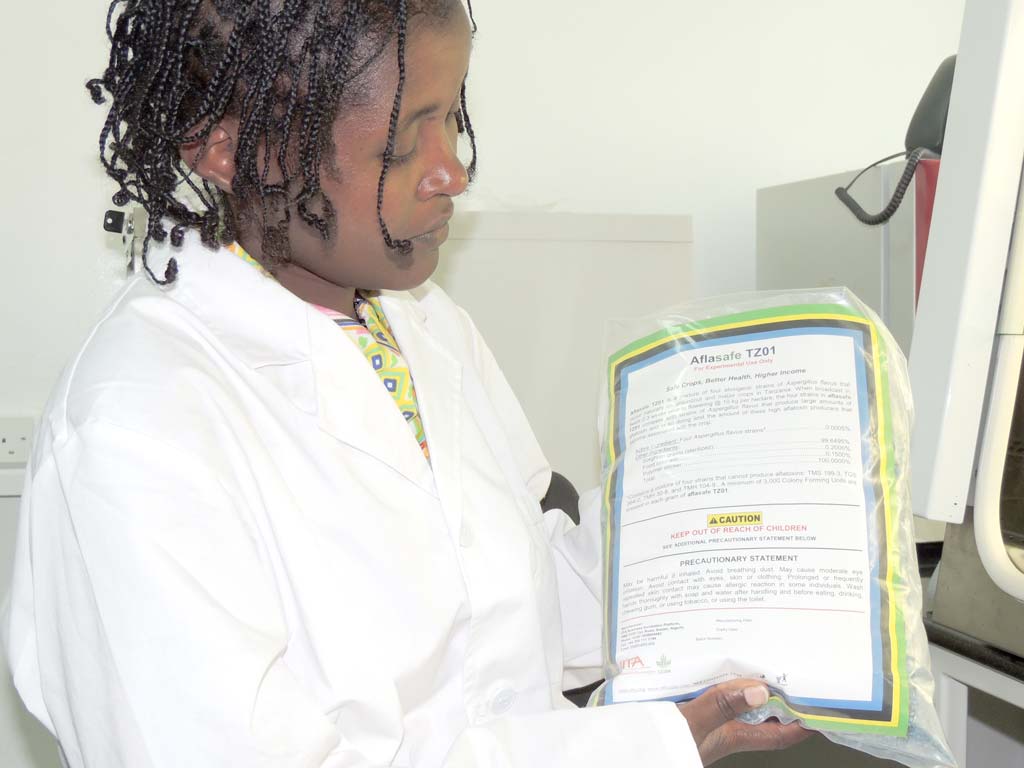
Picture of IITA researchers shows the packed aflasafeTZ product
IITA researchers shows the packed aflasafeTZ product

The trials were conducted in many sites across the country, which are known hotspots for aflatoxin contamination—Babati, Chamwino, Chemba, Kibaigwa, Kilombero, Kilosa, Kiteto Kondoa, Kongwa,Masasi, Mpwapwa, and Nanyumbu. Overall, the technology was able to reduce contamination of aflatoxin on maize and groundnut by over 85% to levels that are fit for human consumption.

The field studies were conducted by a team from the International Institute of Tropical Agriculture (IITA) in partnership with the Department of Biocontrol at the Ministry of Agriculture, with support from many international partners including USAID. The findings were presented at a meeting of stakeholders at IITA offices in Dar es Salaam.

Aflatoxin is a poisonous chemical produced by naturally occurring fungi Aspergillus flavus that is found in soils and is a serious threat to health and food security in the country and many parts of the world. Aflatoxin has been associated with cancer and other liver diseases, reduced immunity, and stunting in children. In cases of acute poisoning, as witnessed in Tanzania and Kenya, poisoning can lead to death.

Aflasafe, on the other h and, is a technology first developed by the United States Department of Agriculture (USDA), and IITA and its partners are spearheading its adoption in Africa. It is a biocontrol product developed using the same family of fungi as those that produce aflatoxins, which do not produce the poison and are further  able to outcompete and displace the aflatoxin producing fungi. The AflasafeTZ is made from country-specific strains of the fungi.

“We are happy with the findings, which are consistent with the results from other countries where the product has been tested. The next step is to present the dossier on its efficacy and safety to the biocontrol registration committee, so the technology can be officially released in the country,” said Dr George Mahuku, IITA plant pathologiest who is leading these efforts in the country while presenting the results.

“Aflatoxin contamination is a major challenge in the country. Therefore, we are happy that we have this technology that has shown it can work. Once it is registered, we will then face the next hurdle of getting the technology to as many farmers as possible to ensure our food is safe and free from this killer,” said Beatrice Pallagyo, Assistant Deputy Department of Food Security, Ministry of Agriculture who has also been working on developing the technology.

“The technology is easy to use. The farmers simply scatter the aflasafe in their fields 50 days after planting their groundnut or 3 weeks to flowering for maize. The technology will also need partnership with the private sector for mass production of the technology to ensure it reaches farmers, it is affordable. IITA will provide technical back stopping,” she added.

The technology is currently in use in Nigeria, Kenya, and The Gambia. Nine other African countries are at various levels of developing their country specific strains. These include Senegal, Ug anda, Zambia, Malawi, Mozambique, Rw anda, and Burundi.

The participants at the event were impressed with the technology and urged urgent action to ensure it is available in the country to ensure safety of food and feed.

“As regulators, we are interested in ensuring the safety of the product to humans and to the environment. From the presentation, all the relevant toxicological and environmental data which determine to what extent the effects on health and environmental safety have been generated using good laboratory practices and in accordance to international guidelines. It is therefore safe if it is used accordingly,” said Habib Mal anda, Principal Scientists Tanzania Pest Registration Institute (TPRI).

‘This was an important session. I have been able to get the real picture of aflatoxins and am happy that there is a solution. As the private sector, we are looking forward to having the product registered in the country and available in the market. It will definitely change the lives of farmers,” said Harish Dhutia, Chairman, Crop Life Tanzania.

One of the researchers from the National Agricultural Research Institute who was also at the meeting was happy with the progress, “We started this journey in 2012 and I am happy we have come this far. A lot of research and science has gone into developing this product. It has potential to make food safe for the people of Tanzania. It also presents business opportunities for the private sector to commercialize it and make it available. We therefore look forward to its commercialization to make food and feed safe for the people of Tanzania,” said Dr Ari Mponda, Principal Agricultural Officer/Acting Director from the Agriculture Research Institute (ARI).

The next step is for the team to present a dossier to the government approval board.

# # #

À propos de l'IITA

The International Institute of Tropical Agriculture (IITA) is a not-for-profit institution that generates agricultural innovations to meet Africa’s most pressing challenges of hunger, malnutrition, poverty, and natural resource degradation. Working with various partners across sub-Saharan Africa, we improve livelihoods, enhance food and nutrition security, increase employment, and preserve natural resource integrity. IITA is a member of CGIAR, a global agriculture research partnership for a food secure future.

For more information, please contact: Catherine Njuguna, IITA communication Officer for Eastern Africa, c.njuguna@cgiar.org  / Katherine Lopez, Head of Communication, k.lopez@cgiar.org


Contribué par

Histoires récentes

Aucun article trouvé

Laisser un commentaire

Votre adresse e-mail ne sera pas publiée. Les champs obligatoires sont indiqués avec *

Retour en haut
Olaosebikan, Olamide

Olamide Deborah Nwanze est une chercheuse principale spécialisée dans la recherche sur l'approche "genre" afin d'éclairer les politiques de sélection participative et inclusive, de développement de variétés et de systèmes semenciers concernant les cultures de racines, tubercules et bananes (RTB) au siège de l'Institut International d'Agriculture Tropicale, à Ibadan, au Nigeria. Elle est candidate au doctorat à l'Université d'Ibadan et titulaire d'un master et d'un diplôme d'ingénieur agronome en vulgarisation agricole et développement rural. Olamide est membre du programme African Women in Agricultural Research and Development – Gender Responsive Agricultural Systems Policy (SAISIE DE RÉCOMPENSEet les Chercheuses Sensibles au Genre Équipées pour la Transformation Agricole (SUPER. Elle cherche à appliquer ses apprentissages en matière d’approche genre, recherche sensible au genre, et expertise en développement et examen de politiques pour faciliter l’accès et l’adoption par les femmes, les jeunes, les enfants et les groupes sociaux vulnérables aux innovations agricoles qui garantissent la sécurité alimentaire, nutritionnelle, des revenus et des moyens de subsistance en Afrique. Ses rôles actuels comprennent le mentorat de chercheurs stagiaires, le développement de guides et manuels de formation, la mise en œuvre et l'adaptation de cadres et d'outils genre, l'engagement des acteurs de la chaîne de valeur en tant que partenaires de la science citoyenne, l'examen et la refonte des politiques, la gestion et l'analyse des données. Ses recherches actuelles portent sur les méthodes mixtes ainsi que sur les approches participatives et interdisciplinaires pour saisir et mettre en évidence les dynamiques de genre, les besoins, les préférences et les défis rencontrés par les parties prenantes au sein de la chaîne de valeur des moyens de subsistance agricoles afin de prioriser des stratégies axées sur le genre dans les programmes de sélection, la conception et la mise en œuvre des politiques.

À l'IITA, elle contribue à la mise en œuvre du CGIAR Initiative d'Élevage Accéléré et Innovation génétique Programmes ; recherche participative et genre au sein des Prochaine Génération ManiocHarvestPlusRTBAliments, et Tricot-ClimMob 1000Fermes Projets ; et la communication des connaissances sur le genre via le Série de webinaires G-LENS, vidéo documentaire, notes de politiquepublications, et blogs.


Publications récentes

de Sousa, K., van Etten, J., Manners, R. Bello, A., Teeken, B., Olaosebikan, O., et al. 2024. L'approche tricot : un cadre agile pour les essais décentralisés à la ferme soutenus par la science citoyenne. Une rétrospective. Agron. Sustain. Dev. 44, 8. https://doi.org/10.1007/s13593-023-00937-1

Madu, T., Onwuka, S., Nwafor, S., Onyemauwa, N., Ejechi, M., Ofoeze, M., Ukeje, B., Eluagu, C., Olaosebikan, O., Okoye, B., 2024. Les études sur les consommateurs inclusifs en matière de genre améliorent l'amélioration du manioc au Nigeria dans : Frontiers in Sociology, volume 9, numéro : 1224504, doi : 10.3389/fsoc.2024.1224504

Olaosebikan, O. ; Bello, A. ; Utoblo, O. ; Okoye, B. ; Olutegbe, N. ; Garner, E. ; Teeken, B. ; Bryan, E. ; Forsythe, L. ; Cole, S. ; Madu, T. 2023. Facteurs de stress et résilience au sein de la chaîne de valeur du manioc au Nigeria : Caractéristiques préférées des variétés de manioc et stratégies de réponse des hommes et des femmes pour informer l'amélioration variétale. Sustainability 15, 7837. https://doi.org/10.3390/su15107837

Okoye, B., Ofoeze, M., Ejechi, M., Onwuka, S., Nwafor, S., Onyemauwa, N., Ukeje, B., Eluagu, C., Obidiegwu, J.*, Olaosebikan, O., Madu, T.* 2023. Priorisation des traits préférés dans la chaîne de valeur de l'igname au Nigeria : une analyse de la situation en matière de genre in: Frontiers in Sociology, volume 8, numéro : 1232626, pages 1 – 9, ISSN 2297-7775, 2023. https://www.frontiersin.org/articles/10.3389/fsoc.2023.1232626/full

Olaosebikan, O., Bello, A. A., de Sousa, K., Ndjouenkeu, R., Adesokan, M., Alamu, E. O., Agbona, A., van Etten, J., Kegah, F. N.*, Dufour, D., Bouniol, A., Teeken, B. 2023. Acceptabilité par les consommateurs des produits alimentaires à base de gari-eba de manioc dans des contextes culturels et environnementaux variés en utilisant l'approche triade de comparaison des technologies (tricot) dans : Journal of the Science of Food and Agriculture,

Teeken, B., Olaosebikan, O., Bello, A. A., Madu, T.*, Cole, S. M. 2023. Évaluation qualitative de la positionnalité et des préférences des dyades en relation avec les activités liées au manioc : travailler avec des scientifiques citoyens du procès tricot https://hdl.handle.net/10568/138326 Type : Manuel

Bouniol, A., Ceballos, H., Bello, A. A., Teeken, B., Olaosebikan, O., Owoade, D., Agbona, A., Fotso Kuate, A., Madu, T.*, Okoye, B.*, Ofoeze, M.*, Nwafor, S.*, Onyemauwa, N.*, Adinsi, L.*, Forsythe, L., Dufour, D. 2023. Impact variétal sur le travail des femmes, la charge de travail et la pénibilité associée dans le traitement des plantes à racines, tubercules et bananes : focus sur le manioc en Afrique subsaharienne dans : Journal of the Science of Food and Agriculture, pages 1 – 25, ISSN 0022-5142,

Bello, A. A., Agbona, A., Olaosebikan, O., Edughaen, G., Dufour, D., Bouniol, A., Iluebbey, P., Ndjouenkeu, R.*, Rabbi, I. Y., Teeken, B. 2023. Effets génétiques et environnementaux sur la productivité de la transformation et le rendement des produits alimentaires : la pénibilité du travail des femmes dans : Journal of the Science of Food and Agriculture, pages 1 – 32, ISSN 0022-5142, 5

Cavicchioli, M., Zimbiti, T., Teeken, B., Nwanze, D.O., Liani, M., Parkes, E. & Bello, A. 2023. Rapport sur la formation en sélection génétique sensible au genre à l'IITA. Genetic Resources Center, IITA-HQ, Ibadan, 21-23 septembre 2022. Ibadan, Nigéria : IITA, (34 p.).https://hdl.handle.net/10568/131368

Agbona, A. Peteti P., Teeken B., Olaosebikan O. Bello, A. A., Parkes, E., Rabbi, I. Y., Mueller, L., Egesi, C., Kulakow, P. 2022. Gestion des données dans les programmes d'amélioration des cultures RTB africaines multidisciplinaires. In : Williamson, H.F., Leonelli, S. (eds) Towards Responsible Plant Data Linkage: Data Challenges for Agricultural Research and Development. Springer, Cham. https://doi.org/10.1007/978-3-031-13276-6_5

Lora Forsythe, Pricilla Marimo, Sarah Mayanja, Olamide D. Olaosebikan, Esme Stuart, Bela Teeken, Benjamin Okoye, Tessy Madu, (2021). Analyse transversale du genre dans RTBfoods Étape 2 Cartographie des genres sur les produits RTB. Comprendre les moteurs des préférences en matière de traits et le développement de profils de produits RTB multi-utilisateurs, WP1. Londres, Royaume-Uni : Rapport scientifique de terrain RTBfoods, 30 p.

Teeken, B., Garner, E., Agbona, A., Balogun, I., Olaosebikan, O., Bello, A., Madu, T., Okoye, B., Egesi, C., Kulakow, P. et Tufan, H.A. 2021. Au-delà des “ traits des femmes ” : explorer comment le genre, les différences sociales et les caractéristiques des ménages influencent les préférences pour les traits. Frontiers Systèmes alimentaires durables 5:740926. https://doi.org/10.3389/fsufs.2021.740926

Teeken, B., Agbona, A., Bello, A., Olaosebikan, O., Alamu, E., Adesokan, M., Awoyale, W., Madu, T., Okoye, B., Chijioke, U., Owoade, D., Okoro, M., Bouniol, A., Dufour, D., Hershey, C., Rabbi, I., Maziya‐Dixon, B., Egesi, C., Tufan, H. et Kulakow, P. (020. Comprendre les préférences variétales du manioc par le classement par paires du gari-eba et du fufu préparés par des agriculteurs-transformateurs locaux. Int J Food Sci Technol. https://doi.org/10.1111/ijfs.14862

Bela Teeken, Olamide Olaosebikan, Ireti Balogun, Benjamin Okoye, Tessy Madu, Steven Cole, Abolore Bello, Elizabeth Parkes. (2020). Pilotage des outils de profil client et produit G+ pour l'amélioration sensible au genre du manioc au Nigeria. Nigeria : Institut international d'agriculture tropicale (IIAT). https://hdl.handle.net/20.500.11766/13000