
NOUVELLES DE L'IITA

Africa RISING partners kick off phase 2 with a science for impact event
février 3, 2017

Approximately 80 people representing different organizations and a diverse group of partners in agricultural research and development gathered in Dar es Salaam to participate in the   AFRIQUE GRANDISSANT science for impact event. The 17–19 January meeting also doubled up as a launch event for a second 5-year phase of the USAID-funded Africa RISING program. The choice of venue, Tanzania’s port city of Dar es Salaam, bore a historical significance—this was the “birthplace” of the program 5 years ago.

Over the 3-day event, participants, including implementing partners from six Africa RISING countries, representatives from USAID, and local and international development organizations reviewed the research achievements of Africa RISING phase 1 while at the same time proffering options for the next step―getting the technologies (at scale) into the hands of smallholder farmers.
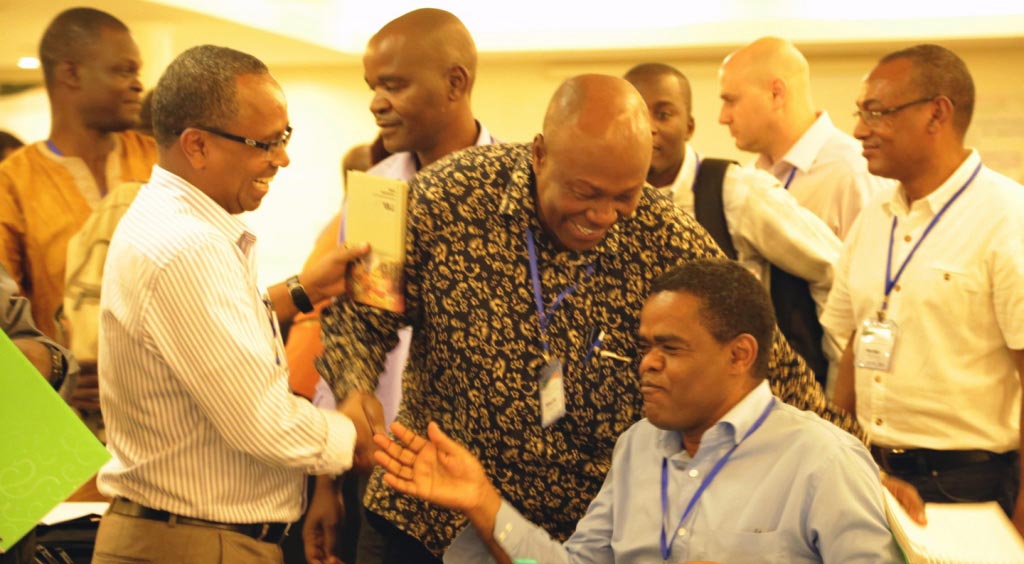
Participants at the Africa RISING science for impact event in Dar es Salaam.

Participants at the Africa RISING science for impact event in Dar es Salaam.

Day 1 focused on phase 2 elements, zooming in on what had changed, what was new, and what remained from phase 1, and a poster-bus-stop process that went on to day 2, providing a rich 3600 view of the technologies developed, tested, and refined by partners from the six program countries. Day 3 assessed various scaling models and approaches used to achieve impact at scale.

Big, achievable vision of success

In his opening remarks, IITA Director for Central Africa and Chair of the Africa RISING Program Coordination  Team Bernard Vanlauwe explained the targets and ambitions of phase 2 of the program. “We have achieved a lot in terms of identifying best-bet technologies in phase 1. In the second phase we therefore need to adopt dynamic scaling approaches to ensure that these technologies get into the hands of millions of farmers who are counting on us. While this is something we (as project implementers) have expressed a lot of appetite for, our donor―USAID―has made this an imperative for us as an extra motivation,” he said. At the program level, Africa RISING has set itself a target to scale sustainable innovation technologies to more than 1 million households in the six project countries through various development partnerships. The program is working on various arrangements for co-investment for wider uptake and adoption of its outputs which will in turn generate a “partnership dividend” that allows a research project like Africa RISING to actually generate impact at scale.

Continuity with evolutionary change

“Africa RISING phase 2 will be a fine blend between continuity from phase 1 and evolutionary change,” explains Peter Thorne, Africa RISING Ethiopia Project Manager. “IITA and ILRI will continue leading the program, which will retain its geographic focus on Ethiopia, Ghana, Malawi, Mali, Tanzania, and Zambia. IFPRI will lead on data management, monitoring, and impact assessment. And ILRI will continue to lead a communication and knowledge sharing component at program level,” he added. The three regional projects that make up the Africa RISING program―West Africa, Ethiopia, and East/Southern Africa, will therefore use lessons, where appropriate, to improve the program’s ways of operating (for example, in terms of cross-project harmonization). This will significantly broaden engagement with development partners which, backstopped by target Africa RISING research, will be able to generate impact on Feed the Future target indicators at scale. “To achieve the best results, the Africa RISING program has to channel the wealth of experiences and lessons learned from phase 1 and make them into successful implementation strategies and plans for the second phase,” notes Irmgard Hoeschle-Zeledon, Manager, Africa RISING West Africa and East/Southern Africa Projects. Program-wide synergies will be built around shared analyses, common research questions, coordinated communities of practice, and learning supported at the program level by investments in M&E, communications and knowledge sharing, and a light coordination structure.

At a critical point and building on good foundations

Siboniso Moyo, ILRI program leader and Africa RISING Program Coordination Team member, notes that the shared vision and commitment by project partners are two critical elements that currently abound within the program, hence the optimism. “Africa RISING is not the culmination of a journey, but a continuation of one that we all set off on 5 years ago. We had extensive synthesis in the first phase. I am certain you all appreciate that there were great achievements in the first phase, but we also have to learn from some challenges. We are at a critical point, transitioning from one phase to another and we are confident that we have good foundations to build on. We can visualize together and commit to delivering on set objectives of the program which we will all come back to in 5 years’ time and check that we have delivered,” she said at the close of the event. Read long version

Contribué par

Nouvelles connexes

Aucun article trouvé

Laisser un commentaire

Votre adresse e-mail ne sera pas publiée. Les champs obligatoires sont indiqués avec *

Retour en haut
Olaosebikan, Olamide

Olamide Deborah Nwanze est une chercheuse principale spécialisée dans la recherche sur l'approche "genre" afin d'éclairer les politiques de sélection participative et inclusive, de développement de variétés et de systèmes semenciers concernant les cultures de racines, tubercules et bananes (RTB) au siège de l'Institut International d'Agriculture Tropicale, à Ibadan, au Nigeria. Elle est candidate au doctorat à l'Université d'Ibadan et titulaire d'un master et d'un diplôme d'ingénieur agronome en vulgarisation agricole et développement rural. Olamide est membre du programme African Women in Agricultural Research and Development – Gender Responsive Agricultural Systems Policy (SAISIE DE RÉCOMPENSEet les Chercheuses Sensibles au Genre Équipées pour la Transformation Agricole (SUPER. Elle cherche à appliquer ses apprentissages en matière d’approche genre, recherche sensible au genre, et expertise en développement et examen de politiques pour faciliter l’accès et l’adoption par les femmes, les jeunes, les enfants et les groupes sociaux vulnérables aux innovations agricoles qui garantissent la sécurité alimentaire, nutritionnelle, des revenus et des moyens de subsistance en Afrique. Ses rôles actuels comprennent le mentorat de chercheurs stagiaires, le développement de guides et manuels de formation, la mise en œuvre et l'adaptation de cadres et d'outils genre, l'engagement des acteurs de la chaîne de valeur en tant que partenaires de la science citoyenne, l'examen et la refonte des politiques, la gestion et l'analyse des données. Ses recherches actuelles portent sur les méthodes mixtes ainsi que sur les approches participatives et interdisciplinaires pour saisir et mettre en évidence les dynamiques de genre, les besoins, les préférences et les défis rencontrés par les parties prenantes au sein de la chaîne de valeur des moyens de subsistance agricoles afin de prioriser des stratégies axées sur le genre dans les programmes de sélection, la conception et la mise en œuvre des politiques.

À l'IITA, elle contribue à la mise en œuvre du CGIAR Initiative d'Élevage Accéléré et Innovation génétique Programmes ; recherche participative et genre au sein des Prochaine Génération ManiocHarvestPlusRTBAliments, et Tricot-ClimMob 1000Fermes Projets ; et la communication des connaissances sur le genre via le Série de webinaires G-LENS, vidéo documentaire, notes de politiquepublications, et blogs.


Publications récentes

de Sousa, K., van Etten, J., Manners, R. Bello, A., Teeken, B., Olaosebikan, O., et al. 2024. L'approche tricot : un cadre agile pour les essais décentralisés à la ferme soutenus par la science citoyenne. Une rétrospective. Agron. Sustain. Dev. 44, 8. https://doi.org/10.1007/s13593-023-00937-1

Madu, T., Onwuka, S., Nwafor, S., Onyemauwa, N., Ejechi, M., Ofoeze, M., Ukeje, B., Eluagu, C., Olaosebikan, O., Okoye, B., 2024. Les études sur les consommateurs inclusifs en matière de genre améliorent l'amélioration du manioc au Nigeria dans : Frontiers in Sociology, volume 9, numéro : 1224504, doi : 10.3389/fsoc.2024.1224504

Olaosebikan, O. ; Bello, A. ; Utoblo, O. ; Okoye, B. ; Olutegbe, N. ; Garner, E. ; Teeken, B. ; Bryan, E. ; Forsythe, L. ; Cole, S. ; Madu, T. 2023. Facteurs de stress et résilience au sein de la chaîne de valeur du manioc au Nigeria : Caractéristiques préférées des variétés de manioc et stratégies de réponse des hommes et des femmes pour informer l'amélioration variétale. Sustainability 15, 7837. https://doi.org/10.3390/su15107837

Okoye, B., Ofoeze, M., Ejechi, M., Onwuka, S., Nwafor, S., Onyemauwa, N., Ukeje, B., Eluagu, C., Obidiegwu, J.*, Olaosebikan, O., Madu, T.* 2023. Priorisation des traits préférés dans la chaîne de valeur de l'igname au Nigeria : une analyse de la situation en matière de genre in: Frontiers in Sociology, volume 8, numéro : 1232626, pages 1 – 9, ISSN 2297-7775, 2023. https://www.frontiersin.org/articles/10.3389/fsoc.2023.1232626/full

Olaosebikan, O., Bello, A. A., de Sousa, K., Ndjouenkeu, R., Adesokan, M., Alamu, E. O., Agbona, A., van Etten, J., Kegah, F. N.*, Dufour, D., Bouniol, A., Teeken, B. 2023. Acceptabilité par les consommateurs des produits alimentaires à base de gari-eba de manioc dans des contextes culturels et environnementaux variés en utilisant l'approche triade de comparaison des technologies (tricot) dans : Journal of the Science of Food and Agriculture,

Teeken, B., Olaosebikan, O., Bello, A. A., Madu, T.*, Cole, S. M. 2023. Évaluation qualitative de la positionnalité et des préférences des dyades en relation avec les activités liées au manioc : travailler avec des scientifiques citoyens du procès tricot https://hdl.handle.net/10568/138326 Type : Manuel

Bouniol, A., Ceballos, H., Bello, A. A., Teeken, B., Olaosebikan, O., Owoade, D., Agbona, A., Fotso Kuate, A., Madu, T.*, Okoye, B.*, Ofoeze, M.*, Nwafor, S.*, Onyemauwa, N.*, Adinsi, L.*, Forsythe, L., Dufour, D. 2023. Impact variétal sur le travail des femmes, la charge de travail et la pénibilité associée dans le traitement des plantes à racines, tubercules et bananes : focus sur le manioc en Afrique subsaharienne dans : Journal of the Science of Food and Agriculture, pages 1 – 25, ISSN 0022-5142,

Bello, A. A., Agbona, A., Olaosebikan, O., Edughaen, G., Dufour, D., Bouniol, A., Iluebbey, P., Ndjouenkeu, R.*, Rabbi, I. Y., Teeken, B. 2023. Effets génétiques et environnementaux sur la productivité de la transformation et le rendement des produits alimentaires : la pénibilité du travail des femmes dans : Journal of the Science of Food and Agriculture, pages 1 – 32, ISSN 0022-5142, 5

Cavicchioli, M., Zimbiti, T., Teeken, B., Nwanze, D.O., Liani, M., Parkes, E. & Bello, A. 2023. Rapport sur la formation en sélection génétique sensible au genre à l'IITA. Genetic Resources Center, IITA-HQ, Ibadan, 21-23 septembre 2022. Ibadan, Nigéria : IITA, (34 p.).https://hdl.handle.net/10568/131368

Agbona, A. Peteti P., Teeken B., Olaosebikan O. Bello, A. A., Parkes, E., Rabbi, I. Y., Mueller, L., Egesi, C., Kulakow, P. 2022. Gestion des données dans les programmes d'amélioration des cultures RTB africaines multidisciplinaires. In : Williamson, H.F., Leonelli, S. (eds) Towards Responsible Plant Data Linkage: Data Challenges for Agricultural Research and Development. Springer, Cham. https://doi.org/10.1007/978-3-031-13276-6_5

Lora Forsythe, Pricilla Marimo, Sarah Mayanja, Olamide D. Olaosebikan, Esme Stuart, Bela Teeken, Benjamin Okoye, Tessy Madu, (2021). Analyse transversale du genre dans RTBfoods Étape 2 Cartographie des genres sur les produits RTB. Comprendre les moteurs des préférences en matière de traits et le développement de profils de produits RTB multi-utilisateurs, WP1. Londres, Royaume-Uni : Rapport scientifique de terrain RTBfoods, 30 p.

Teeken, B., Garner, E., Agbona, A., Balogun, I., Olaosebikan, O., Bello, A., Madu, T., Okoye, B., Egesi, C., Kulakow, P. et Tufan, H.A. 2021. Au-delà des “ traits des femmes ” : explorer comment le genre, les différences sociales et les caractéristiques des ménages influencent les préférences pour les traits. Frontiers Systèmes alimentaires durables 5:740926. https://doi.org/10.3389/fsufs.2021.740926

Teeken, B., Agbona, A., Bello, A., Olaosebikan, O., Alamu, E., Adesokan, M., Awoyale, W., Madu, T., Okoye, B., Chijioke, U., Owoade, D., Okoro, M., Bouniol, A., Dufour, D., Hershey, C., Rabbi, I., Maziya‐Dixon, B., Egesi, C., Tufan, H. et Kulakow, P. (020. Comprendre les préférences variétales du manioc par le classement par paires du gari-eba et du fufu préparés par des agriculteurs-transformateurs locaux. Int J Food Sci Technol. https://doi.org/10.1111/ijfs.14862

Bela Teeken, Olamide Olaosebikan, Ireti Balogun, Benjamin Okoye, Tessy Madu, Steven Cole, Abolore Bello, Elizabeth Parkes. (2020). Pilotage des outils de profil client et produit G+ pour l'amélioration sensible au genre du manioc au Nigeria. Nigeria : Institut international d'agriculture tropicale (IIAT). https://hdl.handle.net/20.500.11766/13000