
NOUVELLES DE L'IITA

Agriculture Minister impressed with IITA’s technologies
juillet 12, 2017

Nigeria’s minister of agriculture says there are high hopes for Nigeria’s agriculture as a result of IITA’s “impressive and advanced” agricultural technologies.

Nigeria’s honorable Minister of Agriculture Chief Audu Ogbeh visited IITA in Ibadan, Nigeria, on 10 July, and had said that he is “deeply impressed” by the many commendable agricultural technologies developed there because they hold promise to quadruple production and export for a crop like yam and also for other staple crops like banana, plantain, soybean, and cocoa.

Picture of Nigeria’s Minister for Agriculture  and Rural Development, Chief Audu Ogbe during visit IITA headquaters, Ibadan, Nigeria
Chief Audu Ogbeh (middle, in blue) was delighted to see finished products from biofortified cassava and hear about IITA’s semi-autotrophic hydroponics technology for mass propagating cassava plants.

At the tour of the Institute’s facilities including cassava fields, the aflasafe (a biocontrol product for controlling aflatoxins) production plant, the seed yam production facility with the aeroponics system, and NoduMax, a soybean inoculum fertilizer facility, Chief Ogbeh said “…We are seeing amazing research happening at IITA. One issue that people raised when they saw Nigeria exporting yams is the fear that there’ll be shortages back home. We assured them that there wouldn’t be because we are not intending to just sell all the yams and starve Nigerians. But even now, with what we have seen at IITA, we are getting more reassured that that won’t happen because if we spread the technologies piloted by IITA throughout Nigeria, yam production can quadruple,” the Honorable Minister said.

Earlier in the day, Chief Ogbeh who was in Oyo State on a working tour, had met with farmers in the state and also visited fields in different parts of the state to underst and and work out implementable policies based on the state’s comparative advantage in terms of crop production.

Oyo state is the largest state in south west Nigeria, sitting on an estimated l and expanse of 28,454 km2, which represents 55.6% of the total l and area of all six states in Nigeria’s south west combined. But over the years the agricultural potential of the state has not been optimally maximized.

Chief Ogbeh said he wants his visit to remind the people of the state that “there is a future and fortune to be made from agriculture, especially for the young and educated who embrace commercial farming”.

According to him, agriculture holds the future but it cannot be achieved through the use of hoes and cutlasses.

“Agriculture is not just hoe and cutlasses, but also research and science. That is what IITA is offering. This institute has come to play a role not just for Nigeria but Africa,” he explained.

He added that: “Agriculture has a future. Agriculture has fortunes, and with an Institute like this, those who want to go into agriculture and make money should know that there is money to be made. With you (IITA) we can move forward,” he added.

The Director General of IITA Nteranya Sanginga reassured the honorable Minister of the Institute’s commitment to support the efforts of the Nigerian government towards ensuring that the country is food secure.

According to DG Sanginga the goal of the Institute is to work with governments in the context of their national agriculture strategies to eradicate hunger and poverty and create wealth.

On 29 June, Nigeria launched the export of yams with 72 tons of tubers from the country to the United States and Europe, sparking concerns over the ability of the country to sustain exports owing to the high cost of seed yams which is exacerbated by a lack of knowledge on modern seed yam multiplication techniques.
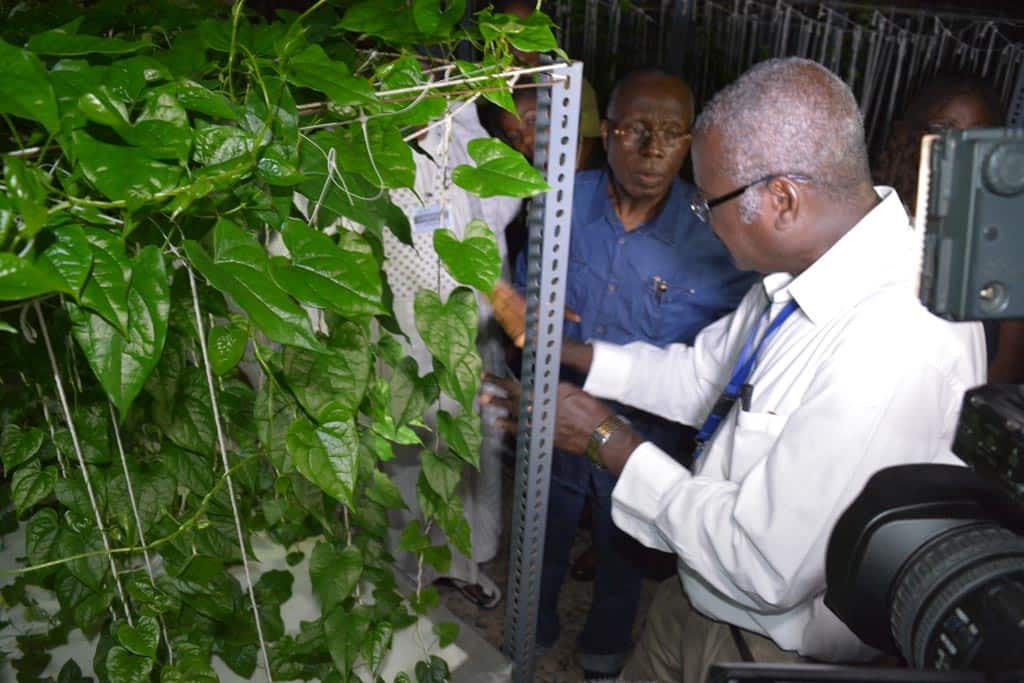
Picture of Chief Ogbeh inspecting how IITA grows yam in the air through aeroponics.
Chief Ogbeh inspecting how IITA grows yam in the air through aeroponics.

Traditionally farmers are compelled to reserve a minimum of 30 percent of their harvest as seeds for the next planting season. However, researchers from IITA and national partners have developed the aeroponics system of seed yam multiplication whereby the vines of the crop are used in propagating seed yams rather than tubers. Through this method, farmers may not need to reserve their harvest for the next planting season but can simply produce seed yams for the planting season, according to Norbert Maroya, Coordinator for the project—Yam Improvement for Incomes and Food Security in West Africa (YIIFSWA).

Chief Ogbeh also cited the strong collaboration history between IITA and the Federal Ministry of Agriculture and Rural Development (FMARD) saying that during IITA’s 50th anniversary celebration which is slated for 24–29 July 2017, FMARD will announce the modalities of how it intends to keenly partner with IITA to get available technologies into farmers’ h ands.

Top African government officials and private sector champions including Prof Yemi Osinbajo, Nigeria’s Acting President; Chief Olusegun Obasanjo, former President; General Yakubu Gowon, former head of state; Bruno Tshibala, Prime minister of the Democratic Republic of Congo; Dr Akinwumi Adesina, President of the African Development Bank; Dr Deo-Guide Rurema, Minister of Agriculture and Livestock, Burundi; Mr Sadanobu Kusaoke, Japanese Ambassador to Nigeria, Alhaji Aliko Dangote, Tony Elumelu, the local king, Oba Saliu Adetunji, Olubadan of Ibadan; and state governors are expected to grace IITA’s 50th anniversary celebration, with support from the Dangote group, Tony Elumelu Foundation, IITA staff, and the Board of Trustees, Bovas, Inqaba, Punch and the Guardian Newspapers.


Contribué par

Recent stories

Aucun article trouvé

Laisser un commentaire

Votre adresse e-mail ne sera pas publiée. Les champs obligatoires sont indiqués avec *

Retour en haut
Olaosebikan, Olamide

Olamide Deborah Nwanze est une chercheuse principale spécialisée dans la recherche sur l'approche "genre" afin d'éclairer les politiques de sélection participative et inclusive, de développement de variétés et de systèmes semenciers concernant les cultures de racines, tubercules et bananes (RTB) au siège de l'Institut International d'Agriculture Tropicale, à Ibadan, au Nigeria. Elle est candidate au doctorat à l'Université d'Ibadan et titulaire d'un master et d'un diplôme d'ingénieur agronome en vulgarisation agricole et développement rural. Olamide est membre du programme African Women in Agricultural Research and Development – Gender Responsive Agricultural Systems Policy (SAISIE DE RÉCOMPENSEet les Chercheuses Sensibles au Genre Équipées pour la Transformation Agricole (SUPER. Elle cherche à appliquer ses apprentissages en matière d’approche genre, recherche sensible au genre, et expertise en développement et examen de politiques pour faciliter l’accès et l’adoption par les femmes, les jeunes, les enfants et les groupes sociaux vulnérables aux innovations agricoles qui garantissent la sécurité alimentaire, nutritionnelle, des revenus et des moyens de subsistance en Afrique. Ses rôles actuels comprennent le mentorat de chercheurs stagiaires, le développement de guides et manuels de formation, la mise en œuvre et l'adaptation de cadres et d'outils genre, l'engagement des acteurs de la chaîne de valeur en tant que partenaires de la science citoyenne, l'examen et la refonte des politiques, la gestion et l'analyse des données. Ses recherches actuelles portent sur les méthodes mixtes ainsi que sur les approches participatives et interdisciplinaires pour saisir et mettre en évidence les dynamiques de genre, les besoins, les préférences et les défis rencontrés par les parties prenantes au sein de la chaîne de valeur des moyens de subsistance agricoles afin de prioriser des stratégies axées sur le genre dans les programmes de sélection, la conception et la mise en œuvre des politiques.

À l'IITA, elle contribue à la mise en œuvre du CGIAR Initiative d'Élevage Accéléré et Innovation génétique Programmes ; recherche participative et genre au sein des Prochaine Génération ManiocHarvestPlusRTBAliments, et Tricot-ClimMob 1000Fermes Projets ; et la communication des connaissances sur le genre via le Série de webinaires G-LENS, vidéo documentaire, notes de politiquepublications, et blogs.


Publications récentes

de Sousa, K., van Etten, J., Manners, R. Bello, A., Teeken, B., Olaosebikan, O., et al. 2024. L'approche tricot : un cadre agile pour les essais décentralisés à la ferme soutenus par la science citoyenne. Une rétrospective. Agron. Sustain. Dev. 44, 8. https://doi.org/10.1007/s13593-023-00937-1

Madu, T., Onwuka, S., Nwafor, S., Onyemauwa, N., Ejechi, M., Ofoeze, M., Ukeje, B., Eluagu, C., Olaosebikan, O., Okoye, B., 2024. Les études sur les consommateurs inclusifs en matière de genre améliorent l'amélioration du manioc au Nigeria dans : Frontiers in Sociology, volume 9, numéro : 1224504, doi : 10.3389/fsoc.2024.1224504

Olaosebikan, O. ; Bello, A. ; Utoblo, O. ; Okoye, B. ; Olutegbe, N. ; Garner, E. ; Teeken, B. ; Bryan, E. ; Forsythe, L. ; Cole, S. ; Madu, T. 2023. Facteurs de stress et résilience au sein de la chaîne de valeur du manioc au Nigeria : Caractéristiques préférées des variétés de manioc et stratégies de réponse des hommes et des femmes pour informer l'amélioration variétale. Sustainability 15, 7837. https://doi.org/10.3390/su15107837

Okoye, B., Ofoeze, M., Ejechi, M., Onwuka, S., Nwafor, S., Onyemauwa, N., Ukeje, B., Eluagu, C., Obidiegwu, J.*, Olaosebikan, O., Madu, T.* 2023. Priorisation des traits préférés dans la chaîne de valeur de l'igname au Nigeria : une analyse de la situation en matière de genre in: Frontiers in Sociology, volume 8, numéro : 1232626, pages 1 – 9, ISSN 2297-7775, 2023. https://www.frontiersin.org/articles/10.3389/fsoc.2023.1232626/full

Olaosebikan, O., Bello, A. A., de Sousa, K., Ndjouenkeu, R., Adesokan, M., Alamu, E. O., Agbona, A., van Etten, J., Kegah, F. N.*, Dufour, D., Bouniol, A., Teeken, B. 2023. Acceptabilité par les consommateurs des produits alimentaires à base de gari-eba de manioc dans des contextes culturels et environnementaux variés en utilisant l'approche triade de comparaison des technologies (tricot) dans : Journal of the Science of Food and Agriculture,

Teeken, B., Olaosebikan, O., Bello, A. A., Madu, T.*, Cole, S. M. 2023. Évaluation qualitative de la positionnalité et des préférences des dyades en relation avec les activités liées au manioc : travailler avec des scientifiques citoyens du procès tricot https://hdl.handle.net/10568/138326 Type : Manuel

Bouniol, A., Ceballos, H., Bello, A. A., Teeken, B., Olaosebikan, O., Owoade, D., Agbona, A., Fotso Kuate, A., Madu, T.*, Okoye, B.*, Ofoeze, M.*, Nwafor, S.*, Onyemauwa, N.*, Adinsi, L.*, Forsythe, L., Dufour, D. 2023. Impact variétal sur le travail des femmes, la charge de travail et la pénibilité associée dans le traitement des plantes à racines, tubercules et bananes : focus sur le manioc en Afrique subsaharienne dans : Journal of the Science of Food and Agriculture, pages 1 – 25, ISSN 0022-5142,

Bello, A. A., Agbona, A., Olaosebikan, O., Edughaen, G., Dufour, D., Bouniol, A., Iluebbey, P., Ndjouenkeu, R.*, Rabbi, I. Y., Teeken, B. 2023. Effets génétiques et environnementaux sur la productivité de la transformation et le rendement des produits alimentaires : la pénibilité du travail des femmes dans : Journal of the Science of Food and Agriculture, pages 1 – 32, ISSN 0022-5142, 5

Cavicchioli, M., Zimbiti, T., Teeken, B., Nwanze, D.O., Liani, M., Parkes, E. & Bello, A. 2023. Rapport sur la formation en sélection génétique sensible au genre à l'IITA. Genetic Resources Center, IITA-HQ, Ibadan, 21-23 septembre 2022. Ibadan, Nigéria : IITA, (34 p.).https://hdl.handle.net/10568/131368

Agbona, A. Peteti P., Teeken B., Olaosebikan O. Bello, A. A., Parkes, E., Rabbi, I. Y., Mueller, L., Egesi, C., Kulakow, P. 2022. Gestion des données dans les programmes d'amélioration des cultures RTB africaines multidisciplinaires. In : Williamson, H.F., Leonelli, S. (eds) Towards Responsible Plant Data Linkage: Data Challenges for Agricultural Research and Development. Springer, Cham. https://doi.org/10.1007/978-3-031-13276-6_5

Lora Forsythe, Pricilla Marimo, Sarah Mayanja, Olamide D. Olaosebikan, Esme Stuart, Bela Teeken, Benjamin Okoye, Tessy Madu, (2021). Analyse transversale du genre dans RTBfoods Étape 2 Cartographie des genres sur les produits RTB. Comprendre les moteurs des préférences en matière de traits et le développement de profils de produits RTB multi-utilisateurs, WP1. Londres, Royaume-Uni : Rapport scientifique de terrain RTBfoods, 30 p.

Teeken, B., Garner, E., Agbona, A., Balogun, I., Olaosebikan, O., Bello, A., Madu, T., Okoye, B., Egesi, C., Kulakow, P. et Tufan, H.A. 2021. Au-delà des “ traits des femmes ” : explorer comment le genre, les différences sociales et les caractéristiques des ménages influencent les préférences pour les traits. Frontiers Systèmes alimentaires durables 5:740926. https://doi.org/10.3389/fsufs.2021.740926

Teeken, B., Agbona, A., Bello, A., Olaosebikan, O., Alamu, E., Adesokan, M., Awoyale, W., Madu, T., Okoye, B., Chijioke, U., Owoade, D., Okoro, M., Bouniol, A., Dufour, D., Hershey, C., Rabbi, I., Maziya‐Dixon, B., Egesi, C., Tufan, H. et Kulakow, P. (020. Comprendre les préférences variétales du manioc par le classement par paires du gari-eba et du fufu préparés par des agriculteurs-transformateurs locaux. Int J Food Sci Technol. https://doi.org/10.1111/ijfs.14862

Bela Teeken, Olamide Olaosebikan, Ireti Balogun, Benjamin Okoye, Tessy Madu, Steven Cole, Abolore Bello, Elizabeth Parkes. (2020). Pilotage des outils de profil client et produit G+ pour l'amélioration sensible au genre du manioc au Nigeria. Nigeria : Institut international d'agriculture tropicale (IIAT). https://hdl.handle.net/20.500.11766/13000